

What Makes a Robot Move? Understanding the Core Components
Motor Fundamentals
Dive into the basics of electric motors, the 'muscles' that convert electrical energy into mechanical motion, driving your robot forward.
Gearbox Essentials
Explore how gearboxes modify motor output, providing the crucial torque and speed adjustments needed for diverse robotic tasks and terrains.
Drivetrain Configurations
Understand the different ways motors and wheels connect to form a drivetrain, influencing your robot's maneuverability and stability.
Power System Integration
Learn how motor controllers and power sources seamlessly integrate with motors and drivetrains to deliver reliable, efficient performance.
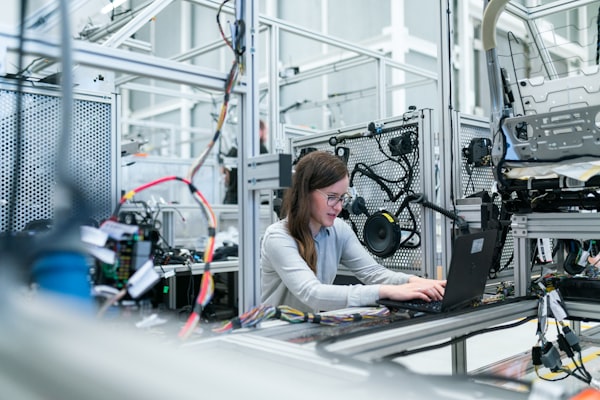 Electric motors are the heart of any mobile robot, converting electrical energy into rotational motion.
What Exactly Are Robot Motors and How Do They Work?
At its core, a robot motor is an electromechanical device that transforms electrical energy into mechanical energy, typically in the form of rotational motion. Think of it as your robot's muscle. When you apply voltage, the motor's internal components interact to create a magnetic field, which then causes a shaft to spin.
For mobile robots, motors are the primary means of propulsion. They connect to wheels, tracks, or other mobility mechanisms, providing the force (torque) and speed necessary to move the robot and its payload. Without a motor, your robot is just a static collection of parts.
Most small robot motors are Direct Current (DC) motors. Inside, you'll find a stator (the stationary part, usually permanent magnets) and a rotor (the rotating part, an electromagnet called an armature). When current flows through the armature coils, it creates a magnetic field that repels or attracts the stator's field, causing the rotor to spin. A component called a commutator reverses the current direction in the coils at just the right moment to maintain continuous rotation.
Which Motor Type is Right for My Robot?
Choosing the right motor is critical for your robot's performance. While many types exist, for mobile robotics, you'll primarily encounter Brushed DC, Brushless DC (BLDC), and Stepper motors. Each has distinct advantages depending on your robot's needs for speed, torque, precision, and efficiency.
For a deeper dive into the pros and cons of each, check out our Comparing Motor Types: Brushed, Brushless, Stepper for Mobility guide.
Which motor type is generally preferred for applications requiring very precise, step-by-step positioning?
 Gearboxes use different sized gears to change the output speed and torque from a motor.
Translating Power: The Drivetrain and Gearboxes
While motors provide the raw rotational power, the drivetrain is the system that transmits this power to the wheels or tracks, ultimately moving the robot. A crucial component within most drivetrains is the gearbox (or gear reduction unit).
Motors, especially smaller ones, often spin at very high RPMs (revolutions per minute) but produce relatively low torque. Imagine trying to push a heavy box with a tiny, fast-spinning fan – it won't work. A gearbox solves this by using a series of meshing gears to reduce the output speed while simultaneously increasing the output torque. This mechanical advantage is essential for a robot to overcome friction, climb inclines, and carry payloads.
The relationship between the number of teeth on the input gear and the output gear determines the gear ratio. A higher gear ratio means more torque but less speed, and vice-versa. Understanding this balance is key to designing an effective mobility system.
What's your robot's primary mobility goal?
Prioritize Speed: Lower Gear Ratios
For robots needing to cover ground quickly, like racing robots or fast delivery platforms, you'll want a lower gear ratio (closer to 1:1 or even overdrive). This means the output shaft spins faster, but with less force. Ensure your motor has enough inherent torque to handle the robot's weight at speed.
Prioritize Torque: Higher Gear Ratios
If your robot needs to climb steep inclines, push heavy objects, or carry significant payloads (e.g., an inspection robot, a heavy-duty AGV), a higher gear ratio is essential. This sacrifices speed for raw pushing power. Planetary gearboxes are excellent for compact, high-ratio reductions.
Balanced Performance: Moderate Gear Ratios
Most general-purpose mobile robots, like educational platforms or indoor navigation bots, benefit from a moderate gear ratio. This provides a good compromise between speed and torque, allowing for versatile movement without being overly specialized. Experimentation and calculation are key here.
To help you find the perfect balance, use our Robot Speed & Torque Calculator.
Common Drivetrain Configurations for Mobile Robots
The way motors and wheels are arranged defines your robot's drivetrain, directly impacting its maneuverability, stability, and ability to traverse different environments. Here are some of the most common configurations:
Differential Drive: Simple & Agile
This is one of the most common and simplest drivetrains, typically using two independently driven wheels and one or more passive caster wheels for stability. By varying the speed and direction of the two main wheels, the robot can move forward, backward, and turn in place (zero-radius turn). It's highly maneuverable and efficient for flat surfaces.
- Pros: Simple control, good maneuverability, efficient.
- Cons: Can struggle with uneven terrain, less stable on slopes.
- Best for: Indoor robots, educational platforms, light-duty mobile bases.
Skid-Steer Drive: Robust & Powerful
Often found in tracked robots or those with four or more wheels (like a tank), skid-steer drivetrains turn by driving wheels on one side faster or in the opposite direction of the other side, causing the robot to 'skid' or drag. This provides excellent traction and power for rough terrain and heavy loads.
- Pros: High traction, good for rough terrain, robust, can carry heavy loads.
- Cons: High friction during turns (can damage surfaces), less energy efficient for turning, less precise.
- Best for: Outdoor robots, tracked vehicles, heavy-duty industrial robots.
Omnidirectional Drive: Ultimate Maneuverability
Utilizing special wheels like Mecanum or Omni wheels, this drivetrain allows a robot to move in any direction (forward, backward, sideways, diagonally) without changing its orientation. This is achieved by the unique roller design on the wheels, which allows for independent motion vectors. It's incredibly versatile for tight spaces and complex navigation.
- Pros: Unparalleled maneuverability, can move sideways, excellent for tight spaces.
- Cons: More complex control, specialized (and often more expensive) wheels, less traction on uneven surfaces.
- Best for: Service robots, warehouse robots, artistic robots requiring fluid motion.
For more details on how these chassis types are built, explore our guide on What Are the Different Types of Robot Chassis?
 Motor controllers are the brain-to-muscle interface, translating commands into motor action.
Powering and Controlling Your Drivetrain: Beyond the Motor
A motor alone isn't enough; it needs a brain and a power source. This is where motor controllers and power systems come into play. A motor controller acts as the intermediary between your robot's main control unit (like a microcontroller or single-board computer) and the motors. It takes high-level commands (e.g., "move forward at half speed") and translates them into the precise electrical signals needed to drive the motors.
Motor controllers manage voltage, current, and direction, often using Pulse Width Modulation (PWM) to control speed. They also provide protection against overcurrent and overheating. The power system, typically consisting of batteries, provides the electrical energy. Sizing your battery correctly is crucial for runtime and delivering enough current to your motors under load.
This robust motor controller is perfect for intermediate mobile robot projects, offering precise speed control and ample current for two DC brushed motors. Integrated thermal protection ensures reliability.
Learn more about matching your power system to your robot's needs in our Sizing Your Robot's Power System: Batteries & Controllers guide.
Designing Your Robot's Mobility System: A Step-by-Step Approach
Bringing together motors, gearboxes, and drivetrains can seem daunting, but by breaking it down into manageable steps, you can confidently design your robot's mobility system. This wizard will guide you through the essential considerations.
Define Your Robot's Mission & Environment
Before selecting any components, clearly define what your robot needs to do. Will it carry heavy loads? Navigate rough terrain? Move quickly indoors? The mission dictates the requirements for speed, torque, and maneuverability. For example, a delivery robot needs speed and precision, while an outdoor exploration robot needs high torque and robust traction.
Calculate Power & Torque Requirements
Estimate your robot's total weight (including chassis, components, and maximum payload). Consider factors like friction from wheels/tracks and potential inclines. Use physics principles (or our calculator!) to determine the minimum torque and power your motors need to achieve your desired speed and acceleration. Don't forget to add a safety margin!
Select Motor Type & Gearbox
Based on your power requirements and mission, choose an appropriate motor type (Brushed DC for simplicity, BLDC for efficiency, Stepper for precision). Then, select a gearbox with a gear ratio that translates the motor's raw output into the required speed and torque at the wheels. This often involves iterative testing and adjustment.
Choose Drivetrain Configuration & Power System
Decide on your drivetrain (differential, skid-steer, omnidirectional, etc.) based on maneuverability needs and terrain. Finally, select a motor controller that can handle your chosen motors' current and voltage, and a battery that provides sufficient capacity and discharge rate for your robot's operational duration.
The Impact of a Well-Designed Drivetrain
A thoughtfully engineered motor and drivetrain system is more than just functional; it's a performance multiplier for your robot.
Ready to Build Your Robot's Mobility?
Understanding motors and drivetrains is a fundamental step in building any mobile robot. With this knowledge, you're better equipped to select the right components and design a system that meets your project's unique demands. Keep exploring our learning center for more in-depth guides!
Your Guide to Robot Mobility & Chassis: Start Here!
Begin your journey into robot movement with our comprehensive hub.
Explore Hub →Wheels, Tracks, & Casters: Understanding Robot Movement
Dive deeper into the physical components that make contact with the ground.
Learn More →Robot Mobility Terms: Understand the Jargon
Demystify complex terms with our easy-to-understand glossary.
View Glossary →