What You'll Learn About Your Robot's Brain
Microcontrollers vs. SBCs
Understand the fundamental differences between these two core computing platforms and their unique strengths in robotics.
Key Selection Criteria
Discover the critical factors like processing power, I/O needs, and real-time performance that guide your decision.
Popular Platforms Compared
Get a side-by-side look at popular options like Arduino, ESP32, Raspberry Pi, and Jetson Nano for robotics.
Real-World Applications
See practical examples of how different 'brains' are applied in various robotic projects, from simple to complex.
 A typical microcontroller board, compact and ready for direct hardware interaction.
What Exactly is a Microcontroller (MCU)?
Think of a microcontroller (MCU) as a tiny, specialized computer designed to perform a specific task repeatedly and reliably. Unlike the computer you're using now, an MCU integrates a processor, memory, and input/output (I/O) peripherals all onto a single chip. This compact design makes them incredibly efficient for controlling hardware directly.
In robotics, MCUs are the workhorses for tasks requiring precise timing and direct control over motors, sensors, and actuators. They excel at real-time operations, meaning they respond to events almost instantaneously, which is crucial for things like motor control, reading sensor data, and executing simple decision logic. Their simplicity often translates to lower power consumption and a more predictable, deterministic behavior.
Common Questions About Microcontrollers
Are microcontrollers difficult to program?
Not necessarily! While they often involve lower-level programming (like C/C++), platforms like Arduino have made it incredibly accessible with simplified IDEs and extensive libraries. For more complex tasks, you might delve into assembly or bare-metal C, but for most robotics projects, the learning curve is manageable.
What are the power requirements for MCUs?
One of the biggest advantages of microcontrollers is their low power consumption. Many can run on a few volts and draw only milliamps, making them ideal for battery-powered robots or applications where energy efficiency is critical. This is a significant differentiator from power-hungry single-board computers.
Can MCUs handle complex calculations or AI?
Generally, no. While some advanced MCUs can handle basic machine learning inferences (often called 'TinyML'), they lack the processing power and memory for complex AI, computer vision, or heavy data processing. For those tasks, you'll need the capabilities of a single-board computer.
Perfect for beginners, this kit provides a robust microcontroller and all necessary components to start building and programming your first robotic controls, directly applying what you've learned about MCUs.
 A Raspberry Pi, a powerful single-board computer capable of running a full operating system.
And What About Single-Board Computers (SBCs)?
A Single-Board Computer (SBC) is essentially a complete computer built on a single circuit board. Think of it as a miniature desktop PC, complete with a powerful processor, significant RAM, graphics capabilities, and various connectivity options like USB, Ethernet, and Wi-Fi. The most famous example in robotics is the Raspberry Pi.
SBCs run full operating systems (like Linux), allowing you to install software, connect to the internet, and perform complex computational tasks. This makes them ideal for robots that need to process large amounts of data, perform advanced AI/ML, handle computer vision, or communicate over networks. While more powerful, they typically consume more power and are less suited for direct, real-time hardware control compared to MCUs.
SBCs vs. MCUs: A Quick Comparison
Single-Board Computer Strengths
SBCs excel in tasks requiring high computational power, such as running complex algorithms for path planning, processing camera feeds for object recognition, or managing a sophisticated user interface. They offer vast software flexibility, supporting multiple programming languages and frameworks. However, their real-time performance for direct hardware control can be less predictable due to the overhead of an operating system.
- Pros: High processing power, large memory, full OS support, network connectivity, rich software ecosystem.
- Cons: Higher power consumption, less deterministic real-time control, larger physical footprint, generally higher cost.
Microcontroller Strengths
Microcontrollers are champions of efficiency and direct hardware interaction. They are perfect for tasks that need precise, immediate responses, like controlling motor speeds, reading sensor values at high frequencies, or managing simple state machines. Their low power draw makes them ideal for battery-operated devices, and their simpler architecture often leads to more robust and predictable behavior.
- Pros: Excellent real-time performance, low power consumption, compact size, cost-effective, robust for dedicated tasks.
- Cons: Limited processing power and memory, no full OS, less software flexibility, more challenging for complex networking or AI.
The Best of Both Worlds: Hybrid Robotics
For advanced robots, a common strategy is to combine an SBC and an MCU. The SBC handles high-level tasks like navigation, AI, and user interaction, while the MCU manages low-level, real-time control of motors, servos, and critical sensors. This hybrid approach leverages the strengths of both, creating a powerful and responsive robotic system. Learn more about integrating components in our Wiring Your Motor Guide.
If your robot needs advanced processing for AI, computer vision, or complex navigation, the Raspberry Pi 5 offers unparalleled power. This kit includes the SBC and essential peripherals for robotics integration.
How Do You Pick the Right Brain for Your Robot?
Choosing between an MCU and an SBC, or even deciding on a specific model, boils down to understanding your robot's core mission. There's no single 'best' option; only the best fit for your project's unique demands. Consider these key factors:
What's the primary goal of your robot project?
Focus on Microcontrollers (MCUs)
For tasks like controlling multiple motors, reading basic sensor arrays (e.g., line sensors, ultrasonic distance), or performing repetitive actions with strict timing, an MCU is your best bet. They offer excellent real-time performance and are energy-efficient. Consider platforms like Arduino or ESP32.
Lean Towards Single-Board Computers (SBCs)
If your robot needs to recognize objects, navigate complex environments using SLAM, process natural language, or run deep learning models, an SBC is essential. Their powerful processors and ample memory are built for these computational demands. Look at Raspberry Pi or NVIDIA Jetson series.
SBCs or Hybrid for Data & Connectivity
When your robot needs to log significant amounts of data, connect to cloud services, stream video, or interact with web APIs, an SBC provides the necessary operating system and network capabilities. A hybrid approach (SBC for high-level, MCU for low-level) can also be very effective here, offloading real-time tasks.
Other Critical Considerations:
A Closer Look: Popular Robotics Platforms
To help solidify your understanding, let's compare some of the most popular microcontrollers and single-board computers frequently used in robotics projects. This table highlights their core capabilities and typical use cases.
| Feature | Arduino Uno R4 | ESP32 | Raspberry Pi 5 | NVIDIA Jetson Nano |
|---|---|---|---|---|
| Type | Microcontroller | Microcontroller (with Wi-Fi/BT) | Single-Board Computer | Single-Board Computer (AI-focused) |
| Processor | Renesas RA4M1 (48 MHz) | Tensilica Xtensa LX6 (240 MHz) | Broadcom BCM2712 (2.4 GHz Quad-core) | Quad-core ARM A57 (1.43 GHz) + 128-core Maxwell GPU |
| RAM | 256 KB | 520 KB SRAM | 4GB / 8GB LPDDR4X | 4GB LPDDR4 |
| Operating System | None (Bare-metal/RTOS) | None (Bare-metal/RTOS) | Linux (Raspberry Pi OS) | Linux (Ubuntu) |
| Connectivity | USB, UART, SPI, I2C | Wi-Fi, Bluetooth, USB, UART, SPI, I2C | Wi-Fi, Bluetooth, Ethernet, USB 3.0, PCIe | Ethernet, USB 3.0, CSI, DSI |
| Real-time Control | Excellent | Excellent | Good (with RTOS kernel) | Good (with RTOS kernel) |
| AI/ML Capabilities | Very Limited (TinyML) | Limited (TinyML) | Moderate (CPU-based inference) | Excellent (GPU-accelerated) |
| Typical Use Case | Beginner projects, motor control, sensor reading | IoT robotics, networked sensors, simple web control | Autonomous robots, computer vision, complex navigation | Advanced AI robots, drone vision, machine learning applications |
For projects needing both microcontroller precision and wireless connectivity (Wi-Fi/Bluetooth), the ESP32 is a fantastic, cost-effective option, bridging the gap between simple MCUs and full SBCs.
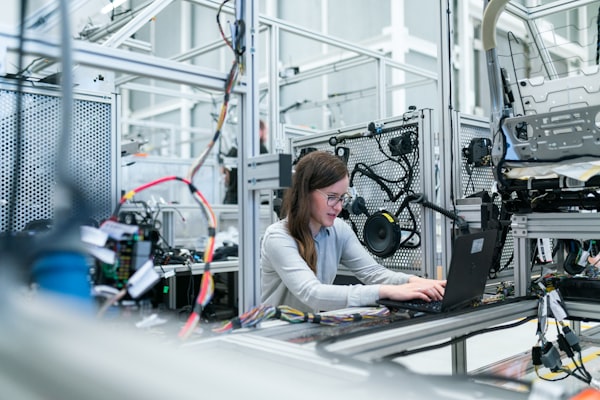 Advanced robotics often combine the strengths of both MCUs and SBCs for optimal performance.
Real-World Robotics: When to Use Which Brain?
Let's look at a couple of scenarios to illustrate how these choices play out in practice:
Scenario 1: The Autonomous Line-Following Robot
Imagine building a small robot that needs to follow a black line on a white floor. This robot requires precise motor control, fast sensor readings (from IR line sensors), and simple decision-making (turn left, turn right, go straight). An Arduino Uno R4 or an ESP32 would be perfect here. Their real-time capabilities ensure smooth motor adjustments, and their low power consumption means longer battery life. The computational demands are minimal, making a powerful SBC unnecessary and inefficient.
Scenario 2: The AI-Powered Surveillance Drone
Now consider a drone that needs to autonomously patrol an area, identify specific objects (e.g., packages, intruders) using a camera, and stream live video to a base station. This project demands significant processing power for computer vision algorithms, ample memory for image buffers, and robust network connectivity. A Raspberry Pi 5 or an NVIDIA Jetson Nano would be the ideal choice. While an MCU might handle the drone's flight stabilization (a hybrid approach), the SBC is indispensable for the high-level intelligence and communication.
The Impact of Your Choice: Why It Matters
Integrating Your Robot's Brain with Other Components
Once you've chosen the brain, the next step is connecting it to the rest of your robot's body. This involves understanding how to interface with motors, sensors, and other peripherals. Microcontrollers often have dedicated pins for direct connection, while SBCs might require intermediary boards (like motor drivers or sensor shields) to handle voltage translation or real-time control.
Proper wiring and communication protocols are crucial for your robot's functionality. For instance, connecting a motor to an MCU often involves a motor driver to handle higher currents, while integrating complex sensors with an SBC might use I2C, SPI, or even USB cameras. Dive deeper into these connections with our guides on Wiring Your Motor and What Sensors Do Robots Use?.
Which type of robot brain is generally better for tasks requiring precise, sub-millisecond timing and low power consumption?
Ready to Build Your Robot's Brain?
Choosing the right brain for your robot is a foundational decision that impacts everything from performance and power consumption to complexity and cost. By carefully considering your project's specific needs – whether it's precise real-time control, advanced AI processing, or robust connectivity – you can confidently select the ideal microcontroller or single-board computer.
Remember, the world of robotics is vast and exciting. Don't be afraid to start simple, experiment, and gradually scale up your projects as your skills and needs evolve. The perfect brain is out there, waiting to bring your robot to life!
Explore More Robotics Learning
Controller Clash: Arduino vs. Raspberry Pi vs. ESP32
Dive deeper into a direct comparison of these popular platforms to help you make an informed decision for your next project.
Read More →What Sensors Do Robots Use? A Guide to Sensing the World
Understand how your robot's brain receives information by exploring the different types of sensors and their applications.
Read More →Wiring Your Motor: A Step-by-Step Connection Guide
Learn the practical steps of connecting motors to your chosen controller, ensuring smooth and reliable movement.
Read More →Further Reading