

Why Do Robots Need Sensors Anyway?
Imagine trying to navigate a crowded room blindfolded, or trying to pick up a delicate object without feeling it. That's essentially what a robot would face without sensors. Sensors are the eyes, ears, and touch of a robot, providing crucial data about its internal state and the external environment. They transform physical phenomena into electrical signals that the robot's 'brain' (its microcontroller or computer) can understand and act upon.
From avoiding obstacles to performing precise tasks, sensors are fundamental to a robot's ability to operate autonomously and safely. They enable robots to perceive, interpret, and respond to the world around them, making them more than just automated machines – they become intelligent agents.
Perception
Sensors allow robots to 'see' and 'hear' their environment, detecting objects, distances, colors, and even sounds, much like our own senses.
Navigation
By measuring distances, detecting edges, and understanding orientation, sensors guide robots safely through complex spaces, avoiding collisions.
Interaction
Whether it's gripping an object with the right force or responding to human presence, sensors enable nuanced and safe interaction with the world.
Safety
Critical for preventing accidents, sensors detect obstacles, human proximity, and unsafe conditions, allowing robots to react appropriately.
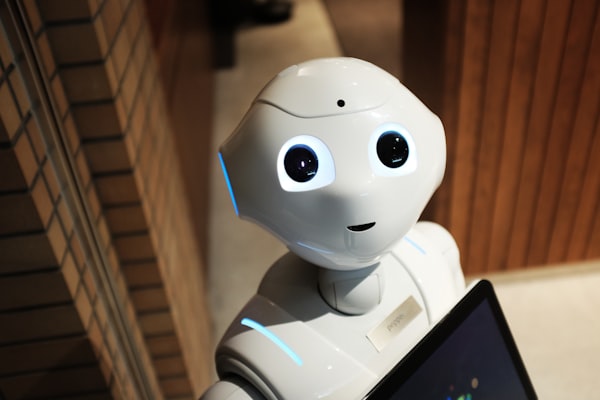 Sensors convert physical inputs into electrical signals for a robot's brain.
How Do Sensors Actually Work? The Basics of Input and Output
At their core, sensors are transducers. This means they convert one form of energy into another. In the context of robotics, they typically convert a physical phenomenon (like light, sound, pressure, or temperature) into an electrical signal. This electrical signal is then processed by the robot's control system, which interprets it as data.
Think of it like this: when you touch a hot stove, your nerve endings (sensors) convert the heat energy into an electrical impulse that travels to your brain. Your brain then interprets this impulse as 'hot' and tells your hand to move. Robot sensors work on a similar principle, but instead of a brain, they send data to a microcontroller or single-board computer.
A transducer is any device that converts energy from one form to another. In electronics, this often means converting a physical quantity (like temperature, pressure, or light) into an electrical signal (voltage or current). Microphones, loudspeakers, and even light bulbs are all examples of transducers in everyday life.
The Main Types of Robot Sensors You'll Encounter
The world of robot sensors is vast, but they generally fall into a few key categories based on what they measure. Understanding these categories is the first step to choosing the right sensors for your robot project.
 Ultrasonic sensors are commonly used for basic obstacle detection.
Sensing Distance: Proximity and Range Sensors
One of the most fundamental abilities for any mobile robot is to know what's around it and how far away things are. This is where proximity and range sensors come in. They are essential for obstacle avoidance, navigation, and even simple object detection.
Ultrasonic Sensors: The Bat's Approach
Ultrasonic sensors work by emitting a high-frequency sound wave and then listening for the echo. By measuring the time it takes for the sound to return, the sensor can calculate the distance to an object. They're great for detecting objects in various lighting conditions and are relatively inexpensive, making them popular for hobbyist robots and simple navigation tasks.
Infrared (IR) Sensors: Seeing with Light
IR sensors use infrared light to detect objects. Some emit IR light and measure the reflection, while others detect ambient IR radiation. They are often used for short-range proximity detection, line following (by detecting dark lines on a light surface), and even remote control applications. They can be affected by ambient light conditions, however.
Lidar: High-Precision Mapping
Lidar (Light Detection and Ranging) sensors use pulsed laser light to measure distances. By rotating and emitting thousands of laser pulses per second, Lidar can create highly detailed 2D or 3D maps of an environment. This makes them invaluable for complex navigation, simultaneous localization and mapping (SLAM), and autonomous vehicles, though they tend to be more expensive.
Which type of sensor uses sound waves to measure distance?
Quick Comparison: Common Distance Sensors
To help you decide which distance sensor might be best for your project, here's a side-by-side look at their key characteristics:
| Feature | Ultrasonic | Infrared (IR) | Lidar |
|---|---|---|---|
| Detection Method | Sound waves | Infrared light | Pulsed laser light |
| Typical Range | 2 cm - 4 m | 1 cm - 80 cm | Up to 100 m+ |
| Accuracy | Moderate (±1-2 cm) | Low to Moderate (affected by surface) | High (±1-5 mm) |
| Environmental Impact | Affected by soft surfaces, wind | Affected by ambient light, surface color | Robust, but can be affected by fog/rain |
| Cost | Low | Very Low | High |
| Common Use | Obstacle avoidance, simple mapping | Line following, short-range proximity | SLAM, autonomous navigation, 3D mapping |
An excellent, cost-effective choice for beginners and hobbyists needing reliable short to medium-range obstacle detection. Easy to interface with Arduino and other microcontrollers.
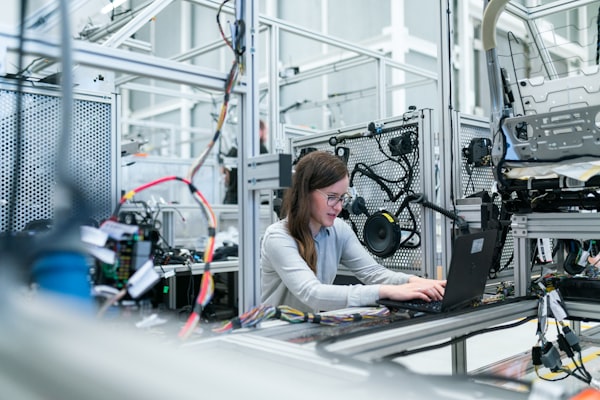 Vision sensors allow robots to interpret their environment visually.
Giving Robots Eyes: Vision Sensors and Cameras
Just as our eyes provide a wealth of information about our surroundings, vision sensors give robots the ability to 'see.' This category primarily includes various types of cameras, which are arguably the most complex and data-rich sensors a robot can employ.
Standard Cameras (RGB)
These are similar to the cameras in your smartphone, capturing color images (Red, Green, Blue channels). Robots use them for tasks like object recognition (identifying specific items), color tracking, reading QR codes, and even basic facial recognition. The challenge lies in processing the vast amount of data quickly and accurately.
Depth Cameras (RGB-D)
Depth cameras, like Intel RealSense or Microsoft Kinect, go a step further by capturing not only color information but also the distance to each pixel in the image. This 'depth map' is incredibly powerful for 3D mapping, understanding object shapes, navigating complex environments, and enabling human-robot interaction by tracking gestures. They are essential for robots that need to manipulate objects in 3D space or navigate dynamic environments.
The data from vision sensors often requires significant computational power and sophisticated algorithms to interpret. Understanding how this data is processed is key to unlocking advanced robotic behaviors. For more on this, check out our guide on Decoding Sensor Data: Accuracy, Range, & Resolution Explained.
The Impact of Advanced Sensing on Robotics
Modern sensors are transforming what robots can achieve, pushing the boundaries of autonomy and precision across industries.
 Tactile sensors allow robots to 'feel' objects and apply appropriate force.
Feeling the World: Touch, Force, and Pressure Sensors
For robots to interact physically with their environment, especially when manipulating objects, they need a sense of touch. This is provided by tactile, force, and pressure sensors, which are crucial for tasks requiring dexterity and gentle handling.
Tactile Sensors: The Robot's Skin
Tactile sensors are designed to detect physical contact and pressure, much like human skin. They can be arrays of tiny pressure-sensitive elements that provide a 'pressure map' of a surface. These are used in robotic grippers to detect when an object has been grasped, to determine its shape, and to prevent crushing delicate items.
Force and Torque Sensors: Measuring Interaction
Force sensors measure the amount of force applied along one or more axes, while torque sensors measure rotational force. These are often placed at the 'wrist' of a robotic arm or within joints to monitor the interaction forces between the robot and its environment. This feedback is vital for tasks like assembly, polishing, or even human-robot collaboration where safe force limits must be maintained.
How do tactile sensors prevent crushing objects?
Tactile sensors provide real-time feedback on the pressure being exerted. If the pressure exceeds a pre-programmed threshold, the robot's control system can immediately reduce the gripping force, preventing damage to the object or the robot itself.
Are force sensors used for safety?
Absolutely. Force sensors are critical for safety in collaborative robotics (cobots). If a cobot detects an unexpected force, indicating a collision with a human or an obstacle, it can immediately stop or reduce its speed to prevent injury.
What's the difference between a load cell and a force sensor?
A load cell is a specific type of force sensor that converts a force into an electrical signal. While all load cells are force sensors, not all force sensors are load cells. Load cells are typically used for measuring weight or static forces, whereas general force sensors might be designed for dynamic forces or specific directional measurements.
Ideal for adding basic touch and pressure detection to robot grippers or feet. These simple, thin sensors change resistance based on applied force, making them easy to integrate into many projects.
 IMUs combine accelerometers and gyroscopes for orientation sensing.
Knowing Where You Are: Navigation and Orientation Sensors
For a robot to move purposefully, it needs to know its own orientation, speed, and position. Navigation and orientation sensors provide this critical self-awareness, allowing robots to track their movement and understand their place in the world.
Inertial Measurement Units (IMUs)
An IMU is a combination of several sensors, typically an accelerometer and a gyroscope. Accelerometers measure linear acceleration, telling the robot how fast it's speeding up or slowing down in different directions. Gyroscopes measure angular velocity, indicating how fast the robot is rotating. Some IMUs also include a magnetometer (digital compass) to provide absolute orientation relative to the Earth's magnetic field. Together, these provide a comprehensive picture of the robot's motion and orientation.
GPS (Global Positioning System)
For outdoor robots, GPS receivers provide global position coordinates (latitude and longitude). While incredibly useful for large-scale navigation, GPS can be inaccurate in urban canyons, completely unavailable indoors, and generally lacks the precision needed for fine-grained robotic tasks.
Encoders: Tracking Wheel Movement
Encoders are sensors attached to a robot's motors or wheels that measure rotational position or speed. By knowing how much each wheel has turned, a robot can estimate its distance traveled and its change in orientation. This is a fundamental component of odometry, a technique for estimating a robot's position over time.
A popular and affordable 6-axis IMU for hobby projects, providing essential data for balancing robots, drone stabilization, and orientation tracking. Integrates easily via I2C.
Your Sensor Selection Checklist
Choosing the right sensors can feel overwhelming, but by considering a few key factors, you can narrow down your options. Use this checklist to guide your decision-making process for any robot project.
Sensor Project Considerations
0 of 6 completed Sensor fusion combines data from multiple sensors for a more robust understanding.
Bringing It All Together: Sensor Fusion
In advanced robotics, it's rare for a robot to rely on just one type of sensor. Instead, robots often employ a technique called sensor fusion. This involves combining data from multiple different sensors to get a more complete, accurate, and robust understanding of the environment and the robot's own state.
For example, a self-driving car might use Lidar for precise distance mapping, cameras for object recognition and traffic light detection, radar for speed and range in adverse weather, and GPS/IMUs for global positioning and orientation. By fusing this diverse data, the robot can overcome the limitations of individual sensors and make more informed decisions.
Sensor fusion is a complex topic, often involving advanced algorithms like Kalman filters or particle filters, but the core idea is simple: more data, intelligently combined, leads to better perception. As you delve deeper into robotics, you'll find that integrating various sensors effectively is a hallmark of sophisticated robotic systems. Ready to compare specific sensor types side-by-side? Head over to our Sensor Selector: Compare Proximity, Vision, & Environmental Sensors.
Ready to Dive Deeper into Robotics Components?
Understanding sensors is just one piece of the robotics puzzle. To build truly capable robots, you'll need to explore how sensors connect to controllers, how motors translate commands into movement, and how all these components work in harmony.
Explore the Component Hub
Start your journey with a comprehensive overview of all essential robotics components, from motors to microcontrollers.
Go to Component Hub →Decode Sensor Data
Learn how to interpret the raw output from your sensors and understand concepts like accuracy, range, and resolution.
Read the Guide →Compare Sensors Side-by-Side
Use our interactive tool to compare different sensor types based on their specifications and find the perfect match for your project.
Compare Sensors →Further Reading