What Does "Peak Performance" Really Mean for Your Robot Motors?
Achieving peak performance isn't just about raw power; it's about optimizing your motor's behavior to perfectly match your application's demands. For advanced robotics, this means striking a delicate balance between speed, accuracy, stability, and efficiency. It's the difference between a robot that merely moves and one that executes tasks with fluid, reliable precision.
Enhanced Precision
Minimizing positional errors and ensuring your robot reaches its target with millimeter-level accuracy, crucial for delicate operations.
Improved Responsiveness
Quickly reacting to command changes and external disturbances, leading to smoother, more dynamic motion profiles.
Greater Stability
Eliminating unwanted oscillations, vibrations, and overshoots, ensuring predictable and safe operation even under varying loads.
Optimized Efficiency
Reducing energy consumption and heat generation, extending battery life and the lifespan of your motor components.
Without proper tuning, even the most powerful motors can underperform. An untuned system might exhibit sluggish responses, overshoot its target, or oscillate uncontrollably, wasting energy and potentially damaging components or the environment it operates in. Tuning transforms raw power into intelligent, controlled motion, essential for applications like surgical robots, precision manufacturing, or autonomous navigation.
 Adjusting parameters on a motor controller for optimal response.
How Do You Master PID Control for Servo Motors?
Servo motors are the workhorses of precise, closed-loop motion, but their true potential is unlocked through effective Proportional-Integral-Derivative (PID) control. PID is an algorithm that continuously calculates an 'error' value as the difference between a desired setpoint and a measured process variable, then applies a correction based on proportional, integral, and derivative terms.
Think of it as a sophisticated feedback loop. The goal is to minimize the error quickly and smoothly, without overshooting or oscillating. Each of the three terms plays a distinct role in achieving this balance:
- Proportional (P) Term: This term responds to the current error. A larger 'P' value means a stronger, faster response to correct the error. Too high, and your system will oscillate; too low, and it will be sluggish.
- Integral (I) Term: The 'I' term addresses accumulated errors over time. It helps eliminate steady-state errors (where the system never quite reaches the target). Too high, and it can cause slow oscillations or 'wind-up'.
- Derivative (D) Term: This term anticipates future errors by looking at the rate of change of the error. It acts as a dampener, reducing overshoot and improving stability. Too high, and it can make the system sensitive to noise.
Your Step-by-Step PID Tuning Walkthrough
Understand Your System & Goals
Before touching any parameters, clearly define what you want your servo to do. Is it precise positioning, smooth velocity control, or rapid acceleration? Understand the load, friction, and inertia of your mechanical system. This context will guide your tuning decisions.
Start with Proportional (P) Gain
Set I and D to zero. Gradually increase the P gain. Observe the motor's response to a step input (e.g., commanding it to move to a specific position). You'll likely see it become faster but also start to oscillate around the target. Find the point where it oscillates consistently, then reduce P by about 30-50% to ensure stability.
Introduce Derivative (D) Gain
With P set, slowly increase the D gain. The D term will help dampen the oscillations you observed with P alone, reducing overshoot and making the system more stable. Be careful not to set D too high, as it can amplify noise and cause jittering.
Fine-Tune with Integral (I) Gain
Finally, introduce the I gain. This term eliminates any steady-state error – the small, persistent difference between your target and the actual position that P and D might leave. Increase I slowly until the steady-state error disappears. Too much I can lead to 'integral wind-up' and slow oscillations.
Remember, PID tuning is often an iterative process. Small adjustments and careful observation are key. For more on the fundamentals, check out our guide on Understanding Motor Controllers: The Brains Behind the Brawn.
How Do You Optimize Stepper Motor Microstepping for Your Application?
Stepper motors are renowned for their precise, open-loop positioning capabilities. While they move in discrete steps, microstepping allows you to divide each full step into smaller, more granular movements. This isn't just about smoother motion; it's a powerful tuning parameter that directly impacts resolution, torque, and system resonance.
By applying current to the motor windings in a sinusoidal fashion, microstepping effectively interpolates between full steps. A 1.8-degree stepper motor, for example, has 200 full steps per revolution. With 1/16 microstepping, it can achieve 3200 microsteps per revolution, offering significantly finer control.
Benefits of Smart Microstepping
 Microstepping enables robotic arms to perform highly precise and smooth movements.
What's your primary microstepping goal?
For Maximum Precision: Higher Microstepping
If your application demands the absolute finest resolution (e.g., microscopy, laser engraving), opt for higher microstepping ratios like 1/16, 1/32, or even 1/64. Be aware that this comes with a trade-off: higher microstepping can reduce available torque at higher speeds and may require more processing power from your controller. Always test to find the sweet spot where precision meets acceptable performance.
For High Speed & Torque: Lower Microstepping
When speed and torque are paramount (e.g., pick-and-place machines, rapid prototyping), lower microstepping ratios (full step, half step, 1/4) are often more effective. While resolution decreases, the motor's ability to deliver full torque at higher speeds is maintained. This also reduces the computational load on your driver.
For Balanced Performance: Moderate Microstepping
For many general-purpose robotics and automation tasks, a moderate microstepping ratio like 1/8 or 1/16 offers a good balance. You gain significant smoothness and resolution over full steps without severely impacting high-speed torque. This is often a good starting point for experimentation.
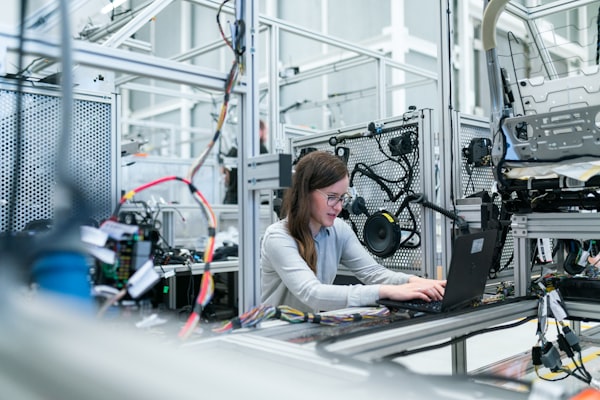 Integrated sensors provide critical feedback for precise motor control.
Why Are Sensors Essential for Enhanced Motor Control?
While open-loop systems (like basic stepper motor control) can be effective, truly fine-tuned and robust motor performance in advanced robotics relies heavily on feedback from sensors. These sensors provide real-time data about the motor's actual state – its position, velocity, or even current draw – allowing the controller to make dynamic adjustments and correct for errors.
This closed-loop feedback is what elevates a motor from simply following commands to intelligently adapting to its environment and maintaining desired performance under varying conditions. Here are some key sensor types:
- Encoders: Optical or magnetic encoders provide highly accurate positional and velocity feedback. They are crucial for servo systems and for adding closed-loop control to stepper motors (often called 'closed-loop steppers').
- Hall Effect Sensors: These detect magnetic fields and are often used for commutation in brushless DC (BLDC) motors or for basic positional sensing.
- Current Sensors: Monitoring motor current can provide insights into load, detect stalls, and enable advanced current control techniques for smoother operation and protection.
- Force/Torque Sensors: For highly interactive robots, these sensors allow the robot to 'feel' its environment, enabling compliant motion and safe interaction.
Integrating these sensors effectively requires careful consideration of their resolution, update rate, and noise immunity. The data they provide feeds directly into your control algorithms, such as the PID loop, to ensure your motor performs exactly as intended. For a deeper dive into how these components work together, explore our article on Achieving High Precision in Robotics: Motors & Beyond.
Pair this 10,000 CPR encoder with your servo or stepper motor to achieve unparalleled positional feedback, essential for advanced PID tuning and microstepping optimization.
What Are Advanced Tuning Techniques and Common Pitfalls to Avoid?
Beyond manual PID tuning and microstepping adjustments, several advanced techniques can further refine motor performance. These often involve more sophisticated algorithms or automated processes to achieve optimal results faster and more reliably.
| Technique | Description | Best For | Considerations |
|---|---|---|---|
| Auto-Tuning Algorithms | Software-based methods that automatically identify system dynamics and calculate optimal PID gains. | Rapid prototyping, systems with varying loads. | Requires compatible motor controller; results may need fine-tuning. |
| Frequency Response Analysis | Injecting sine waves into the system and analyzing the output to understand system dynamics. | Highly critical, complex systems. | Requires specialized equipment (oscilloscope, function generator) and expertise. |
| Model-Based Control | Developing a mathematical model of the motor and load to predict behavior and design controllers. | Predictive control, highly dynamic systems. | Requires significant mathematical modeling and computational power. |
| Gain Scheduling | Varying PID gains based on operating conditions (e.g., speed, load, position). | Systems with wide operating ranges or non-linear behavior. | More complex to implement; requires careful mapping of gains to conditions. |
Which PID term primarily helps eliminate steady-state error?
Quantifying Your Performance Gains: Why Tuning Matters
The effort invested in fine-tuning your motors translates directly into measurable improvements across your robotic system. These aren't just theoretical benefits; they're tangible enhancements that impact everything from operational efficiency to product quality.
"The difference between a good robot and a great robot often lies in the quality of its motor control. Tuning isn't just a step; it's an art that transforms potential into precision."
— Dr. Anya Sharma, Lead Robotics Engineer, iBuyRobotics Advanced Systems
Real-World Applications: Where Tuning Makes the Difference
Understanding the theory is one thing; seeing it in action is another. Here are a few scenarios where meticulous motor tuning is not just beneficial, but absolutely critical:
- Robotic Arms for Manufacturing: In assembly lines, a robotic arm needs to place components with sub-millimeter precision, often at high speeds. PID tuning ensures smooth, accurate trajectories and rapid settling times, preventing costly errors and increasing throughput.
- CNC Machines: Computer Numerical Control (CNC) machines rely on stepper and servo motors for precise cutting, milling, and engraving. Optimized microstepping and robust PID control prevent chatter, improve surface finish, and ensure dimensional accuracy of manufactured parts.
- Drone Gimbals: For stable aerial photography or surveillance, drone gimbals must counteract aircraft movement with extreme speed and smoothness. Highly tuned servo motors, often with advanced sensor fusion, keep cameras perfectly level, even in turbulent conditions.
- Medical Robotics: Surgical robots and rehabilitation devices demand the highest levels of safety and precision. Fine-tuned motors ensure gentle, controlled movements, crucial for delicate procedures and patient interaction.
In each of these examples, the ability to fine-tune motor performance directly impacts the system's reliability, safety, and overall effectiveness. It's a skill that elevates a robotics project from functional to exceptional.
Designed for demanding applications, this kit includes a high-torque servo motor and a compatible drive with advanced auto-tuning features, simplifying the optimization process for peak performance.
Ready to Dive Deeper into Motor Control?
Mastering motor tuning is a continuous journey. Explore more resources to expand your knowledge and build even more capable robotic systems.
Servo Motor Control
Understand the core principles that make servo motors the go-to choice for controlled, precise motion in robotics.
Explore Servo Control →Stepper Motor Precision
Delve into the mechanics and control strategies that allow stepper motors to achieve such remarkable positional accuracy.
Learn Stepper Precision →Motor Control Basics
Get a foundational understanding of how motor controllers work and their essential role in any robotic system.
Start with Basics →Further Reading