

What Makes a Motor "Heavy-Duty" for Robotics?
When we talk about "heavy-duty" in robotics, we're not just talking about lifting a little extra weight. We're entering a realm of sustained high torque, extreme precision under load, continuous operation, and often, resilience in challenging environments. These are the motors that drive industrial automation, power large mobile platforms, and enable complex manufacturing processes.
Sustained High Torque
The ability to generate and maintain significant rotational force, crucial for moving heavy payloads or overcoming substantial resistance without stalling.
Exceptional Precision
Maintaining accurate positioning and smooth motion control, even when subjected to varying loads and external disturbances.
Robust Durability
Designed to withstand continuous operation, high temperatures, vibrations, and often harsh industrial environments for extended lifespans.
Advanced Control
Integration with sophisticated feedback systems and controllers for dynamic response, safety, and complex motion profiles.
While the fundamental principles of robotics remain the same, industrial robotics demands a significantly higher degree of reliability, repeatability, and safety. Hobby robots often prioritize cost-effectiveness and ease of experimentation, whereas industrial systems are built for continuous, mission-critical operations where failure can lead to significant financial losses or safety hazards. This translates directly into more robust components, higher quality materials, and more rigorous testing for industrial-grade motors and systems.
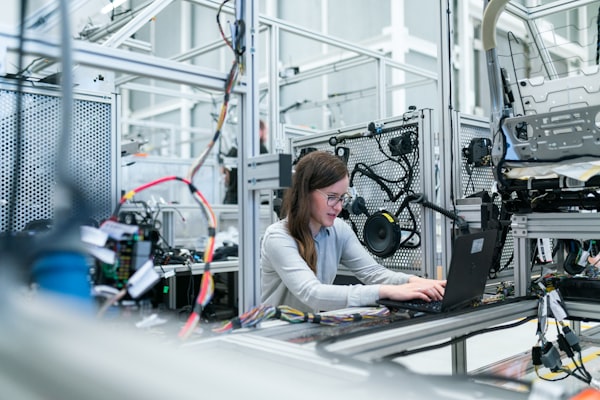 Industrial robots perform critical tasks like welding with high precision and endurance.
What Unique Challenges Do Industrial Robots Face?
Industrial robots operate in environments and under conditions that push components to their limits. Understanding these challenges is the first step in selecting the right motor. Unlike smaller, lighter applications, heavy-duty robots must contend with a confluence of factors that demand robust engineering and precise control.
These challenges directly influence motor selection, requiring not just raw power, but also specific performance characteristics and environmental resilience. Ignoring any of these can lead to premature failure, costly downtime, or compromised operational safety.
Which Motor Types Are Up to the Task?
For heavy-duty industrial robotics, the choice often narrows down to a few key motor technologies, each offering distinct advantages. While DC brushed motors have their place in simpler applications, brushless DC (BLDC) and servo motors dominate the high-performance industrial landscape due to their efficiency, control, and longevity.
Brushless DC (BLDC) Motors: The Workhorses
BLDC motors are a cornerstone of heavy-duty robotics. Their lack of brushes means less wear and tear, leading to longer lifespans and reduced maintenance – critical for industrial settings. They offer excellent power-to-weight ratios, high efficiency, and the ability to operate at high speeds. When paired with appropriate controllers, they provide smooth, controllable torque across a wide operating range.
Ideal for: Continuous motion, mobile robot propulsion, high-speed applications, and where efficiency and longevity are paramount. Often found in AGVs, conveyor systems, and larger robotic joints.
Learn more about DC Motor Essentials →Servo Motors: Precision & Dynamic Control
Servo motors, which are essentially BLDC motors integrated with an encoder and a sophisticated control loop, are the gold standard for applications demanding precise position, velocity, and torque control. Their ability to respond dynamically to changing loads and maintain exact positions makes them indispensable for robotic arms, manipulators, and any application requiring highly coordinated, repeatable movements.
Ideal for: Robotic arms, CNC machinery, pick-and-place robots, and applications requiring high accuracy, rapid acceleration/deceleration, and dynamic load handling.
Understand Servo Motor Control →Stepper Motors: Niche Precision (for lighter heavy-duty)
While typically associated with smaller, open-loop positioning, stepper motors can be used in some heavy-duty applications, particularly when high holding torque at standstill and precise incremental movements are required, and speeds are relatively low. However, their efficiency drops significantly at higher speeds and they can lose steps under heavy, dynamic loads without a closed-loop system (which essentially turns them into a type of servo motor).
Ideal for: Indexing tables, precise linear actuators, and applications where the load is well-defined and speed is not a primary concern. Less common for primary motive power in very heavy industrial robots.
How Stepper Motors Achieve Precision →Why Are Gearmotors Almost Always Essential?
The raw speed of an electric motor is often too high, and its torque too low, for direct application in heavy-duty robotics. This is where gearboxes come in. A gearmotor is simply a motor integrated with a gearbox, forming a single, optimized unit. This combination is crucial for several reasons:
- Torque Multiplication: Gearboxes significantly increase the output torque, allowing a smaller, more efficient motor to move much heavier loads.
- Speed Reduction: They reduce the motor's high rotational speed to a usable level for the robot's joints or wheels.
- Inertia Matching: Gearboxes help match the motor's inertia to the load's inertia, improving control system stability and reducing the motor's effort to accelerate and decelerate the load.
- Precision & Holding: High-ratio gearboxes can provide excellent holding torque, preventing back-driving and maintaining position even when power is off.
When Do You Need a Gearmotor (and Why)? →"In industrial robotics, the gearbox isn't just an accessory; it's an integral part of the power transmission system. It transforms high-speed, low-torque motor output into the low-speed, high-torque force that heavy machinery demands, all while enhancing control and efficiency."
— Dr. Evelyn Reed, Lead Robotics Engineer, iBuyRobotics R&D
 A planetary gearbox, commonly used in heavy-duty applications for high torque density.
What's your primary heavy-duty application?
For High Payload Lifting:
You'll need high-torque gearmotors, typically Brushless DC or Servo, with robust planetary or worm gearboxes. Focus on continuous torque ratings and peak torque capabilities to handle initial acceleration and potential overloads. Safety brakes are also critical.
Engineered for continuous high-load operation, offering exceptional torque density and efficiency for lifting and manipulation tasks.
For Precise, Repetitive Motion:
Servo gearmotors are your best bet. The combination of a high-resolution encoder, a responsive servo drive, and a low-backlash gearbox (like planetary or cycloidal) ensures the accuracy and repeatability essential for tasks like welding, assembly, or machining.
Designed for critical applications requiring sub-degree accuracy and smooth, repeatable motion profiles under varying loads.
For Mobile Platform Propulsion:
Brushless DC gearmotors are ideal for AGVs (Automated Guided Vehicles) and AMRs (Autonomous Mobile Robots). They provide the necessary continuous torque for movement, high efficiency for battery life, and durability for constant operation. Look for integrated encoders for odometry and navigation.
Optimized for mobile robotics, offering robust construction, high efficiency, and integrated feedback for reliable navigation and propulsion.
How Do You Size a Motor for Industrial Loads?
Motor sizing for heavy-duty applications is a complex process that goes beyond simply matching a motor's rated power to the application's needs. It involves a detailed analysis of the load, motion profile, and environmental conditions. Undersizing can lead to overheating and premature failure, while oversizing wastes energy and increases cost.
| Parameter | Description | Why it's Critical for Heavy-Duty |
|---|---|---|
| Continuous Torque | The maximum torque a motor can produce indefinitely without overheating. | Ensures sustained operation under load, preventing thermal shutdown during long duty cycles. |
| Peak Torque | The maximum torque a motor can produce for a short duration (e.g., during acceleration). | Crucial for overcoming starting inertia and handling sudden load changes without stalling. |
| Speed Range | The operational RPM range, from minimum controlled speed to maximum no-load speed. | Must match the application's required motion velocity, considering gearbox ratios. |
| Inertia Ratio | The ratio of load inertia to motor rotor inertia. | Impacts control system stability and dynamic response. An optimal ratio (often 5:1 to 10:1) is key for precise motion. |
| Duty Cycle | The proportion of time a motor is active versus resting. | Determines thermal management requirements; continuous duty demands more robust cooling and higher continuous torque ratings. |
| Environmental Rating (IP) | Ingress Protection rating against dust and water. | Essential for motors operating in harsh industrial environments (e.g., IP65 for dust/water jets, IP67 for temporary immersion). |
For a more detailed approach to calculating your specific motor needs, check out our dedicated tool:
What Size Motor Do You Really Need? (Motor Sizing Calculator) →Beyond the Motor: Control Systems for Robust Performance?
A powerful motor is only as effective as the system controlling it. In heavy-duty robotics, sophisticated control systems are paramount for achieving the required precision, safety, and dynamic response. This involves a tightly integrated ecosystem of components working in harmony.
Key elements include:
- Motor Drivers/Amplifiers: These devices translate control signals into the appropriate voltage and current to drive the motor, often managing complex commutation for BLDC and servo motors.
- Encoders & Resolvers: Essential feedback devices that provide real-time information on the motor's position, speed, and direction to the controller, enabling closed-loop control.
- Programmable Logic Controllers (PLCs) & Industrial PCs: The brains of the operation, coordinating multiple axes, executing complex motion profiles, and interfacing with other factory systems.
- Safety Systems: Integrated emergency stops, torque-off functions, and other safety protocols are non-negotiable in industrial environments.
Understanding these components is crucial for designing a reliable and safe heavy-duty robotic system. Without precise feedback and robust control, even the most powerful motor cannot deliver its full potential.
Understanding Motor Controllers: The Brains Behind the Brawn →What's the primary purpose of an encoder in a heavy-duty servo system?
Where Do These Motors Shine? Real-World Scenarios
Heavy-duty motors are the unsung heroes behind many of the industrial marvels we see today. Their applications are diverse, spanning manufacturing, logistics, energy, and beyond. Here are a few examples where robust motor selection is absolutely critical:
Why Choose iBuyRobotics for Your Industrial Needs?
At iBuyRobotics, we understand the uncompromising demands of heavy-duty industrial applications. Our motors and gearmotors are engineered for performance, reliability, and longevity, backed by expert support.
Ready to Dive Deeper?
Selecting the right motor for heavy-duty robotics is a critical decision that impacts performance, cost, and system longevity. Continue your learning journey with these related resources: