

What Exactly Do We Mean by 'Sensing'?
Just like humans rely on sight, touch, hearing, and smell to understand their surroundings, robots need sensors to gather information about their environment. Without sensors, a robot is essentially blind, deaf, and unable to interact intelligently. This ability to 'sense' is fundamental to any robot's autonomy and functionality.
Sensor Fundamentals
Understand the core principles behind how various sensors convert physical phenomena into usable data for a robot.
Proximity & Vision
Explore how robots detect objects nearby and interpret visual information to navigate and identify items.
Force & Touch
Discover how robots 'feel' pressure, grip strength, and contact, enabling delicate manipulation and safe interaction.
Sensor Fusion
Learn how robots combine data from multiple sensors to create a more complete and reliable understanding of their world.
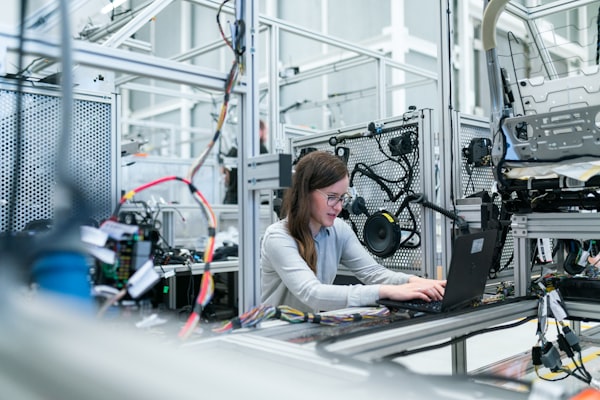
 A robotic arm equipped with multiple sensors, illustrating its ability to perceive its environment.
Why is Sensing So Crucial for Robots?
At its core, robot sensing is about gathering data from the physical world and converting it into a format that the robot's control system can understand and act upon. This process is often referred to as perception. Without accurate perception, a robot cannot effectively navigate, manipulate objects, or interact safely with humans or other machines.
Think of a robot assembling a delicate electronic component. It needs to know the component's exact position, its orientation, and how much force to apply when gripping it. This requires a combination of vision, proximity, and force sensors working in harmony. The quality of a robot's sensors directly impacts its precision, reliability, and overall intelligence.
The perception-action loop describes the continuous cycle where a robot senses its environment, processes that information to make decisions, and then acts upon those decisions. The results of its actions are then fed back into its sensors, restarting the loop. This feedback mechanism is vital for adaptive and intelligent behavior.
For example, an autonomous mobile robot uses its sensors to detect an obstacle (perception), decides to steer around it (action), and then uses its sensors again to confirm it successfully avoided the obstacle and is on its new path (feedback).
 An ultrasonic sensor, commonly used for basic distance measurement in robotics.
How Do Robots Know What's Nearby? Proximity & Distance Sensors
Proximity and distance sensors are fundamental for navigation, collision avoidance, and even simple object detection. They allow a robot to understand its immediate surroundings without making physical contact. These sensors work on various principles, each with its own strengths and ideal applications.
Common types include ultrasonic, infrared (IR), and LiDAR. Ultrasonic sensors emit sound waves and measure the time it takes for the echo to return, providing distance. IR sensors detect reflected infrared light, often used for short-range detection. LiDAR (Light Detection and Ranging) uses pulsed laser light to measure distances, creating highly accurate 2D or 3D maps of the environment.
Ultrasonic Sensors: The Bat's Approach
These sensors emit high-frequency sound waves (beyond human hearing) and calculate distance based on the time-of-flight of the sound wave to an object and back. They are robust, relatively inexpensive, and work well in various lighting conditions. However, their accuracy can be affected by soft surfaces that absorb sound, and their beam can spread, leading to less precise object localization.
Best for: Basic obstacle avoidance, simple distance measurement, water level detection.
Infrared (IR) Sensors: Detecting Heat & Reflection
IR sensors typically consist of an IR LED emitter and an IR photodiode receiver. They work by emitting infrared light and measuring the amount of light reflected back. The intensity of the reflected light indicates proximity. They are compact and fast but can be sensitive to ambient light conditions and the color/reflectivity of the target object.
Best for: Line following, short-range obstacle detection, edge detection.
LiDAR Sensors: Precision Mapping
LiDAR systems use laser pulses to measure distances to objects. By scanning the environment, they can generate highly detailed 2D or 3D point clouds, creating a precise map of the surroundings. While more expensive and complex, LiDAR offers superior accuracy and range compared to ultrasonic and IR, making it ideal for autonomous navigation and mapping.
Best for: Autonomous vehicle navigation, complex environment mapping, high-precision obstacle avoidance.
An affordable and reliable ultrasonic sensor, perfect for hobbyists and educational projects requiring basic distance measurement and obstacle detection.
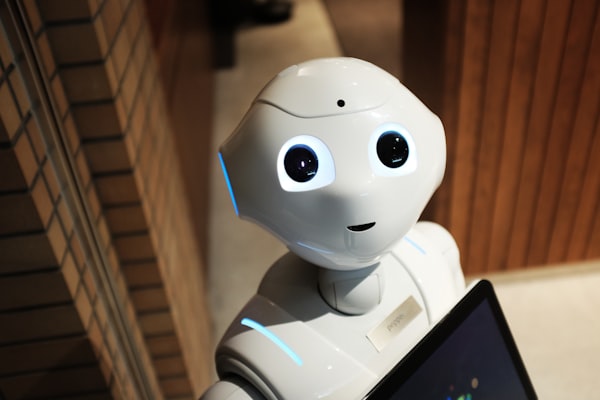 A robot equipped with a camera, enabling it to 'see' and interpret its surroundings.
Can Robots Really 'See'? Understanding Vision Sensors
Vision sensors are arguably the most complex and powerful type of sensor, allowing robots to perceive their world in a way that mimics human sight. They capture visual data, which can then be processed to identify objects, recognize patterns, measure dimensions, and even understand spatial relationships.
The most common vision sensor is a camera, which captures 2D images. However, for robots to truly understand their environment, they often need depth information. This is where advanced vision systems come in, such as stereo cameras (mimicking human binocular vision) and Time-of-Flight (ToF) cameras, which measure the time it takes for emitted light to return, providing precise depth maps.
Which type of vision sensor is primarily used to capture 3D depth information by measuring light travel time?
For a deeper dive into how robots process visual information, explore our Introduction to Vision Sensors.
A powerful stereo depth camera with an integrated IMU, ideal for advanced robotics applications requiring high-resolution depth sensing and motion tracking.
 A force/torque sensor mounted on a robot gripper, enabling precise interaction with objects.
How Do Robots 'Feel' Pressure and Force? Force & Torque Sensors
The sense of touch is critical for robots that need to interact physically with their environment, whether it's gripping delicate objects, performing assembly tasks, or safely collaborating with humans. Force and torque sensors provide this crucial feedback, measuring the forces and moments (torques) applied to a robot's end-effector or joints.
These sensors typically rely on principles like strain gauges, which change electrical resistance when deformed by force, or piezoresistive materials, whose resistance changes under mechanical stress. By arranging multiple sensing elements, a sensor can measure forces along X, Y, Z axes and torques around those axes (a 6-axis force/torque sensor).
What's your primary need for a force sensor?
For Precision Assembly: High-Resolution 6-Axis F/T Sensors
If your robot needs to insert components with tight tolerances or perform delicate polishing, you'll require a high-resolution 6-axis force/torque sensor. These provide detailed feedback on forces and moments, allowing for fine-tuned control and adaptive manipulation. Look for sensors with low noise and high linearity.
For Collision Detection: Robust & Fast Response F/T Sensors
For applications where human-robot collaboration or safety is paramount, a robust force/torque sensor with a fast response time is essential. These sensors can detect unexpected contact quickly, allowing the robot to stop or retract, preventing injury or damage. Integrated safety features are a plus.
For Gripping Feedback: Single-Axis or Tactile Sensors
When the main goal is to ensure a secure grip without crushing an object, a simpler single-axis force sensor or even tactile sensors embedded in the gripper fingers might suffice. These provide feedback on the gripping force, allowing the robot to adjust its hold dynamically based on the object's properties.
Beyond Sight and Touch: What Else Do Robots Sense?
While proximity, vision, and force sensors cover a broad range of robotic perception, many other specialized sensors are vital for specific applications. These sensors provide crucial data about a robot's internal state or other environmental parameters.
 Complex data streams merging, symbolizing the process of sensor fusion.
Putting It All Together: The Power of Sensor Fusion
No single sensor can provide a complete picture of a robot's environment. Each sensor has its strengths and weaknesses. For example, a camera provides rich visual detail but struggles with depth, while a LiDAR provides excellent depth but lacks color information. This is where sensor fusion comes in.
Sensor fusion is the process of combining data from multiple sensors to obtain a more accurate, complete, and reliable understanding of the environment than could be achieved by using individual sensors alone. By fusing data, robots can overcome the limitations of individual sensors, reduce uncertainty, and improve overall perception. This often involves complex algorithms like Kalman filters or particle filters.
Choosing the Right Sensor: What Really Matters?
Selecting the optimal sensors for your robot project involves balancing several critical factors. Understanding these trade-offs is key to building a functional and cost-effective system.
When evaluating sensors, consider:
- Accuracy & Precision: How close are the measurements to the true value, and how repeatable are they?
- Range: What is the minimum and maximum distance or value the sensor can reliably measure?
- Resolution: What is the smallest change the sensor can detect?
- Response Time: How quickly does the sensor provide a reading after a change occurs?
- Environmental Robustness: Can the sensor operate reliably in dust, water, temperature extremes, or varying light conditions?
- Cost & Complexity: Does the sensor fit your budget and can your system handle its data processing requirements?
For a structured approach to sensor selection, refer to our Sensor Selection Framework.
A comprehensive kit including ultrasonic, IR, IMU, and force sensors, perfect for beginners to experiment with different perception capabilities.
Sensors in Action: Real-World Robot Applications
To truly appreciate the role of sensors, let's look at how different types are combined in common robotic applications:
| Application | Key Sensors Used | Why They're Essential |
|---|---|---|
| Autonomous Mobile Robot (AMR) Navigation | LiDAR, Ultrasonic, IMU, Encoders, Vision Cameras | LiDAR for mapping and obstacle detection; Ultrasonic for close-range collision avoidance; IMU for orientation; Encoders for wheel odometry; Vision for lane detection and object recognition. |
| Precision Industrial Assembly | Vision Cameras (2D/3D), Force/Torque Sensors, Encoders | Vision for part identification and precise positioning; Force/Torque for delicate insertion and feedback on contact; Encoders for exact joint control. |
| Human-Robot Collaboration (Cobots) | Force/Torque Sensors, Proximity Sensors, Vision Cameras | Force/Torque for immediate collision detection and safe interaction; Proximity for detecting human presence; Vision for gesture recognition and workspace monitoring. |
| Drone Flight & Stabilization | IMU (Accelerometer, Gyro, Magnetometer), Barometer, GPS, Ultrasonic/LiDAR (for altimetry) | IMU for attitude and orientation; Barometer for altitude; GPS for global positioning; Ultrasonic/LiDAR for precise height above ground. |
Further Reading