

What You'll Learn in This Guide
Define Your Robot's Mission
Understand how your robot's purpose and environment dictate its sensing requirements, laying the groundwork for smart choices.
Explore Sensor Technologies
Get familiar with the main types of sensors, from proximity detection to advanced vision systems, and what each excels at.
Evaluate Practical Factors
Consider crucial aspects like budget, power consumption, data processing, and physical integration for a successful project.
Make Informed Decisions
Apply a structured approach to sensor selection, ensuring your robot is equipped with the optimal 'senses' for its specific tasks.
 A robot's ability to interact with its environment hinges on its sensor suite.
Why Does Sensor Selection Matter So Much?
Think of a robot's sensors as its eyes, ears, and touch. Without the right sensors, a robot is essentially blind, deaf, or numb to its surroundings. The quality and type of information a robot receives directly impacts its ability to navigate, manipulate objects, interact safely, and ultimately, achieve its purpose.
Choosing the correct sensors isn't just about adding components; it's about enabling intelligent behavior. A well-chosen sensor suite can simplify programming, improve reliability, and even reduce overall system cost by avoiding unnecessary complexity or over-specification. It's a foundational decision that shapes your entire robot project.
What's Your Robot's Primary Mission?
Before diving into specific sensor types, it's crucial to clearly define what your robot needs to *do*. Its mission will dictate what it needs to sense and how accurately. Is it moving around, picking things up, or working closely with people?
What's the main goal your robot needs to achieve?
Focus: Object Manipulation
Robots designed to pick, place, assemble, or interact physically with objects will benefit from vision sensors (for object recognition and pose estimation), force/torque sensors (for delicate handling and collision detection), and tactile sensors. Precision and feedback are key here to ensure successful and safe manipulation.
Explore specific vision capabilities in our Introduction to Vision Sensors.
Focus: Human-Robot Interaction
When robots work alongside or directly with humans, safety and intuitive interaction are paramount. This calls for sensors like vision (for gesture recognition, facial detection), force/torque (for safe contact and collision detection), and potentially proximity sensors to maintain safe distances. The goal is to make the robot predictable and responsive to human presence.
Focus: Inspection & Monitoring
Robots used for data collection, quality control, or environmental monitoring often require specialized sensors. This could include high-resolution cameras, thermal cameras, gas sensors, or even radiation detectors, depending on the specific data needed. Accuracy, resolution, and data bandwidth are critical considerations.
Exploring the Core Sensor Categories
Once you have a clear mission, you can start looking at the tools available. Here's a breakdown of the most common sensor categories and what they're generally used for:
Proximity & Distance Sensors
These sensors detect the presence of objects and measure distances. They are fundamental for obstacle avoidance, simple navigation, and detecting when a robot is near a target. Common types include:
- Ultrasonic: Uses sound waves to detect objects and measure distance. Good for general obstacle detection, less precise.
- Infrared (IR): Emits IR light and measures reflection. Good for short-range detection, can be affected by ambient light and surface color.
- LiDAR (Light Detection and Ranging): Uses pulsed laser light to measure distances. Provides highly accurate 2D or 3D maps of the environment, essential for advanced navigation and mapping.
Want to dive deeper? Check out our Which Proximity Sensor is Right for Your Robot? guide.
Compact, high-performance LiDAR ideal for drones and mobile robots requiring precise distance measurements up to 40 meters.
Vision Sensors (Cameras)
Vision sensors allow robots to 'see' and interpret their environment. They are crucial for object recognition, tracking, quality inspection, and complex navigation tasks. Types include:
- 2D Cameras: Standard cameras for image processing, object detection, and QR code reading.
- 3D Cameras (Stereo, ToF, Structured Light): Provide depth information, enabling robots to understand the shape and position of objects in 3D space. Essential for manipulation and complex scene understanding.
Get started with robot vision in our Seeing Like a Robot: Introduction to Vision Sensors.
Force & Torque Sensors
These sensors measure the forces and torques applied to a robot's end-effector or joints. They are vital for delicate manipulation, collision detection, and ensuring safe interaction with objects and humans.
- Single-axis: Measures force along one direction.
- Multi-axis (6-axis): Measures forces along X, Y, Z axes and torques around X, Y, Z axes. Provides comprehensive feedback for complex tasks.
Understand the practical applications in our guide on Force & Torque Sensor Use Cases.
Orientation & Motion Sensors (IMU)
Inertial Measurement Units (IMUs) combine accelerometers, gyroscopes, and sometimes magnetometers to provide data on a robot's orientation, angular velocity, and linear acceleration. They are critical for:
- Stabilization: Keeping drones level or balancing mobile robots.
- Dead Reckoning: Estimating position based on motion, often combined with other sensors for improved accuracy.
- Orientation Tracking: Knowing which way the robot is facing.
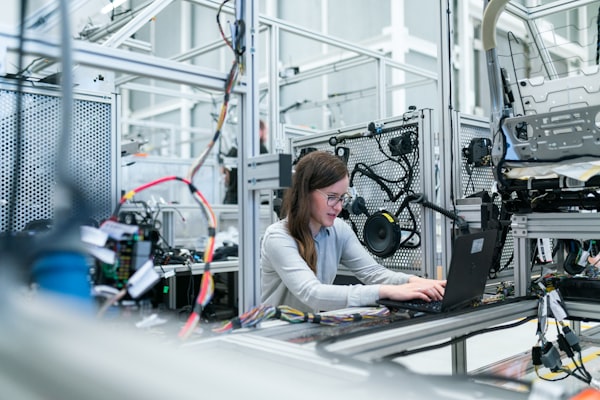 Environmental conditions like dust, light, and temperature heavily influence sensor performance.
How Does the Environment Affect Sensor Choice?
Your robot's operating environment is a major factor in sensor selection. A sensor that performs perfectly in a controlled lab might fail completely in a harsh industrial setting or outdoors. Consider these environmental aspects:
- Lighting Conditions: Is it bright, dim, variable, or completely dark? Vision sensors struggle in poor light, while IR sensors can be affected by strong sunlight.
- Dust, Dirt, & Moisture: Will the sensors be exposed to contaminants? Some sensors are sealed and rated for harsh conditions (IP ratings), while others are delicate.
- Temperature Extremes: Operating outside a sensor's specified temperature range can lead to inaccurate readings or permanent damage.
- Obstacle Characteristics: Are obstacles reflective, transparent, soft, or irregularly shaped? Ultrasonic sensors might struggle with soft, sound-absorbing materials, while LiDAR can be confused by highly reflective surfaces.
- Interference: Are there other robots, machinery, or electromagnetic fields that could interfere with sensor signals?
Balancing Budget, Performance, and Integration
Beyond the technical capabilities, practical considerations like cost, power, and how easily a sensor integrates into your system are critical. These often involve trade-offs.
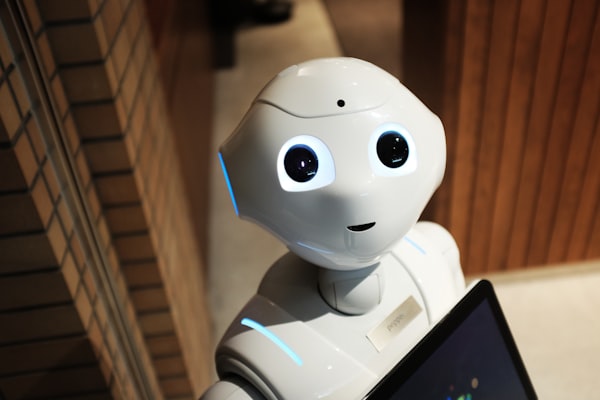 Integration complexity can significantly impact project timelines and costs.
- Cost: High-precision, advanced sensors (like industrial LiDAR or 6-axis force/torque sensors) can be very expensive. Can a simpler, cheaper sensor achieve 'good enough' performance for your application?
- Power Consumption: Some sensors, especially vision and LiDAR, can be power-hungry. This is a major concern for battery-powered mobile robots.
- Data Processing: High-resolution cameras or fast LiDAR units generate massive amounts of data. Does your robot's microcontroller or onboard computer have the processing power to handle this data in real-time?
- Physical Integration: How large is the sensor? Where will it be mounted? Does it require specific alignment or calibration? Consider the mechanical design implications.
- Software Integration: Does the sensor come with readily available drivers and libraries for your chosen programming language or robot operating system (ROS)? Custom driver development can be a significant undertaking.
Your Sensor Selection Checklist
0 of 6 completedKey Performance Metrics to Consider
Understanding these technical specifications will help you compare sensors effectively and ensure they meet your robot's demands.
Scenario: Equipping an Autonomous Warehouse Robot
Let's put this framework into practice. Imagine you're designing an autonomous mobile robot (AMR) for a large warehouse. Its primary tasks are to navigate aisles, avoid forklifts and personnel, identify specific pallets, and transport them to designated areas. The environment is indoors, well-lit but can have dusty areas, and involves both static and dynamic obstacles.
What sensors would be essential for this robot, and why?
Which sensor combination would be most effective for our warehouse AMR?
- A) Ultrasonic sensors lack the precision and range for complex warehouse navigation. IR sensors are too limited for reliable pallet detection.
- B) A 2D camera alone struggles with depth perception for navigation and obstacle avoidance in dynamic environments. A single-axis force sensor isn't suitable for identifying pallets.
- D) An IMU alone is prone to drift and cannot provide environmental mapping. A thermal camera is not ideal for identifying standard pallets.
Combines RGB and depth sensing with an integrated IMU, perfect for object recognition, 3D mapping, and precise manipulation in warehouse environments.
Your Path to Optimal Sensor Selection
Choosing the right sensors is a systematic process that combines understanding your robot's needs with knowledge of available technologies and practical constraints. By following these steps, you'll be well on your way to building a robot that truly 'senses' its world effectively.
Ready to Explore More Robot Components?
Your robot's sensors are just one piece of the puzzle. Continue building your knowledge with these related guides:
How Do Robots Sense Their World?
Dive deeper into the fundamental principles and diverse types of robot sensors.
Explore Sensor Technologies →Which Proximity Sensor is Right?
A detailed guide to selecting ultrasonic, IR, or capacitive sensors for your specific needs.
Compare Proximity Sensors →Seeing Like a Robot: Vision Sensors
An introduction to how robots use cameras and advanced vision systems to perceive their surroundings.
Understand Robot Vision →