

What You'll Learn About Microcontroller Boards
The Core Components
Understand the essential parts that make up a microcontroller board, from its central processing unit to its memory and input/output pins.
How They Actually Work
Demystify the process of how these boards take inputs, process information, and control outputs to perform specific tasks.
Why They're Indispensable
Discover the critical role microcontroller boards play in everything from smart home devices to advanced robotics and industrial automation.
Getting Started with Your First Board
Gain practical insights into what you need to begin your journey and choose the right board for your initial projects.
 A typical microcontroller board, featuring a central chip, various pins, and power connectors.
What Exactly is a Microcontroller Board, Anyway?
Imagine a tiny, specialized computer designed to do one or a few specific tasks really well. That's essentially what a microcontroller board is. Unlike the powerful computer you're using right now, which can run many different programs and handle complex operations, a microcontroller board is built for dedicated control applications.
It's a compact circuit board that houses a microcontroller chip – the 'brain' – along with all the necessary support components like power regulation, clock circuitry, and input/output (I/O) pins. These boards provide an easy-to-use platform for you to program and interact with the physical world, making them the heart of countless electronic projects and smart devices.
While often confused, a microcontroller is a complete, self-contained computer system on a single chip, including CPU, memory, and I/O peripherals. A microprocessor, on the other hand, is just the CPU (the processing unit) and requires external memory and peripherals to function as a computer. Microcontroller boards integrate everything you need into one convenient package. Want to learn more? Check out our detailed guide: Microcontroller vs. Microprocessor: What's the Difference?
The Brains of the Operation: Core Components Explained
Every microcontroller board, regardless of its specific type or brand, shares a fundamental set of components that allow it to function as a miniature computer. Understanding these parts is key to grasping how your projects will come to life.
Which component on a microcontroller board is responsible for permanently storing your program's instructions?
 The fundamental cycle: a microcontroller takes input, processes it, and generates an output.
How Do Microcontroller Boards Actually Work?
The operation of a microcontroller board can be simplified into a continuous cycle: Input → Process → Output. This cycle is what allows your projects to react to their environment and perform actions.
First, the board receives input from various sources. This could be a sensor detecting light, temperature, or distance; a button being pressed; or even data coming in wirelessly. These inputs are typically electrical signals that the microcontroller's CPU can understand.
Next, the CPU processes this input according to the program (firmware) you've uploaded to its flash memory. This processing involves executing instructions, performing calculations, comparing values, and making decisions based on the logic you've defined. For example, if a temperature sensor reads above a certain threshold, the program might decide to turn on a fan.
Finally, based on its processing, the microcontroller generates an output. This output could be turning an LED on or off, sending a command to a motor to spin, displaying text on an LCD screen, or transmitting data to another device. This completes the cycle, allowing the board to continuously monitor and control its surroundings.
Why Are Microcontroller Boards So Important for Robotics and Beyond?
Microcontroller boards are the unsung heroes behind the automation and intelligence we see all around us. Their ability to precisely control physical systems makes them indispensable.
From simple blinking lights to complex robotic movements, microcontroller boards provide the control, flexibility, and cost-effectiveness needed for innovation. They bridge the gap between software instructions and physical actions.
What kind of project are you dreaming of building?
Perfect for Simple Automation
For projects involving basic sensor readings, controlling LEDs, or simple motor tasks, boards like the Arduino Uno are fantastic. They offer straightforward programming and a robust community for support. Consider the Arduino Uno R3 for its ease of use and extensive resources.
The classic choice for beginners, offering a simple interface and vast online support for learning basic automation.
Optimized for Robotics & Motion Control
Robotics projects often require precise timing, multiple motor drivers, and the ability to handle various sensor inputs simultaneously. Boards with more processing power and dedicated motor control capabilities, or those easily expandable with shields, are ideal. The ESP32 or more advanced Arduino models are great starting points. Explore our guide on Bringing Your Robot to Life.
Excellent for robotics due to its dual-core processor, integrated Wi-Fi/Bluetooth, and ample I/O for sensors and motor drivers.
Ideal for IoT & Wireless Connectivity
If your project needs to connect to the internet, send data to the cloud, or communicate wirelessly, boards with integrated Wi-Fi and Bluetooth are essential. The ESP32 is a standout here, offering powerful connectivity features at an accessible price point. Consider the ESP32 Dev Kit C V4 for its robust wireless capabilities.
A powerful and affordable option for IoT projects, offering RP2040 microcontroller performance with integrated Wi-Fi.
Common Types of Microcontroller Boards You'll Encounter
The world of microcontroller boards is vast, but a few key players dominate the beginner and intermediate spaces. Each has its strengths, making them suitable for different types of projects.
Arduino Boards: The Beginner's Best Friend
Arduino boards, like the popular Uno, are renowned for their ease of use, extensive documentation, and massive community support. They are open-source hardware and software, making them incredibly accessible for learning. They typically use an ATmega microcontroller and are programmed using a simplified C++ language within the Arduino IDE.
Best for: Learning electronics basics, simple automation, educational projects, quick prototyping. While not always the most powerful, their simplicity makes them ideal for understanding core concepts.
Everything you need to begin your journey with Arduino, including an Uno board, sensors, and components for your first projects.
ESP32 Boards: The Connectivity Powerhouse
ESP32 boards, developed by Espressif Systems, are known for their integrated Wi-Fi and Bluetooth capabilities, making them perfect for Internet of Things (IoT) projects. They feature powerful dual-core processors and more memory than typical Arduinos, allowing for more complex applications and faster processing. They can be programmed with the Arduino IDE, MicroPython, or ESP-IDF.
Best for: IoT devices, smart home automation, wireless communication projects, projects requiring more processing power and memory, advanced robotics with network capabilities.
Integrates a camera with Wi-Fi/Bluetooth, ideal for surveillance, remote monitoring, or vision-enabled robotics projects.
Raspberry Pi Pico: The New Kid on the Block
The Raspberry Pi Pico, featuring the RP2040 microcontroller chip designed by Raspberry Pi, offers a compelling balance of performance, flexibility, and affordability. It boasts a dual-core ARM Cortex-M0+ processor, ample RAM, and a unique Programmable I/O (PIO) subsystem for highly flexible peripheral control. It can be programmed with MicroPython or C/C++.
Best for: High-performance embedded projects, precise timing applications, robotics, audio processing, and projects where custom hardware interfaces are needed. The Pico W variant adds Wi-Fi connectivity.
The standard Pico with pre-soldered headers, making it easier to connect to breadboards and other components for rapid prototyping.
For a deeper dive into choosing the right board for your specific needs, explore our comprehensive comparison guide: Arduino vs. ESP32 vs. Raspberry Pi: Which Board is Right for You?
Getting Started: What You Need to Begin Your Journey
Embarking on your first microcontroller project is exciting! Here's a basic checklist of what you'll typically need to get started:
Your First Project Checklist
0 of 5 completedWhere Do Microcontroller Boards Shine in the Real World?
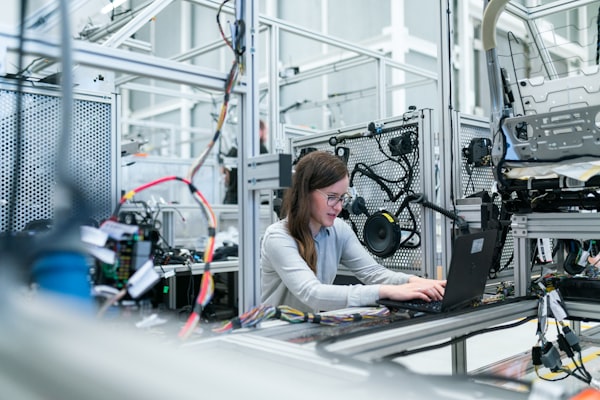
 Industrial robots rely heavily on microcontroller boards for precise motion control and task execution.
Microcontroller boards are ubiquitous, powering a vast array of devices that make our lives easier, safer, and more automated. Once you understand their core function, you'll start seeing them everywhere.
- Robotics: From hobbyist robots to advanced industrial manipulators, microcontrollers are the brains that interpret commands, control motors, read sensors, and execute complex movement sequences. They are fundamental to bringing any robot to life.
- Smart Home Devices: Your smart thermostat, automated lighting system, smart locks, and even robotic vacuum cleaners all rely on microcontrollers to sense their environment and respond accordingly.
- Wearables & Health Tech: Fitness trackers, smartwatches, and many medical monitoring devices use tiny, low-power microcontrollers to collect data, process it, and communicate with other devices.
- Automotive Electronics: Modern cars are packed with microcontrollers managing everything from engine control and anti-lock braking systems to infotainment and power windows.
- Industrial Automation: In factories, microcontrollers are at the heart of programmable logic controllers (PLCs), machine control systems, and automated assembly lines, ensuring precision and efficiency.
The possibilities are truly endless, limited only by your imagination and your growing understanding of how to program these versatile little computers. Ready to see how they control movement? Explore Bringing Your Robot to Life: How Microcontrollers Control Movement & Sensors.
Ready to Dive Deeper into Microcontroller Boards?
You've taken the first step in understanding the foundational technology behind modern electronics and robotics. Now, let's continue building your knowledge and skills!
Explore Board Features
Get a closer look at the various pins, ports, and power options available on different boards. Explore Common Microcontroller Board Features
Start Coding Your Board
Ready to write your first program? Our beginner's guide will walk you through the basics of firmware. Coding Your Microcontroller: A Beginner's Guide to Firmware
Find Your First Project
Ready to apply what you've learned? Discover inspiring projects to kickstart your robotics journey. Project Planner: Which Microcontroller Board Fits Your Vision?