What Advanced Features Can Do For Your Robot?
Enhanced Processing Power
Tackle complex algorithms, real-time sensor fusion, and advanced motor control without lag, ensuring your robot responds instantly and intelligently.
Seamless Wireless Connectivity
Enable remote control, data logging to cloud services, and inter-robot communication with integrated Wi-Fi and Bluetooth, opening up new possibilities for interaction.
Specialized Peripheral Integration
Directly interface with high-speed cameras, advanced motor drivers, and custom sensors using dedicated hardware, reducing external component count and simplifying designs.
Enhanced Security & Reliability
Protect your robot's data and operations with hardware-accelerated encryption and robust error handling, crucial for industrial or sensitive applications.
 Modern microcontrollers often feature multiple processing cores for parallel task execution.
Why Would My Robot Need More Processing Power?
When you're moving beyond simple blinking LEDs or basic sensor readings, your robot's brain needs to keep up. Advanced robotics projects often involve tasks that demand significant computational muscle. Think about real-time object detection, simultaneous localization and mapping (SLAM), or complex inverse kinematics for robotic arms. These aren't just sequential operations; they often require parallel processing to maintain responsiveness and accuracy.
Multi-core microcontrollers, like many modern ESP32 variants or higher-end Teensy boards, offer a significant advantage here. They allow different tasks to run concurrently on separate cores, preventing bottlenecks. For instance, one core could handle motor control and PID loops, while another manages sensor data acquisition and communication, ensuring smooth, coordinated movement even under heavy load.
In a single-core system, the microcontroller executes one instruction at a time, rapidly switching between tasks (context switching). While fast, this can introduce latency when tasks are time-critical. Multi-core architectures dedicate physical processing units to different tasks, drastically reducing latency and improving overall system throughput. This is crucial for applications like autonomous navigation where milliseconds can make a difference in obstacle avoidance or path planning accuracy.
For example, an ESP32-S3 features a dual-core Xtensa LX7 processor. One core can be dedicated to handling Wi-Fi and Bluetooth communication, while the other manages application logic, sensor data processing, and motor control. This separation ensures that network latency doesn't directly impact the robot's real-time control systems.
When Does Integrated Wireless Connectivity Become Essential?
Gone are the days when robots operated in isolation. Modern robotics often thrives on connectivity, whether it's for remote control, data logging, or interacting with other smart devices. Integrated Wi-Fi and Bluetooth capabilities transform a standalone robot into a connected system, enabling a host of advanced functionalities.
What's your primary connectivity need?
Wi-Fi is Your Go-To
For robust internet connectivity, cloud integration, and streaming large datasets, Wi-Fi is the clear winner. Boards like the ESP32 series excel here. Consider the ESP32-DevKitC for its strong Wi-Fi performance and extensive community support.
Excellent for projects requiring reliable Wi-Fi, dual-core processing, and a rich set of peripherals for IoT and robotics applications.
Bluetooth for Close-Range Interaction
If you need to connect to smartphones, wearables, or other nearby devices with low power consumption, Bluetooth (especially BLE) is ideal. Many ESP32 boards also include Bluetooth, but for simpler, power-sensitive applications, a dedicated BLE module or a board like the Raspberry Pi Pico W offers a great balance.
Get the Best of Both Worlds
Many modern microcontrollers, particularly the ESP32 family, offer both Wi-Fi and Bluetooth capabilities on a single chip. This versatility makes them perfect for projects that need both internet access and local device communication. The ESP32 vs. Raspberry Pi comparison can help you decide which specific board fits best.
Beyond the Basics: Specialized Peripherals and Their Impact
While general-purpose I/O pins are fundamental, advanced microcontrollers integrate specialized peripherals that significantly enhance their capabilities and simplify complex designs. These aren't just extra pins; they are dedicated hardware blocks designed for specific, high-performance tasks.
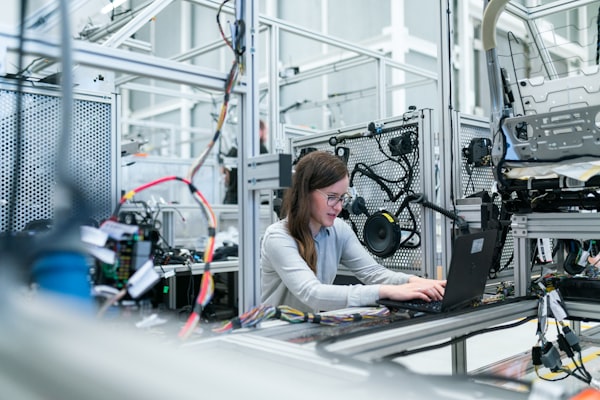 Specialized peripherals like high-speed ADCs or DACs are crucial for precision control.
High-Resolution ADCs and DACs
For applications requiring precise analog signal measurement (e.g., sensitive force sensors, audio processing) or accurate analog output (e.g., fine motor control, waveform generation), high-resolution Analog-to-Digital Converters (ADCs) and Digital-to-Analog Converters (DACs) are indispensable. Standard 10-bit ADCs might suffice for basic readings, but 12-bit or 16-bit ADCs offer significantly more granularity, crucial for scientific instruments or high-fidelity audio.
Hardware Accelerators
Some advanced boards include dedicated hardware for specific computational tasks, offloading the main CPU. Examples include cryptographic accelerators for secure communication, DSP (Digital Signal Processing) units for audio or image processing, or even AI/ML accelerators for on-device inference. These dramatically improve performance and efficiency for specialized workloads.
Advanced Communication Interfaces
Beyond standard UART, SPI, and I2C, advanced boards might offer:
- CAN Bus: Essential for automotive and industrial automation, enabling robust communication over long distances in noisy environments.
- Ethernet MAC: For wired network connectivity, offering higher bandwidth and reliability than Wi-Fi in certain industrial settings.
- USB Host/Device: Allows the microcontroller to act as a USB host (connecting to keyboards, cameras) or a USB device (appearing as a serial port or mass storage).
- Camera Interfaces (e.g., DVP, MIPI CSI): Direct connection to camera modules for vision-based robotics without needing external bridge chips.
CAN Bus: Robust Industrial Communication
The Controller Area Network (CAN) bus is a message-based protocol designed for robust communication in vehicles and industrial automation. It's highly resilient to electrical interference and allows multiple devices to communicate over a single pair of wires. If your robot needs to interface with industrial sensors, motor drivers, or other machinery in a factory setting, a microcontroller with integrated CAN support (like some STM32 or ESP32 variants) is invaluable.
Learn more about connecting various components in our guide: Connecting Sensors & Actuators: A Practical Guide.
Ethernet: High-Bandwidth Wired Networking
While Wi-Fi offers flexibility, Ethernet provides unparalleled speed, reliability, and security for wired network connections. For stationary robots, industrial control systems, or applications requiring high data throughput and minimal latency, an Ethernet MAC (Media Access Controller) on your microcontroller is a significant advantage. It's common in industrial PLCs and advanced embedded systems.
Camera Interfaces: Enabling Robot Vision
For robots that need to 'see' and interpret their environment, a direct camera interface (like DVP or MIPI CSI) on the microcontroller simplifies hardware design and improves performance. Instead of relying on USB cameras and external processing, the microcontroller can directly capture and process image data, crucial for applications like object recognition, facial detection, or autonomous navigation.
The Impact of Advanced Features: By the Numbers
Comparing Advanced Microcontrollers: A Feature Snapshot
Choosing the right advanced board means balancing processing power, connectivity, and specialized peripherals with your project's specific needs and budget. Here's a quick look at how some popular advanced boards stack up.
| Feature | ESP32-S3 | Raspberry Pi Pico W | Teensy 4.1 |
|---|---|---|---|
| CPU Cores | Dual-core Xtensa LX7 | Dual-core ARM Cortex-M0+ | ARM Cortex-M7 (600MHz) |
| Clock Speed | Up to 240 MHz | Up to 133 MHz | 600 MHz (Overclockable) |
| Integrated Wireless | Wi-Fi 4 & Bluetooth 5 (BLE) | Wi-Fi 4 (BLE via external module) | None (External modules required) |
| Hardware Accelerators | AI/ML, Cryptographic | None | DSP, Cryptographic |
| High-Res ADC | 12-bit (20 channels) | 12-bit (3 channels) | 12-bit (2 ADCs, 10 channels) |
| Special Interfaces | USB OTG, Camera, LCD, CAN | PIO, USB 1.1 | USB Host/Device, Ethernet, CAN, SDIO |
| Typical Use Case | IoT, AIoT, Robotics with Vision | Low-cost IoT, Embedded ML | High-performance Audio/Video, Robotics |
Real-World Robotics Projects Demanding Advanced Features
Let's look at some practical examples where basic microcontrollers simply wouldn't cut it, and advanced features become indispensable.
Autonomous Mobile Robot with SLAM & Object Recognition
Requirements: High processing power for real-time SLAM algorithms (mapping and localization), camera interface for object recognition (e.g., OpenCV), Wi-Fi for remote monitoring and mission updates, multiple motor control channels, and potentially CAN bus for advanced lidar or motor drivers.
Why Advanced: SLAM and object recognition are computationally intensive. A dual-core processor with hardware AI/ML acceleration (like the ESP32-S3) or a high-speed Cortex-M7 (like Teensy 4.1) is crucial. Wi-Fi enables seamless integration with a control station or cloud services for map sharing and task assignment.
Integrates a powerful dual-core processor, Wi-Fi, Bluetooth, and a direct camera interface, making it ideal for vision-based autonomous robotics.
Industrial Robotic Arm with Precision Control & Safety
Requirements: High-speed, high-resolution ADCs for precise feedback from encoders and force sensors, multiple PWM channels for servo/stepper control, CAN bus for robust communication with industrial motor drivers, Ethernet for factory network integration, and robust error handling.
Why Advanced: Industrial robots demand extreme precision and reliability. The fast clock speeds and dedicated DSP capabilities of boards like the Teensy 4.1, combined with robust communication protocols like CAN and Ethernet, ensure real-time control and seamless integration into industrial environments.
Smart Home Assistant Robot with Voice Recognition & IoT Integration
Requirements: Dual-core processing for concurrent voice recognition and IoT communication, Wi-Fi and Bluetooth for connecting to smart home devices and cloud services, audio input/output capabilities, and sufficient memory for voice models.
Why Advanced: Voice recognition is computationally intensive, and simultaneously managing network connections and device control requires a powerful, multi-core microcontroller with integrated wireless. The ESP32 family is a strong contender here due to its excellent Wi-Fi/Bluetooth support and growing AI capabilities.
A versatile module with Wi-Fi and Bluetooth, ideal for smart home robotics requiring robust connectivity and moderate processing for voice commands.
Your Advanced Board Selection Checklist
Use this checklist to guide your decision-making process when considering advanced microcontroller features for your next project.
Advanced Feature Checklist
0 of 6 completedReady to Plan Your Advanced Robotics Project?
Understanding advanced board features is a crucial step in designing sophisticated and capable robots. By carefully evaluating your project's demands for processing power, connectivity, and specialized peripherals, you can select a microcontroller that not only meets but exceeds your expectations.
Don't forget to leverage our Project Planner: Which Microcontroller Board Fits Your Vision? to help consolidate your requirements and find the perfect match.
Continue Your Learning Journey
Further Reading