What You'll Discover Next
Deeper Programming
Move beyond visual block coding to text-based languages like Python or C++, unlocking more complex robot behaviors and AI integration.
Advanced Mechanics
Explore custom chassis design, advanced kinematics, gear ratios, and the integration of more powerful motors and actuators for specific tasks.
Complex Electronics
Understand circuit design, power management, sensor fusion, and how to integrate microcontrollers like Raspberry Pi for more robust systems.
Community & Projects
Connect with fellow enthusiasts, participate in robotics competitions, or contribute to open-source projects to accelerate your learning.
 Carefully planning your next robotics project.
Ready for More? Assessing Your Next Steps
Congratulations on completing your first robotics kit! That initial experience is a fantastic foundation, but it's just the beginning. The world of robotics is vast and exciting, offering endless opportunities for learning and creation. Before diving into advanced topics, it's helpful to reflect on what you enjoyed most and where you'd like to grow.
Did you love the coding aspect, the mechanical assembly, or perhaps the problem-solving challenge? Your interests will guide your next steps, ensuring your journey remains engaging and rewarding. Consider what kind of robot you'd like to build next, or what specific problem you want to solve.
What aspect of your first kit excited you most?
Focus on Programming & AI
Great! Your next step should involve diving into text-based programming languages like Python or C++. Explore microcontrollers like the Raspberry Pi or advanced Arduino boards, and consider projects involving computer vision or machine learning. Look into platforms like ROS (Robot Operating System) for complex software architectures.
Check out our guide on Which Coding Language Should I Learn for My Robot? to get started.
Explore Advanced Mechanical Design
Excellent! You're ready to tackle more intricate mechanical systems. Think about custom chassis fabrication, exploring different types of motors (stepper, servo, brushless DC), gear train design, and even 3D printing custom parts. Projects involving robotic arms, walking robots, or complex manipulators will be right up your alley.
Consider exploring Which Type of Robot Kit is Right for My Project? for inspiration.
Embrace Systems Integration & Project Management
Fantastic! You enjoy the holistic challenge. Your path involves integrating various components – hardware, software, and electronics – to achieve a specific goal. Consider projects that require sensor fusion, autonomous navigation, or human-robot interaction. Learning about project management and iterative design will be invaluable.
Our Your First Robot Project Ideas page might spark some inspiration for your next challenge.
Key Areas to Explore for Deeper Learning
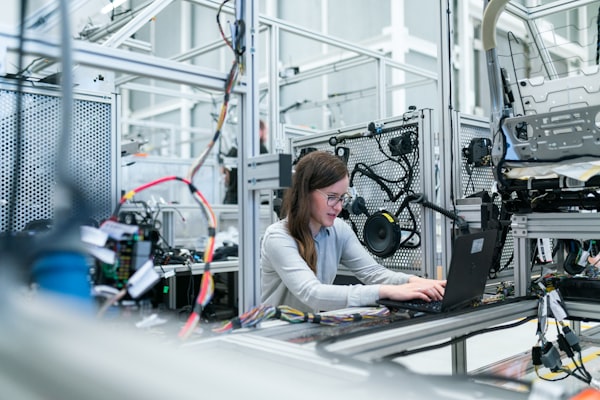 Writing Python code for advanced robot control.
Diving Deeper into Programming: Beyond the Basics
Your first kit likely introduced you to visual programming languages like Scratch or block-based Arduino IDE. These are excellent for understanding fundamental logic, but to truly unlock your robot's potential, text-based coding is essential. Python is often recommended as a next step due to its readability, extensive libraries for robotics (like OpenCV for vision or NumPy for calculations), and strong community support.
For performance-critical applications or direct hardware control, C++ remains a powerful choice, especially when working with microcontrollers or the Robot Operating System (ROS). Learning these languages opens doors to implementing complex algorithms, artificial intelligence, and sophisticated control systems.
Python's simplicity allows for rapid prototyping, while its rich ecosystem of libraries makes it ideal for tasks like data analysis, machine learning, and computer vision – all critical components in modern robotics. It integrates well with various hardware platforms, from Raspberry Pi to industrial controllers, making it a versatile choice for hobbyists and professionals alike.
 Precision engineering is key in advanced mechanical design.
Mastering Mechanical Design: Building Beyond the Blueprint
While beginner kits provide pre-designed parts, advancing in robotics means understanding *why* certain mechanical choices are made. This includes learning about materials, structural integrity, weight distribution, and the physics of motion. You might explore different types of joints, linkages, and gear systems to achieve specific movements or torque requirements.
Tools like CAD (Computer-Aided Design) software become invaluable for designing custom parts, simulating their behavior, and preparing them for fabrication methods like 3D printing or CNC machining. This hands-on design experience transforms you from an assembler into an innovator.
Your Advanced Mechanical Design Checklist
0 of 4 completedThis kit provides a robust aluminum frame, high-torque motors, and ample mounting points, perfect for custom mechanical designs and heavier payloads.
The Impact of Advanced Robotics: Key Metrics
 Understanding the intricate world of robot electronics.
Exploring Advanced Electronics: The Robot's Nervous System
Beyond simply connecting wires, advanced electronics involves understanding circuit diagrams, power requirements, signal conditioning, and component selection. You'll move from breadboards to custom PCBs (Printed Circuit Boards) and learn to integrate a wider array of sensors and actuators. This includes everything from precise motor controllers to sophisticated vision systems and communication modules.
Understanding concepts like voltage, current, resistance, and capacitance becomes critical, as does learning how to troubleshoot complex electrical issues. This knowledge empowers you to design more efficient, reliable, and capable robotic systems.
What are the key differences between Arduino and Raspberry Pi?
Arduino is a microcontroller, ideal for real-time control, simple tasks, and direct sensor/actuator interaction. It's excellent for learning basic electronics and programming. Raspberry Pi, on the other hand, is a single-board computer, running a full operating system (like Linux). It's more powerful, capable of complex computations, networking, computer vision, and running advanced software like ROS. Think of Arduino as the robot's reflexes, and Raspberry Pi as its brain.
How do I choose the right motor for my advanced project?
Motor selection depends on your project's specific needs: torque, speed, precision, and power consumption. DC motors are simple for continuous rotation. Servo motors offer precise angular positioning. Stepper motors provide very precise step-by-step movement, ideal for applications like 3D printers. Brushless DC (BLDC) motors offer high efficiency and power in a compact size, often used in drones and high-performance robots. You'll need to consider factors like stall torque, no-load speed, and operating voltage.
What is sensor fusion and why is it important?
Sensor fusion is the process of combining data from multiple sensors to get a more accurate, reliable, and comprehensive understanding of the environment or the robot's state than could be obtained from a single sensor. For example, combining data from an accelerometer, gyroscope, and magnetometer (an IMU) provides a more stable orientation estimate than any single sensor alone. It's crucial for robust navigation, object detection, and overall robot autonomy.
This kit includes the powerful Raspberry Pi 5, essential sensors, and motor drivers, providing a robust platform for advanced programming, AI, and complex electronic integrations.
Comparing Advanced Robotics Platforms: A Quick Look
| Feature | Arduino Ecosystem | Raspberry Pi Ecosystem | Robot Operating System (ROS) |
|---|---|---|---|
| Primary Function | Microcontroller for real-time control | Single-board computer for complex tasks | Software framework for robot development |
| Programming Languages | C/C++ (Arduino IDE) | Python, C++, Java, etc. (Linux OS) | C++, Python |
| Complexity Level | Intermediate | Intermediate to Advanced | Advanced |
| Best For | Sensor/actuator control, simple automation | AI, computer vision, networking, complex logic | Large-scale, modular, research-grade robotics |
| Typical Projects | Line-following robots, home automation | Autonomous vehicles, robotic arms with vision | Humanoid robots, industrial automation, research |
Joining the Robotics Community: Learn, Share, Grow
One of the most valuable resources for advancing in robotics is the community itself. Engaging with other enthusiasts, mentors, and professionals can provide insights, solutions, and inspiration that you won't find in textbooks. Online forums, local robotics clubs, hackathons, and competitions are excellent avenues for connection.
Participating in events like FIRST Robotics, RoboCup, or even local maker fairs can push your skills, expose you to new technologies, and help you build a network. Don't be afraid to share your projects, ask questions, and contribute to discussions – the collaborative spirit of robotics is incredibly powerful.
Further Reading