

What You'll Discover on Your Robotics Journey
Mobile Robots
Explore robots that move, navigate, and interact with their environment, from simple wheeled bots to complex legged machines.
Robotic Arms
Understand the mechanics and applications of robotic manipulators, perfect for tasks requiring precision and repetition.
Aerial & Underwater Bots
Learn about robots designed for exploration in challenging environments, from the skies to the deep sea.
Specialized Designs
Delve into unique robotic forms like humanoids, medical robots, and other purpose-built machines.
 Wheeled robots are excellent for navigating flat, predictable surfaces.
Want a Robot That Moves Around? Meet Mobile Robots
Mobile robots are perhaps the most common type of robot people imagine. These machines are designed to move and operate in various environments, performing tasks that range from simple navigation to complex manipulation. They're perfect for exploring, delivering items, or even just following you around.
The key to a mobile robot is its locomotion system. This determines where it can go and how it interacts with its surroundings. From the smooth glide of wheels to the rugged grip of tracks or the dynamic balance of legs, each system has its strengths and ideal applications.
Building a mobile robot often involves choosing the right motors, sensors for obstacle avoidance, and a microcontroller to act as its brain. It's a fantastic starting point for many robotics enthusiasts.
What's your primary goal for a mobile robot?
Wheeled Robots: Agile & Efficient for Indoors
For indoor exploration, wheeled robots are often the best choice. They are fast, energy-efficient on flat surfaces, and relatively simple to build. Consider a differential drive (two wheels, one caster) for easy turning. You'll want to explore different movement systems to see what fits best.
This kit provides a sturdy wheeled chassis, motors, and basic sensors, perfect for learning indoor navigation and programming.
Tracked or Legged Robots: Conquer Any Landscape
If your robot needs to traverse uneven ground, climb small obstacles, or handle outdoor environments, tracked or legged designs are superior. Tracked robots offer excellent traction and weight distribution, while legged robots can step over obstacles. These are more mechanically complex but incredibly versatile.
Tracked Robots: Stability for Heavy Lifting
For carrying significant payloads, tracked robots provide a large contact area with the ground, distributing weight effectively and offering stability. While wheeled robots can carry loads, tracks generally offer better performance for heavier, more challenging transport tasks, especially on varied surfaces.
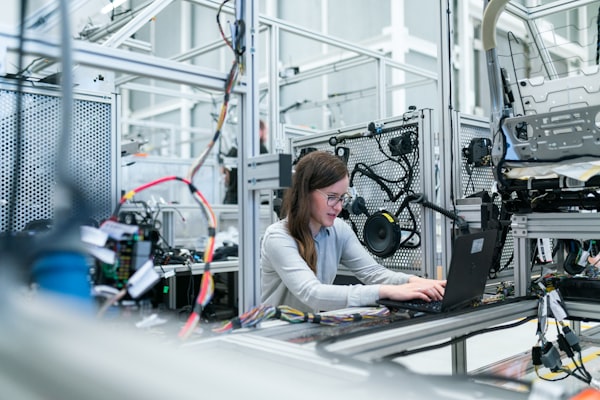 Robotic arms are masters of precision and repetitive tasks in manufacturing.
Thinking About Building a Robotic Arm?
Robotic arms, or manipulators, are designed to interact with objects in a fixed workspace. They excel at tasks requiring high precision, repetitive movements, or handling dangerous materials. Think assembly lines, surgical procedures, or even just sorting items on your desk.
The complexity of a robotic arm is often described by its 'degrees of freedom' (DoF), which refers to the number of independent movements it can make. More DoF means greater flexibility and reach, but also more complex control. A simple arm might have 2-3 DoF, while industrial arms can have 6 or more.
Building an arm involves selecting appropriate motors and actuators, designing a sturdy mechanical structure, and implementing control algorithms. It's a rewarding challenge that teaches you a lot about kinematics and control systems.
Articulated Arm: The Most Common & Versatile
Articulated arms mimic the human arm, with rotary joints that allow for a wide range of motion and flexibility. They are highly versatile and can reach complex positions within their workspace. They are widely used in welding, painting, assembly, and material handling.
- Pros: High flexibility, large workspace, good for complex paths.
- Cons: More complex kinematics, can be harder to program for beginners.
- Best Use: General assembly, welding, painting, pick-and-place.
SCARA Arm: Speed & Precision in a Plane
SCARA (Selective Compliance Assembly Robot Arm) robots are known for their high speed and precision in a horizontal plane. They typically have two parallel rotary joints that provide compliance in the X-Y plane but are rigid in the Z-axis. This makes them ideal for vertical assembly tasks.
- Pros: High speed, excellent repeatability, good for vertical assembly.
- Cons: Limited to a planar workspace, less flexible than articulated arms.
- Best Use: Pick-and-place, packaging, assembly of small parts.
Delta Robot: Blazing Fast & Lightweight
Delta robots are parallel robots consisting of three arms connected to a base and a single end-effector. Their unique design allows for incredibly high speeds and accelerations, making them perfect for very fast pick-and-place operations of lightweight objects, often seen in food packaging.
- Pros: Extremely fast, high precision, lightweight end-effector.
- Cons: Small workspace, limited payload, complex mechanical design.
- Best Use: High-speed pick-and-place, sorting, packaging.
A 4-axis articulated arm kit, perfect for learning arm kinematics and basic pick-and-place programming in a compact form factor.
 Drones offer a unique perspective for aerial inspection and data collection.
Ready to Take to the Skies with a Drone?
Aerial robots, commonly known as drones or Unmanned Aerial Vehicles (UAVs), have revolutionized industries from agriculture to filmmaking. These flying machines can perform tasks that are dangerous or impossible for humans, offering a bird's-eye view and access to remote areas.
Most hobbyist drones are multi-rotors (like quadcopters), which use multiple propellers for lift and control. Fixed-wing drones, resembling small airplanes, are used for longer-duration flights and cover larger areas. Building a drone involves understanding aerodynamics, flight controllers, and communication systems.
Beyond just flying, drones can be equipped with various sensors – cameras, LiDAR, thermal imagers – to collect data for mapping, inspection, surveillance, and more. It's a field that combines mechanical engineering, electronics, and advanced robot programming.
Which of these is a primary benefit of using drones for agricultural monitoring?
A beginner-friendly quadcopter kit with modular components, perfect for learning drone assembly, flight principles, and basic aerial photography.
The Impact of Robotics: By the Numbers
 Humanoid robots are designed to mimic human form and interaction, opening new possibilities.
Beyond the Basics: Humanoids and Specialized Designs?
While mobile robots, arms, and drones cover a vast range of applications, the world of robotics extends even further into highly specialized and often bio-inspired designs. Humanoid robots, for instance, are built to resemble and interact with human environments, aiming for tasks like assistance, exploration in human-centric spaces, or even entertainment.
Other specialized robots include underwater remotely operated vehicles (ROVs) for deep-sea exploration, surgical robots for minimally invasive procedures, and even soft robots designed to safely interact with delicate objects or human bodies. These robots often push the boundaries of materials science, AI, and advanced control.
Building these types of robots typically requires a deeper understanding of advanced mechanics, complex sensor fusion, and sophisticated artificial intelligence. They represent the cutting edge of what's possible in robotics and offer incredible opportunities for innovation.
The future of robotics is incredibly exciting! We're seeing rapid advancements in areas like:
- Artificial Intelligence & Machine Learning: Robots are becoming smarter, learning from experience, and adapting to new situations with less human intervention.
- Soft Robotics: Using flexible, compliant materials to create robots that are safer for human interaction and can navigate complex, delicate environments.
- Human-Robot Collaboration (Cobots): Robots designed to work safely alongside humans, enhancing productivity without replacing human workers entirely.
- Bio-inspired Robotics: Drawing inspiration from nature to create robots with enhanced mobility, sensing, and adaptability, like robots that mimic insects or fish.
These innovations are paving the way for robots that are more capable, versatile, and integrated into our daily lives than ever before.
Your Robotics Journey Starts Here: Key Takeaways
Ready for Your Next Step?
Now that you've explored the diverse world of robots you can build, it's time to dive deeper into specific aspects of robotics. Here are some recommended next steps:
Cool Robotics Project Ideas for Beginners
Get inspired with actionable project ideas tailored for those just starting out in robotics.
Bringing Your Robot to Life: Motors, Sensors & Actuators
Understand the fundamental components that make robots move, sense, and interact.
Choosing Your Robot's Movement: Wheels, Tracks, or Legs?
A detailed comparison to help you select the best locomotion system for your robot's purpose.
Further Reading