

What You'll Learn in This Guide
Define Your Project Scope
Understand how to clearly articulate your robot's purpose, target environment, and the specific problems it will solve, setting a solid foundation.
Design & Component Selection
Learn to translate your ideas into a functional design, making informed choices about microcontrollers, motors, sensors, and power systems.
Prototyping & Iteration
Discover the iterative process of building, testing, and refining your robot, embracing challenges as opportunities for improvement.
Manage Your Project Effectively
Gain insights into setting realistic timelines, managing your budget, and documenting your progress for a smoother build experience.
 Initial sketches help visualize your robot's form and function.
What Problem Are You Trying to Solve?
Every great robot project starts with a clear purpose. Before you even think about motors or microcontrollers, ask yourself: what problem will my robot address? Is it a practical challenge, a learning objective, or a creative exploration? Defining this early on will guide every subsequent decision, from its physical form to its software capabilities.
A well-defined problem statement acts as your project's North Star. It helps prevent scope creep, ensures you're building something truly useful or innovative, and provides a benchmark for success. Think about the user, the environment, and the specific tasks your robot needs to perform.
What's your robot's primary goal?
Focus on Utility & Reliability
If your robot is solving a practical problem (e.g., automating a household chore, assisting in a workshop), prioritize robust design, reliable components, and user-friendly operation. Consider factors like power efficiency, durability, and ease of maintenance. Explore real-world robot applications for inspiration.
Emphasize Modularity & Documentation
For educational or learning projects, modularity is key. Choose components that are easy to assemble, disassemble, and reconfigure. Good documentation and clear code examples will enhance the learning experience. Look into STEM robot kits for excellent starting points.
Optimize for Performance & Strategy
Competition robots demand high performance, precision, and often speed. Focus on lightweight materials, powerful motors, advanced sensors for navigation, and strategic programming. Reliability under pressure is paramount. Research specific competition rules early.
Unleash Creativity & Experimentation
For creative or exploratory projects, flexibility and ease of prototyping are important. Don't be afraid to experiment with unusual materials or unconventional designs. Open-source platforms and readily available components can accelerate your creative process. Consider building your own for maximum customization.
Defining Your Robot's Core Purpose and Constraints
Once you have a general goal, it's time to drill down into the specifics. This involves asking a series of questions that will shape your robot's entire architecture and component choices.
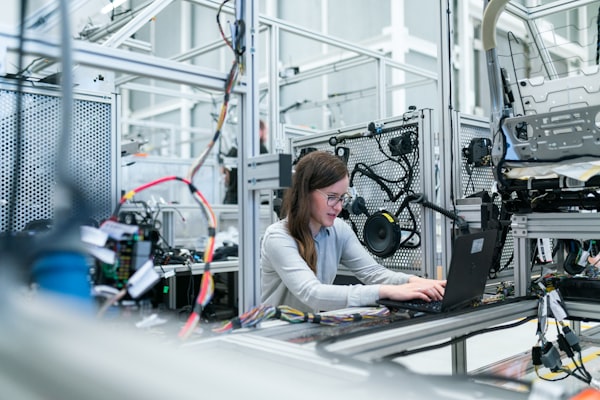 Detailed technical drawings are crucial for precise component integration.
From Concept to Blueprint: Initial Design
With your robot's purpose clearly defined, the next step is to translate those ideas into a tangible design. This doesn't mean jumping straight to CAD software; start with simple sketches, block diagrams, and flowcharts. Visualize how different parts will interact and how information will flow through the system.
Consider the robot's form factor: how big does it need to be? How much weight will it carry? What kind of movement system is best suited for its environment and tasks? This phase is about exploring possibilities and making high-level architectural decisions before diving into specific components.
Microcontrollers: The Efficient Workhorses
Microcontrollers like Arduino are excellent for tasks requiring real-time control, precise timing, and direct interaction with hardware. They are typically low-power, cost-effective, and have a simpler programming model, making them ideal for embedded systems where the robot performs a dedicated function. Think of them as the brain for simple, repetitive, or time-critical actions.
- Pros: Low cost, low power consumption, real-time control, robust for dedicated tasks, large community support.
- Cons: Limited processing power, less memory, no operating system (generally), harder for complex vision/AI.
- Best for: Line-following robots, simple manipulators, sensor data logging, motor control.
Single Board Computers: The Powerful Thinkers
SBCs like Raspberry Pi offer significantly more processing power, memory, and the ability to run a full operating system (like Linux). This makes them suitable for complex tasks such as computer vision, machine learning, network communication, and managing multiple high-level processes simultaneously. They are the go-to for robots requiring advanced intelligence and connectivity.
- Pros: High processing power, ample memory, runs full OS, supports complex software (Python, ROS), excellent for AI/vision.
- Cons: Higher cost, higher power consumption, not always real-time, can be more complex to set up.
- Best for: Autonomous navigation, facial recognition, complex data analysis, web-connected robots.
Hybrid Approaches: Best of Both Worlds
For many advanced robotics projects, a hybrid approach combines the strengths of both. An SBC can handle high-level decision-making, complex algorithms, and communication, while a microcontroller manages low-level, real-time tasks like motor control and reading sensor data directly. This offloads critical timing from the SBC, improving overall system responsiveness and reliability.
- Pros: Combines real-time control with high-level processing, optimized resource allocation, robust system architecture.
- Cons: Increased complexity in communication between boards, higher overall cost.
- Best for: Advanced mobile robots, robotic arms with vision, drones, complex industrial automation.
The Right Parts for the Job: Component Selection
Once you have a conceptual design and have chosen your robot's brain, it's time to select the specific components that will bring it to life. This is where your earlier definitions of purpose, environment, and tasks become critical. Every component choice should directly support these requirements.
Movement System Considerations Checklist
0 of 5 completedMotors: The Muscles of Your Robot
Motors are fundamental for any robot that needs to move or manipulate objects. The type of motor you choose depends on the required torque, speed, precision, and control. Common types include DC motors (simple, continuous rotation), servo motors (precise angular control), and stepper motors (precise positional control).
Ideal for projects requiring precise angular control and moderate lifting capabilities, these servos are a versatile choice for robotic arms and grippers.
Powering Your Vision & Budgeting Smartly
Power is the lifeblood of your robot, and managing your budget is the backbone of your project. Neglecting either can lead to frustrating setbacks.
Sensors: How Your Robot Perceives the World
Sensors are your robot's eyes, ears, and touch. They gather data from the environment, allowing your robot to understand its surroundings and make informed decisions. The choice of sensors is directly tied to your robot's tasks and operating environment. Do you need to detect distance, light, temperature, motion, or something else entirely?
Which sensor type is best for detecting obstacles and measuring distances in varying light conditions?
This board simplifies power distribution and includes voltage regulation, protecting your sensitive components and ensuring stable operation for complex projects.
Bringing It to Life: Prototyping & Testing
With your design finalized and components in hand, the real fun begins: building your prototype. This is an iterative process, meaning you'll build, test, identify issues, refine, and repeat. Don't expect perfection on the first try; embrace the learning curve.
Start with small, manageable sub-systems. Test your motors independently, then your sensors, then integrate them. This modular testing approach helps isolate problems and makes debugging much easier. Remember, a working prototype is more valuable than a perfectly planned but unbuilt robot.
Assemble Core Structure
Begin by assembling the basic chassis or frame of your robot. Ensure it's sturdy and provides adequate mounting points for your chosen components. Use temporary fasteners if you anticipate frequent adjustments. Refer to our first robot assembly guide for tips.
Integrate Movement System
Mount your motors, wheels, tracks, or legs. Connect them to your motor drivers and power supply. Write a simple test program to ensure all movement components function correctly and move in the intended directions. Check for mechanical binding or excessive friction.
Add Sensors & Electronics
Carefully mount and wire your sensors, microcontroller/SBC, and any other electronic modules. Double-check all connections. Write individual test scripts for each sensor to verify it's reading data accurately before integrating them into a larger program.
Initial Programming & Testing
Begin writing the core logic for your robot's intended behavior. Start simple and add complexity incrementally. Conduct thorough tests in your target environment, observing how the robot responds to various inputs and conditions. Document any issues and plan for refinements.
This kit provides a versatile chassis, breadboards, jumper wires, and basic components, perfect for quickly assembling and testing your initial robot designs.
 Rigorous testing ensures your robot performs reliably under various conditions.
Documentation, Refinement, and Safety
As you progress through prototyping, documentation becomes invaluable. Keep a project log, noting design decisions, component choices, code changes, and test results. This helps you track progress, troubleshoot problems, and allows others (or your future self) to understand your work.
Refinement is an ongoing process. Don't be afraid to revisit earlier decisions if new challenges arise. Robotics is about continuous improvement. Finally, always prioritize safety. Working with electronics, moving parts, and power sources requires vigilance.
Good documentation is the unsung hero of any successful project. It allows you to:
- Track Progress: See how far you've come and what challenges you've overcome.
- Troubleshoot Effectively: Quickly pinpoint when a problem was introduced or what changes might have caused it.
- Share & Collaborate: Make it easier for others to understand and contribute to your project.
- Learn from Mistakes: Analyze past decisions and avoid repeating errors in future projects.
- Replicate Success: Documenting successful configurations means you can easily rebuild or expand upon your robot.
Include schematics, code comments, component lists, and a written log of your build process.
Your Project, Your Success
Planning a robot project is a journey filled with learning, problem-solving, and immense satisfaction. By following a structured approach from ideation to iterative prototyping, you'll be better equipped to tackle challenges and bring your robotic vision to life. Remember that every expert was once a beginner, and every successful robot started as an idea.
Don't be discouraged by setbacks; they are an integral part of the learning process. Celebrate small victories, stay curious, and keep building! The world of robotics is constantly evolving, and your contributions, big or small, push the boundaries of what's possible.
Explore More Robotics Guides
Ready to dive deeper into specific aspects of robot building? Check out these related resources:
Where Should Your Robotics Journey Begin?
A comprehensive hub to guide beginners through the exciting world of robotics, from basic concepts to advanced projects.
How Do Robots Work? Understanding Their Essential Parts
Demystify the core components of any robot, from actuators to sensors, and learn how they all fit together.
Ready to Code Your Robot? A Beginner's Programming Intro
Get started with the fundamentals of robot programming, understanding logic, control flow, and basic coding principles.