

What Will You Discover Here?
Your Ideal Starting Point
Uncover the best entry points into robotics based on your interests, goals, and current skill level. No prior experience needed!
Key Robotics Concepts
Get a clear, jargon-free understanding of what makes a robot tick, from its brain to its motors and sensors.
Practical Next Steps
Receive actionable advice and resources to move from curiosity to your first successful robot project, whether you build or buy.
Connect to the Community
Learn how to find support, share your creations, and grow your skills within the vibrant world of robotics enthusiasts.
 Robotics is about bringing ideas to life, one component at a time.
Why Embark on a Robotics Journey?
Robotics isn't just for scientists in labs anymore; it's a fascinating field accessible to everyone, from curious beginners to seasoned engineers. Whether you dream of building a smart home assistant, a competitive battle bot, or simply understanding how automated systems work, the journey into robotics offers unparalleled opportunities for learning, creativity, and problem-solving.
It's a hands-on discipline that blends engineering, programming, and design, giving you tangible results you can see and interact with. The skills you gain are highly transferable, opening doors to various tech careers or simply enriching your personal projects.
At its core, a robot is a machine designed to carry out a complex series of actions automatically, especially one programmable by computer. It typically consists of a mechanical structure, a power source, a control system (the 'brain'), and sensors to perceive its environment. Unlike simple machines, robots can often adapt to changing conditions and perform tasks with a degree of autonomy. Think beyond the humanoid; a robotic vacuum cleaner or an industrial arm on an assembly line are equally valid examples of robots.
What's Your Robotics Ambition?
Before you pick up a screwdriver or write a line of code, it's helpful to consider what you hope to achieve. Your goals will largely dictate the type of robot, components, and learning path that's best for you. Are you looking to learn, create, compete, or innovate?
What's your primary goal for getting into robotics?
Excellent for Learning & Education!
If your goal is to understand fundamental STEM principles, develop problem-solving skills, or teach others, then educational robot kits are your best bet. They often come with guided lessons, clear instructions, and a supportive curriculum. You'll learn about mechanics, electronics, and programming in a structured, engaging way.
Recommended Next Step: Explore Comparing STEM Robot Kits or dive into A Beginner's Programming Intro.
This kit is designed specifically for beginners, offering a comprehensive introduction to coding, electronics, and mechanical assembly with clear, step-by-step projects.
Perfect for Fun & Hobby Projects!
For those who love tinkering, creating unique gadgets, or just having a cool robot to show off, hobby robotics offers immense freedom. You might start with a simple mobile robot, a robotic arm, or even something artistic. The focus here is on personal satisfaction and exploring your creativity without strict rules.
Recommended Next Step: Check out Which Robot is Right for Your First Project? or learn about Understanding Essential Robot Parts.
Ideal for Innovation & Prototyping!
If you're looking to develop new solutions, test out advanced concepts, or build a proof-of-concept for a larger idea, then prototyping is your path. This often involves more complex microcontrollers, a wider array of sensors, and custom fabrication. You'll be pushing boundaries and solving real-world problems.
Recommended Next Step: Dive into Arduino vs. Raspberry Pi: Which Brain for Your Robot? or explore Which Sensor Does Your Robot Need?.
Ready for Competition & Challenge!
Competitive robotics is an exhilarating way to apply your skills under pressure. Whether it's sumo bots, line followers, or complex task-oriented challenges, competitions push you to optimize design, programming, and strategy. It's a fantastic way to learn from others and showcase your abilities.
Recommended Next Step: Start with Planning Your Robot Project, focusing on robust design and efficient coding.
Quick Look: Common Robotics Paths
To help you visualize the different avenues, here's a quick comparison of common robotics journeys and what they typically entail:
| Aspect | STEM Education | Hobby & DIY | Prototyping & Innovation | Competition |
|---|---|---|---|---|
| Primary Goal | Learning concepts, skill development | Personal enjoyment, creative expression | Solving problems, developing new tech | Winning, strategic design, performance |
| Typical Projects | Guided kits, simple mobile robots | Custom robots, home automation, art bots | Proof-of-concept devices, specialized tools | Battle bots, line followers, task-oriented robots |
| Key Skills Gained | Foundational coding, electronics, mechanics | Creative problem-solving, integration, fabrication | Advanced programming, sensor integration, system design | Optimization, rapid iteration, teamwork, strategy |
| Common Tools/Platforms | Arduino, micro:bit, pre-built kits | Arduino, Raspberry Pi, custom PCBs, 3D printing | Raspberry Pi, ESP32, advanced sensors, CAD software | Custom builds, robust motors, specialized controllers |
| Time Commitment | Moderate, structured lessons | Flexible, project-dependent | High, iterative development | High, especially leading up to events |
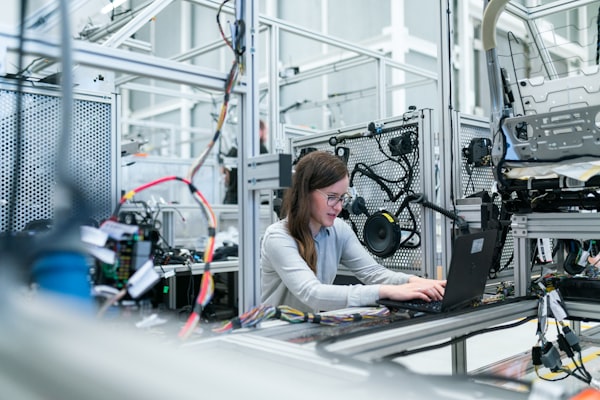 The intricate dance of components brings a robot to life.
Understanding the Core Trio: Brains, Muscles, & Senses
No matter your robotics path, every robot shares fundamental building blocks. Think of them as the core trio: the brain, the muscles, and the senses. Understanding these essential parts is crucial for any aspiring robot builder. They work together to allow a robot to perceive, think, and act.
If you want to dive deeper into each component, we have a comprehensive guide: How Do Robots Work? Understanding Their Essential Parts.
Microcontrollers: The Robot's Command Center
This is where your robot's intelligence resides. Microcontrollers like Arduino or Raspberry Pi process information, execute your code, and send commands to other components. They are essentially tiny computers designed for controlling electronic devices. Choosing the right one depends on the complexity of your project and your programming comfort level.
For simple tasks and beginners, Arduino is often recommended due to its ease of use and vast community support. For more complex projects requiring operating systems, networking, or advanced processing, a Raspberry Pi might be a better fit. Learn more in our Arduino vs. Raspberry Pi guide.
Motors & Actuators: Giving Your Robot Movement
Motors are the 'muscles' that allow your robot to move, grasp, or manipulate its environment. There are various types, including DC motors for continuous rotation, servo motors for precise angular movement, and stepper motors for exact positioning. Actuators are broader terms for devices that convert energy into motion, which can include motors, but also hydraulic or pneumatic systems.
Selecting the right motor involves considering factors like torque, speed, and power requirements. A small hobby robot might use simple DC motors, while a robotic arm would require powerful servo motors. Our How Do Servo Motors Actually Work? guide is a great place to start.
Sensors: How Your Robot Perceives the World
Just like humans use eyes, ears, and touch, robots use sensors to gather information about their surroundings. These can range from simple switches and infrared distance sensors to complex cameras and lidar systems. Sensors provide the data that the microcontroller processes to make decisions and react to its environment.
Common sensors include ultrasonic sensors for distance, line-following sensors, accelerometers for orientation, and light sensors. The type of sensor you need depends entirely on what you want your robot to detect and how it should interact with its world. Explore your options with Which Sensor Does Your Robot Need?
The Growing World of Robotics: Why Now is the Time
The robotics industry is booming, creating incredible opportunities for innovation, career growth, and personal enrichment. There's never been a better time to start your journey.
 Deciding whether to build from scratch or start with a kit is a key early choice.
Build or Buy? Your First Big Decision
One of the earliest choices you'll face is whether to build a robot from individual components or purchase a pre-built kit. Both approaches have their merits, and the best option depends on your learning style, budget, and desired level of involvement.
Buying a kit offers a streamlined experience, often with all necessary parts and instructions included, making it ideal for beginners who want to focus on assembly and programming without the hassle of sourcing individual components. Building from scratch, while more challenging, provides deeper learning about each component's function and allows for greater customization and innovation.
We've put together a detailed guide to help you weigh your options: Should You Build Your Own Robot or Buy a Pre-Built One?
Your Robotics Kickstart Checklist
Ready to take the plunge? Use this interactive checklist to guide your initial steps. Mark them off as you go!
Getting Started Checklist
0 of 5 completedReady to Dive In? Your First Robot Awaits!
With a clearer understanding of your ambitions and the foundational elements of robotics, you're well-equipped to take the next step. Remember, every expert was once a beginner. The most important thing is to start, experiment, and enjoy the process of bringing your ideas to life.
We at iBuyRobotics are here to support you every step of the way, offering high-quality components, comprehensive guides, and a community of fellow enthusiasts.
This all-in-one kit is perfect for beginners, featuring an Arduino-compatible board, multiple sensors, and clear assembly instructions to build your first mobile robot. It's designed to teach core concepts in a fun, engaging way.
Continue Your Robotics Journey
Your adventure in robotics is just beginning. Explore these related guides to deepen your knowledge and find your next project:
Which Robot is Right for Your First Project?
A detailed guide to help you select the perfect robot for your initial build, considering complexity and cost.
Planning Your Robot Project: From Idea to Reality
Learn the essential steps for planning, designing, and executing your robotics projects successfully.
How Do Robots Work? Understanding Their Essential Parts
A deep dive into the individual components that make up any robot, from power sources to sensors.