

What You'll Learn
Sensor Fundamentals
Understand the basic principles behind how different sensors gather information about the world around your robot.
Common Sensor Types
Explore the most popular sensors like ultrasonic, infrared, and touch, and their specific strengths and weaknesses.
Smart Selection
Learn a systematic approach to choosing the ideal sensors based on your robot's purpose and environment.
Integration & Tips
Get practical advice on connecting sensors to your robot's brain and troubleshooting common issues.
 Sensors are the eyes and ears of your robot, providing crucial data.
Why Do Robots Need Sensors Anyway?
Imagine trying to navigate a room blindfolded. That's essentially what a robot without sensors would experience. Sensors are the fundamental components that allow a robot to perceive its environment, gather data, and react intelligently. They transform physical phenomena like distance, light, sound, or touch into electrical signals that your robot's microcontroller can understand and process.
From avoiding obstacles to precisely gripping an object, every meaningful interaction a robot has with the real world relies on accurate sensor data. Choosing the right sensor isn't just about adding a component; it's about giving your robot the specific 'senses' it needs to perform its intended tasks effectively and safely.
Exploring the Most Common Robot Sensors
Let's dive into the workhorses of the robotics world. These are the sensors you'll encounter most frequently in hobby projects, educational kits, and even industrial applications. Understanding their core principles will empower you to make informed decisions.
Ultrasonic Sensors: The Bat's Sonar
Ultrasonic sensors work by emitting a high-frequency sound wave and then listening for the echo. By measuring the time it takes for the sound to travel to an object and bounce back, the sensor can calculate the distance to that object. This principle is similar to how bats navigate in the dark.
Best for: Obstacle avoidance, distance measurement (typically 2cm to 4m), mapping simple environments. They are generally unaffected by ambient light conditions.
- Pros: Reliable distance measurement, works in dark environments, relatively inexpensive.
- Cons: Can be affected by soft, sound-absorbing surfaces; wide beam angle can lead to false positives; slower response time than IR.
A highly popular and cost-effective ultrasonic sensor, perfect for beginner and intermediate projects requiring reliable distance sensing.
Infrared (IR) Sensors: Seeing with Light
Infrared sensors typically consist of an IR LED emitter and an IR phototransistor receiver. The LED sends out infrared light, and if an object is present, the light reflects back to the receiver. The amount of reflected light indicates the presence or absence of an object, and some advanced IR sensors can even estimate distance based on the angle of reflection.
Best for: Line following, close-range obstacle detection (a few centimeters to tens of centimeters), edge detection (e.g., preventing a robot from falling off a table).
- Pros: Fast response time, compact size, good for precise short-range detection.
- Cons: Highly susceptible to ambient light interference (especially sunlight), performance varies with object color and reflectivity (dark objects absorb more IR).
Touch/Bumper Sensors: Feeling the Way
These are perhaps the simplest sensors, acting like a robot's sense of touch. A touch sensor is essentially a switch that changes its state (on/off) when physical pressure is applied. Bumper sensors are often arrays of touch sensors integrated into a robot's chassis, triggering when the robot physically collides with an object.
Best for: Simple obstacle detection (contact-based), button presses, confirming physical contact with an object or surface.
- Pros: Extremely simple to implement, highly reliable for contact detection, very inexpensive.
- Cons: Requires physical contact, provides no information about distance before impact, can be slow to react if not positioned correctly.
Encoders: Knowing Where You're Going
Encoders are crucial for understanding a robot's movement. They attach to motors or wheels and measure rotation. Optical encoders use light to detect patterns on a rotating disk, while magnetic encoders use magnetic fields. By counting pulses or changes in these patterns, the robot can determine how far its wheels have turned, and thus, how far it has traveled or its current speed.
Best for: Precise motor control, odometry (estimating position based on wheel rotation), speed measurement, closed-loop control systems.
- Pros: High accuracy for position and speed, essential for navigation and precise movement.
- Cons: Can be more complex to integrate than simple proximity sensors, mechanical wear can affect accuracy over time.
How Do Different Sensors Measure the World?
While the specific technologies vary, most sensors rely on a few core principles to gather information. Understanding these helps you anticipate their strengths and limitations in different environments.
For instance, active sensors like ultrasonic and some IR distance sensors emit energy (sound or light) and measure the reflection. This gives them control over the signal but can also lead to interference if multiple active sensors are used too close together. Passive sensors, like simple light sensors or some temperature sensors, simply detect existing energy in the environment. They are simpler but rely on external conditions.
The type of output also matters: some sensors provide a simple digital (on/off) signal, while others offer analog values (a range of voltages) that correspond to a measurement, or even complex digital data streams (like I2C or SPI) that require more advanced processing.
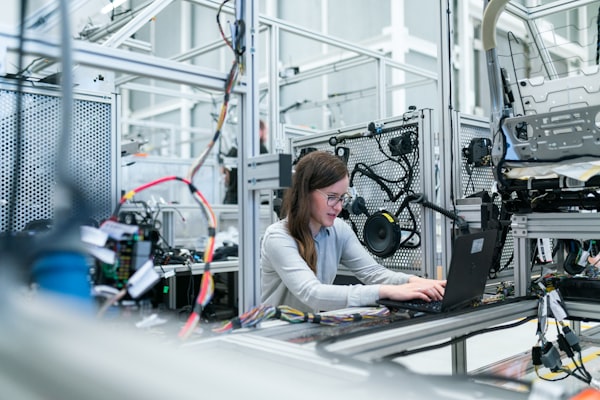 The tiny components on a circuit board enable a sensor to translate the physical world into data.
Ready to Choose? Let's Find Your Perfect Sensor
Selecting the right sensor often comes down to your robot's primary mission. Use this interactive decision flow to narrow down your options based on common robotics goals.
What is your robot's primary goal?
For Obstacle Avoidance:
Consider Ultrasonic sensors for general-purpose detection (10cm - 4m range) or IR proximity sensors for very close-range detection (1-30cm). For a robust solution, combine both! Touch/Bumper sensors are excellent as a fail-safe.
For Precise Distance Measurement:
Ultrasonic sensors offer good general distance measurement. For more precise, short-range (up to ~1.5m) and less beam-spread issues, consider Time-of-Flight (ToF) sensors, which are a more advanced type of IR sensor.
For Line Following:
Infrared (IR) line sensors are ideal. These typically come in arrays to detect the contrast between a dark line and a light surface. They are fast and accurate for this specific task.
For Position Tracking & Movement:
Encoders are essential for knowing how far your wheels have turned and thus estimating your robot's position (odometry). For more advanced 3D orientation and movement, you'll need an IMU (Inertial Measurement Unit), which combines accelerometers and gyroscopes.
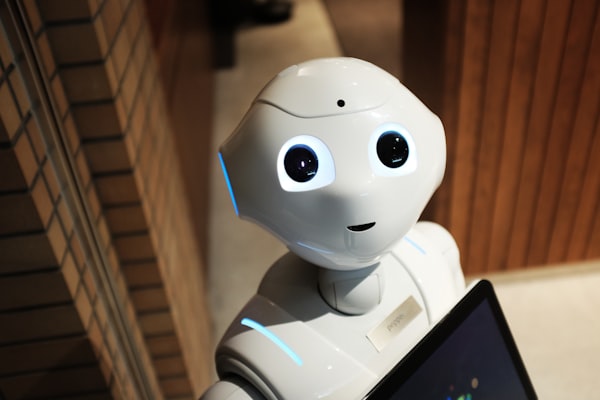 Advanced robotics often integrate multiple sensor types for complex tasks.
Beyond the Basics: Advanced Sensors for Complex Tasks
As your robotics projects grow in complexity, you might find yourself needing more sophisticated ways for your robot to understand its world. Here are a few advanced sensor types that open up new possibilities:
- LiDAR (Light Detection and Ranging): Uses pulsed laser light to measure distances, creating highly accurate 2D or 3D maps of environments. Essential for autonomous navigation and mapping.
- Cameras (Vision Systems): Provide rich visual data, enabling object recognition, facial detection, color tracking, and more. Requires significant processing power.
- IMU (Inertial Measurement Unit): Combines accelerometers, gyroscopes, and sometimes magnetometers to measure orientation, angular velocity, and linear acceleration. Crucial for balancing robots, drones, and precise motion tracking.
- GPS (Global Positioning System): For outdoor robots, GPS provides global coordinates, though accuracy can vary and it's not suitable for indoor navigation.
Integrating these sensors often involves more complex programming and hardware interfaces, but they unlock capabilities that simpler sensors cannot provide.
Your Sensor Integration Checklist
Once you've chosen your sensors, successful integration is key. Use this checklist to ensure you've considered all the important aspects before powering up your robot.
Pre-Integration Checklist
0 of 6 completedSensors in Action: Real-World Impact
"Sensors are the bridge between the robot's digital brain and the unpredictable analog world. Without them, even the most powerful processor is just a fancy calculator."
— Dr. Anya Sharma, Lead Robotics Engineer at iBuyRobotics Labs
Troubleshooting Common Sensor Issues
Even with careful planning, you might encounter issues. Here are some common problems and how to approach them.
Check Power & Wiring: Ensure the sensor is correctly wired to power (VCC, GND) and data pins. Double-check for loose connections or incorrect pin assignments. Use a multimeter to confirm voltage supply.
Correct Code: Verify that your code initializes the sensor correctly and is reading from the right pins. Are you using the correct library functions?
Faulty Sensor: In rare cases, the sensor itself might be defective. Try swapping it with another if you have one.
Environmental Interference: For IR sensors, strong ambient light (especially sunlight) can cause issues. For ultrasonic, soft materials or complex geometries can scatter sound. Try testing in a controlled environment.
Calibration Needed: Many sensors benefit from calibration. For distance sensors, compare readings against known distances. For IMUs, perform a calibration routine.
Noise: Electrical noise from motors or other components can interfere with sensor signals. Ensure proper grounding and consider shielding or filtering if necessary.
Logic Error: The sensor might be providing correct data, but your robot's code isn't interpreting it or acting upon it as intended. Debug your decision-making logic.
Thresholds: Are your sensor thresholds set appropriately? For example, is your 'obstacle detected' distance too close or too far?
Timing: Is your robot reading the sensor data frequently enough? Or too frequently, causing processing bottlenecks?
Connecting Your Sensors to Your Robot's Brain
Once you've selected your sensors, the next critical step is connecting them to your robot's microcontroller – its brain. This involves understanding the sensor's interface and how to wire it correctly to your chosen board.
Most common sensors connect via simple digital or analog pins, or more advanced serial communication protocols like I2C or SPI. For example, an ultrasonic sensor typically needs 4 pins: VCC (power), GND (ground), Trigger (to send a pulse), and Echo (to receive the pulse). An IR line sensor might just need VCC, GND, and a digital output pin.
Choosing the right microcontroller is just as important as choosing the right sensor. Boards like Arduino are excellent for beginners due to their simplicity and vast community support, while Raspberry Pi offers more processing power for complex tasks like computer vision. Learn more about selecting your robot's brain in our guide: Arduino vs. Raspberry Pi: Which Brain for Your Robot?
An excellent choice for integrating a wide range of sensors, offering robust performance, ample I/O pins, and extensive community libraries for easy setup.
Your Robot's Perception Journey Continues
By now, you should have a solid understanding of how different sensors work and how to choose the right ones for your robot. Remember, the best sensor setup often involves a combination of types, leveraging each one's strengths to create a more robust and intelligent robot.
Explore More Robotics Guides
Ready to deepen your understanding of robotics? Check out these related articles to continue building your knowledge and skills.
How Do Robots Work?
Demystify the essential parts of any robot, from actuators to power sources, and see how they all fit together.
Planning Your Robot Project
Turn your robot idea into a reality with our comprehensive guide to project planning, from concept to execution.
Arduino vs. Raspberry Pi
Compare the two most popular robot brains and decide which one is the best fit for your next project.
Further Reading