What You'll Learn About Sensor Signals
Analog Signals Explained
Understand continuous data, like temperature or light intensity, and how it's represented.
Digital Signals Demystified
Grasp discrete ON/OFF states and complex data packets, crucial for precise control.
Robot's Perspective
See how your robot's microcontroller interprets and uses both types of sensor data.
Choosing the Right Sensor
Equip yourself to select the optimal sensor type for your robot's specific tasks and environment.
 Analog signals are like a dimmer switch, offering a smooth range of values.
What Exactly Are Analog Signals?
Imagine a light dimmer switch. You can turn it slightly, halfway, or all the way up. There are countless points in between fully off and fully on. This continuous, smooth range of values is the essence of an analog signal. In robotics, an analog sensor measures a physical quantity (like temperature, light intensity, or distance) and outputs a voltage or current that directly corresponds to that measurement.
The key characteristic is that an analog signal can take on any value within a given range. For example, a temperature sensor might output 0.5V at 20°C, 0.501V at 20.01°C, and so on. This level of detail can be incredibly useful when your robot needs to perceive subtle changes in its environment.
Your robot's brain, the microcontroller, can't directly understand continuous analog voltages. It needs to convert them into discrete numbers it can process. This is where an Analog-to-Digital Converter (ADC) comes in. The ADC takes the analog voltage and samples it at regular intervals, converting each sample into a digital number. The 'resolution' of the ADC (e.g., 10-bit, 12-bit) determines how many distinct values it can represent, directly impacting the precision of your sensor readings. A higher bit count means more precision.
For a deeper dive into how sensors work at a fundamental level, check out our What Exactly Is a Robot Sensor? guide.
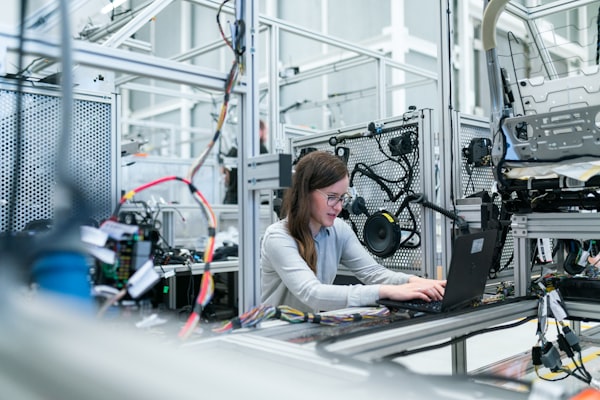 Digital signals are precise, like an ON/OFF switch, representing distinct states.
What Exactly Are Digital Signals?
In contrast to analog's smooth curve, digital signals are like a simple light switch: either ON or OFF, HIGH or LOW, 1 or 0. They represent discrete states. A digital sensor outputs data in distinct, predefined steps. This could be a simple binary signal (like a button press or an obstacle detected by an IR proximity sensor) or a more complex stream of data (like from an encoder or a camera).
Digital signals are inherently less susceptible to noise and interference than analog signals because they only need to distinguish between two primary states. This makes them very robust for transmitting data over longer distances or in noisy environments. Many modern sensors, even those measuring analog phenomena, convert their readings into a digital format internally before sending them to your robot's microcontroller.
Which of these is most likely to be a purely digital sensor output?
How Do Robots "Read" These Signals?
Understanding how your robot's microcontroller interacts with these signals is crucial for proper wiring and programming. For analog sensors, microcontrollers like those on an Arduino board have dedicated Analog Input pins. These pins are connected to an internal ADC that performs the conversion we discussed earlier. You'll typically use functions like analogRead() in your code to get a numerical value.
Digital sensors, on the other hand, connect to General Purpose Input/Output (GPIO) pins. These pins can be configured as either inputs or outputs. When configured as an input, the microcontroller simply checks if the voltage on that pin is above a certain threshold (read as HIGH or 1) or below another threshold (read as LOW or 0). Functions like digitalRead() are used for this. Some digital sensors communicate using more complex protocols like I2C or SPI, which still use GPIO pins but involve specific timing and data packet structures.
Analog vs. Digital: A Quick Comparison
Let's break down the key differences and when each type shines. This isn't always a clear-cut choice, as many modern sensors bridge the gap, but understanding the core principles helps.
Analog Sensor Characteristics
Analog sensors provide a continuous range of values, offering high resolution for subtle measurements. They are often simpler to interface with basic microcontrollers (just a voltage reading) but can be more susceptible to electrical noise. Calibration might be needed to map voltage readings to real-world units accurately.
Simple Digital Sensor Characteristics
These sensors output a clear ON/OFF or HIGH/LOW signal. They are excellent for detecting states: is a door open or closed? Is an obstacle present? They are very robust against noise and require minimal processing from the microcontroller. Examples include simple push buttons, limit switches, or basic IR proximity sensors.
Complex Digital Sensor Characteristics
These sensors also output digital data, but it's often a stream of bytes representing more intricate measurements (e.g., precise distance, IMU data, camera images). They use communication protocols like I2C, SPI, or UART. While requiring more complex code to parse the data, they offer high accuracy, often include internal processing, and can sometimes connect multiple sensors to the same bus, saving pins.
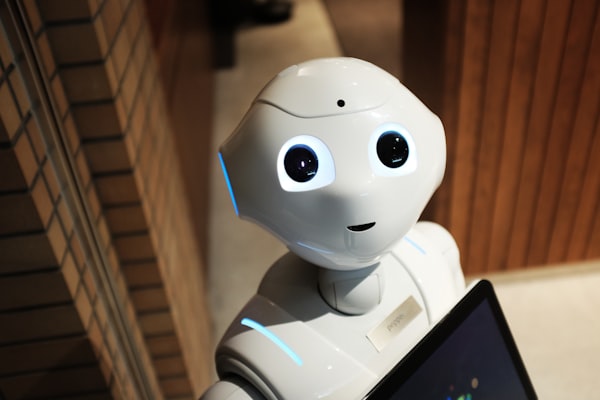 Analog sensors excel when your robot needs to perceive subtle changes, like pressure or light.
When Should I Choose Analog Sensors?
Analog sensors are your go-to choice when your robot needs to measure a continuous range of values with fine granularity. Think about applications where subtle changes are important, not just an ON/OFF state. For instance, if your robot needs to precisely control the speed of a motor based on a potentiometer's position, or adjust its behavior based on the exact ambient light level, an analog sensor is ideal.
Common scenarios for analog sensors include:
- Light Intensity: Photoresistors (LDRs) provide a resistance that changes continuously with light.
- Temperature: Thermistors or analog temperature sensors output a voltage proportional to temperature.
- Distance (basic): Some ultrasonic or IR distance sensors provide an analog voltage output that varies with distance.
- Force/Pressure: Force-sensitive resistors (FSRs) change resistance based on applied pressure.
- Potentiometers: Used for user input, position sensing, or tuning parameters.
Perfect for projects requiring precise temperature monitoring, outputting a voltage directly proportional to Celsius temperature for easy microcontroller integration.
 Digital sensors are excellent for clear state detection and complex data communication.
When Should I Choose Digital Sensors?
Digital sensors are preferred when you need clear, unambiguous states or when the sensor itself performs complex measurements and processing. For tasks like obstacle avoidance (is there an obstacle or not?), line following (is the robot on the line or off?), or precise motor control (how many rotations has the wheel made?), digital sensors provide reliable, noise-resistant data.
Common scenarios for digital sensors include:
- Obstacle Detection: IR proximity sensors (digital output) or ultrasonic sensors (often digital pulse output).
- Line Following: Digital line sensors that output HIGH/LOW based on line detection.
- Motor Encoders: Provide digital pulses to measure rotation and speed.
- IMUs (Inertial Measurement Units): Accelerometers, gyroscopes, and magnetometers often communicate via I2C or SPI.
- Buttons/Switches: Simple ON/OFF inputs.
Ideal for basic obstacle detection, providing a clear HIGH/LOW signal when an object is within its adjustable range, simplifying robot navigation.
Making Your Decision: A Step-by-Step Guide
Still unsure? Use this interactive guide to help narrow down your sensor choice based on your project's primary needs.
What kind of information does your robot need to gather?
Consider Analog Sensors
For continuous data, analog sensors are often the most direct solution. They provide the raw, granular information your robot needs to make nuanced decisions. Be mindful of noise and ensure your microcontroller's ADC has sufficient resolution for your application.
Example: A robot adjusting fan speed based on room temperature.
Opt for Simple Digital Sensors
When a clear, unambiguous state is all you need, simple digital sensors are robust and easy to implement. They simplify your code and reduce the chances of misinterpretation due to noise.
Example: A robot stopping when it bumps into a wall.
Look for Complex Digital Sensors
For advanced perception, sensors with built-in ADCs and digital communication protocols (I2C, SPI) are usually superior. They handle much of the data processing, delivering clean, accurate information. While requiring more complex communication code, the data quality is often worth it.
Example: A drone maintaining stable flight using an IMU.
Key Considerations for Your Robot
Beyond the basic signal type, keep these factors in mind when selecting sensors:
The Future is Hybrid: Advanced Sensors
It's important to note that the line between analog and digital sensors is often blurred in modern robotics. Many sensors that measure analog phenomena (like temperature or acceleration) now include an internal Analog-to-Digital Converter (ADC) and output their data digitally via protocols like I2C or SPI. This offers the best of both worlds: the precision of analog measurement combined with the noise immunity and data integrity of digital communication.
When you encounter such sensors, you'll still be dealing with digital signals from your microcontroller's perspective, but the underlying measurement is inherently analog. Understanding how to process this digital data effectively is key to unlocking the full potential of these advanced components. For more on handling sensor outputs, explore our Making Sense of Sensor Data: A Beginner's Processing Tutorial.
Why Understanding Sensor Signals Matters
Your Sensor Selection Checklist
Use this checklist to confirm you've considered all the critical aspects before finalizing your sensor choice.
Sensor Type Decision Points
0 of 5 completedContinue Your Robotics Learning Journey
Ready to dive deeper into the world of robot perception? Explore these related guides and tutorials:
Further Reading