What You'll Learn About Robot Touch
The Fundamentals of Robot Touch
Understand why a robot needs to 'feel' its environment and the core principles behind tactile sensing.
Force-Sensing Resistors (FSRs)
Explore the simplest and most common touch sensors, how they work, and their practical applications.
Load Cells & Strain Gauges
Dive into precision force measurement, essential for tasks requiring high accuracy and weight detection.
Tactile Arrays & Robot Skin
Discover how advanced arrays provide robots with a sense of 'skin' for complex object manipulation.
 Robots use force and touch sensors to interact safely and precisely with their environment.
Why Does a Robot Need to "Feel" Its Environment?
Imagine trying to pick up a glass of water without feeling its weight or the pressure you're applying. You'd likely either drop it or crush it. For robots, the challenge is similar. Without a sense of touch or force, their interactions with the physical world would be clumsy, inefficient, and potentially destructive.
Force and touch sensors provide crucial feedback, allowing robots to detect contact, measure pressure, and even discern textures. This capability is fundamental for tasks ranging from delicate assembly to safe human-robot collaboration, transforming robots from rigid machines into adaptable, responsive partners.
Haptics is the science of applying touch (tactile) and motion (kinesthetic) feedback to users. In robotics, it refers to the robot's ability to sense and respond to physical interaction. This goes beyond simple contact detection, encompassing the nuances of pressure, texture, and even temperature, enabling more sophisticated and human-like manipulation. Advanced haptic feedback systems can even allow human operators to 'feel' what the robot is touching remotely.
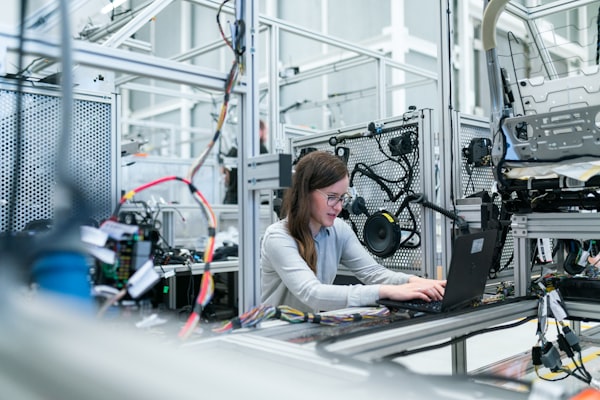 A typical FSR changes its resistance based on applied pressure.
What Are Force-Sensing Resistors (FSRs)? The Basic Touch
Force-Sensing Resistors, or FSRs, are perhaps the most straightforward and cost-effective way to give your robot a sense of touch. They are essentially a variable resistor whose resistance decreases as the force applied to its surface increases. Think of them as a simple switch that also tells you *how hard* it's being pressed.
FSRs are typically made from a polymer film with a conductive ink layer. When pressure is applied, the conductive particles in the ink come closer together, reducing the material's electrical resistance. This change in resistance can be easily measured with a microcontroller, providing a direct indication of the applied force.
What happens to an FSR's resistance when more force is applied?
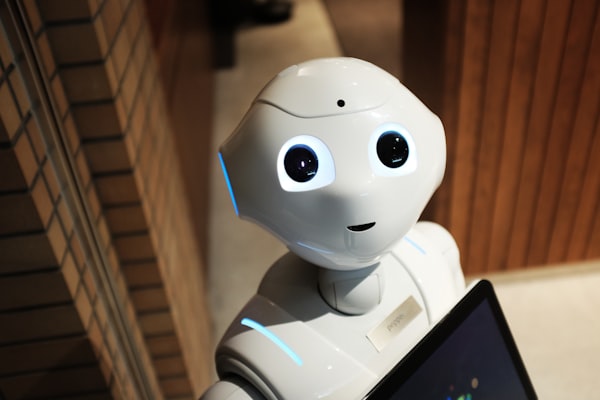 Load cells provide highly accurate force and weight measurements for industrial applications.
How Do Load Cells Offer Precision Force Measurement?
When your robot needs to know the exact weight of an object or apply a precise amount of force, a simple FSR won't cut it. This is where load cells come into play. Load cells are transducers that convert force into an electrical signal, typically using strain gauges. A strain gauge is a small, resistive sensor whose resistance changes when it is stretched or compressed.
Inside a load cell, multiple strain gauges are arranged in a Wheatstone bridge configuration. When force is applied, the load cell deforms slightly, causing the strain gauges to stretch or compress. This changes their resistance, unbalancing the bridge and producing a measurable voltage output proportional to the applied force. This setup allows for extremely accurate and repeatable measurements, often with resolutions down to fractions of a gram.
Common types include single-point load cells (for platforms), S-type load cells (for tension/compression), and beam load cells. Each is designed for specific applications, offering robust and reliable performance in demanding environments.
Ideal for projects requiring accurate tension and compression force measurement, perfect for robotic grippers or small weighing systems.
 Tactile array sensors give robots a 'skin' for detailed object recognition and manipulation.
What Are Tactile Arrays? Giving Robots a Sense of "Skin"
While FSRs and load cells provide single-point or distributed force data, tactile arrays take robot touch to the next level. Imagine a grid of hundreds or thousands of tiny force sensors, all working together to create a high-resolution 'map' of pressure across a surface. This is essentially what a tactile array, often referred to as 'robot skin,' achieves.
These arrays can detect not just the presence of an object, but its shape, texture, and how pressure is distributed across its surface. This capability is critical for dexterous manipulation, allowing robots to grasp irregular objects, detect slippage, and even perform tasks like peeling fruit or handling delicate biological samples without damage. They often utilize technologies like piezoresistive, capacitive, or optical sensing elements.
The data from tactile arrays is complex and requires sophisticated processing, often involving machine learning algorithms, to interpret meaningful patterns. This is where the robot truly begins to 'understand' what it's touching. Learn more about processing complex sensor data in our Sensor Data Processing Tutorial.
Force-Sensing Resistors (FSRs)
Best For: Simple contact detection, relative pressure sensing, low-cost projects, button-like interfaces.
- Principle: Resistance changes with pressure.
- Accuracy: Low to moderate.
- Cost: Very low.
- Complexity: Low integration.
- Example: Detecting if a gripper has closed on an object.
Load Cells
Best For: High-precision weight measurement, exact force application, industrial scales, material testing.
- Principle: Strain gauges deform, changing resistance in a Wheatstone bridge.
- Accuracy: High to very high.
- Cost: Moderate to high.
- Complexity: Moderate integration (requires amplifier).
- Example: Weighing ingredients in an automated food production line.
Tactile Arrays
Best For: Detailed object recognition, slip detection, dexterous manipulation, human-robot interaction.
- Principle: Grid of micro-sensors (piezoresistive, capacitive, optical) mapping pressure.
- Accuracy: High resolution, complex data.
- Cost: High.
- Complexity: High integration (requires advanced processing).
- Example: A robot hand gently grasping an egg without breaking it.
Choosing the Right Sensor: A Decision Framework
Selecting the perfect force or touch sensor depends heavily on your robot's specific task and environment. Consider these factors to guide your choice:
What's your primary need for robot touch?
Consider Force-Sensing Resistors (FSRs)
FSRs are perfect for detecting if an object is present, if a button is pressed, or for basic grip sensing. They are affordable and easy to integrate into most hobby or entry-level industrial projects. Look for models with appropriate sensing area and sensitivity for your application.
A versatile and durable FSR, ideal for basic contact sensing in grippers, robot feet, or interactive surfaces.
Consider Load Cells
For applications requiring exact force or weight measurements, such as automated weighing, force feedback control, or material testing, load cells are the superior choice. Pair them with an appropriate amplifier and ADC for optimal performance. Explore our Sensor Selection Calculator for specific recommendations.
Consider Tactile Arrays
If your robot needs to understand object shape, texture, or prevent slippage during complex manipulation, tactile arrays are the way to go. Be prepared for higher costs and more complex data processing, but the capabilities they unlock are unparalleled for advanced robotics.
An advanced kit for researchers and developers looking to integrate sophisticated, high-resolution touch sensing into robotic hands or surfaces.
Real-World Applications: Where Robot Touch Matters Most
The ability to 'feel' is not just a theoretical concept; it's a critical component in many cutting-edge robotic applications today. From manufacturing floors to surgical suites, force and touch sensors are enabling robots to perform tasks with unprecedented dexterity and safety.
 The future of robot touch involves soft robotics and advanced material integration.
What Does the Future Hold for Robot Touch?
The field of robot touch is rapidly evolving. Researchers are exploring new materials and designs to create even more sensitive, durable, and versatile sensors. Soft robotics, for instance, is developing robots made from flexible materials that can inherently sense deformation and contact without discrete sensors.
Integration with artificial intelligence and machine learning is also pushing boundaries. Robots are learning to interpret complex tactile data, allowing them to identify objects by touch alone, much like humans do. Imagine a robot sorting recycled materials by feeling their texture and rigidity, or a domestic robot handling delicate items with human-like care. These advancements promise a future where robots interact with our world with unprecedented finesse and understanding.
Key Takeaways & Next Steps
Explore More Robot Senses
Understanding force and touch is just one piece of the puzzle. Dive deeper into how robots perceive their world with these related guides:
Unlock Your Robot's Senses
Start your journey into robot perception with our comprehensive hub page.
Read More →How Do Robots See Obstacles?
Explore distance sensors like ultrasonic, IR, and LiDAR for navigation.
Read More →Making Sense of Sensor Data
Learn the basics of processing and interpreting data from your robot's sensors.
Read More →Further Reading