What You'll Discover About Robot Vision
Basic Light Detection
Understand how simple sensors like photoresistors and photodiodes allow robots to perceive ambient light levels and react to changes in brightness.
Accurate Color Recognition
Explore how color sensors break down light into its primary components, enabling robots to identify specific colors for tasks like line following or object sorting.
Advanced Camera Vision
Delve into the world of robot cameras, from basic image capture to sophisticated computer vision algorithms that interpret complex visual data.
Real-World Applications
See how visual perception is crucial for navigation, object manipulation, quality control, and human-robot interaction in various robotic systems.
 Photoresistors change resistance based on light intensity, a simple way for robots to detect brightness.
How Do Robots First "See" Light?
Before a robot can recognize a face or navigate a room, it often starts with the most basic form of visual perception: detecting light. This is achieved using simple light sensors that react to the presence or intensity of light. Think of them as the robot's rudimentary eyes, capable of telling if it's bright or dark, or if a light source is present.
Common types include photoresistors (also known as Light Dependent Resistors or LDRs), photodiodes, and phototransistors. Photoresistors change their electrical resistance based on the amount of light hitting them – more light means less resistance. Photodiodes and phototransistors, on the other hand, generate a current proportional to the light intensity. These simple components are fundamental for tasks like automatic lighting, detecting shadows, or even basic obstacle avoidance by sensing changes in reflected light.
A photoresistor's resistance decreases as light intensity increases. When connected in a voltage divider circuit, this change in resistance translates to a change in voltage, which your robot's microcontroller can read. This analog signal can then be converted to a digital value, allowing the robot to quantify the brightness it's experiencing. It's a simple yet effective way to get a basic sense of light in the environment.
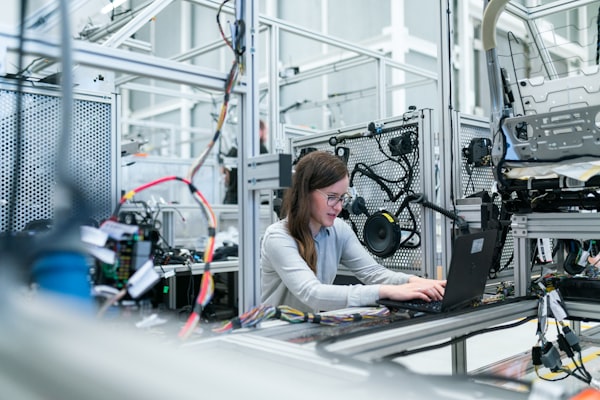 Color sensors are vital for tasks requiring object identification and sorting based on hue.
How Do Robots Distinguish Between Colors?
Moving beyond just light or dark, color sensors give robots the ability to differentiate between various hues. These sensors typically work by emitting a white light and then measuring the intensity of the reflected red, green, and blue (RGB) components. By analyzing the ratios of these primary colors, the sensor can determine the color of the surface it's pointed at.
For example, a robot following a black line on a white floor uses a color sensor (or often, an array of IR sensors that detect light/dark contrast, which is a simpler form of 'color' detection for this specific task). The sensor detects the stark difference in reflected light between the line and the background, allowing the robot to adjust its movement to stay on track. This capability is crucial for many industrial sorting applications, educational robots, and even advanced navigation where color markers are used. Learn more about this in our How to Build a Line-Following Robot Guide.
What is the primary method a typical color sensor uses to identify a color?
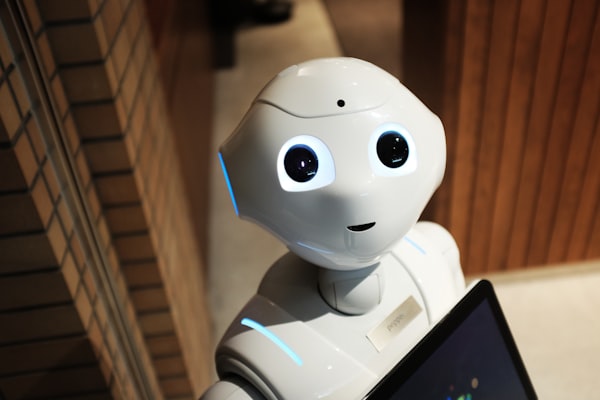 Robot cameras capture detailed visual information, forming the basis for complex computer vision tasks.
When Do Robots Need a Camera, Not Just a Sensor?
While light and color sensors are great for specific, simple tasks, robots need cameras to truly "see" and understand their environment in a human-like way. Cameras provide a rich stream of visual data – images and video – that can be processed to identify objects, recognize patterns, read text, and even map out entire spaces. This is where the field of computer vision comes into play.
Robot cameras come in various forms, from simple webcams to high-resolution industrial cameras. Key considerations include resolution (how many pixels), frame rate (how many images per second), and sensor type (CCD or CMOS). These factors directly impact the quality and quantity of visual data available for processing, which in turn affects the robot's ability to perform complex visual tasks accurately and quickly.
Charge-Coupled Device (CCD) Cameras
CCD sensors are known for their high image quality, low noise, and excellent light sensitivity. They capture light by converting photons into electrical charges, which are then transferred pixel by pixel to an analog-to-digital converter. This sequential readout process can be slower but results in very uniform and high-fidelity images, making them ideal for scientific imaging, astrophotography, and high-end industrial applications where image quality is paramount.
Key Characteristics: High image quality, low noise, good for low light, higher power consumption, generally more expensive.
Complementary Metal-Oxide-Semiconductor (CMOS) Cameras
CMOS sensors integrate the analog-to-digital conversion directly onto each pixel, allowing for faster readout speeds and lower power consumption. While historically they had lower image quality than CCDs, modern CMOS sensors have significantly closed the gap and often surpass CCDs in many aspects. Their speed and efficiency make them prevalent in consumer electronics, smartphones, and most robotics applications where real-time processing and battery life are critical.
Key Characteristics: High speed, low power, cost-effective, good for real-time applications, widely available.
 Computer vision algorithms analyze raw camera data to identify objects, track movement, and understand scenes.
How Do Robots Make Sense of Camera Images?
Capturing an image is just the first step; the real magic happens in computer vision. This field involves teaching computers to interpret and understand the visual world. For robots, this means processing raw pixel data from a camera into meaningful information. Techniques range from simple edge detection and color segmentation to complex machine learning models for object recognition and semantic segmentation.
For instance, an autonomous delivery robot uses computer vision to identify traffic lights, pedestrians, and road signs. A robotic arm in a factory might use it to locate and pick up specific components from a bin, even if they're oriented differently each time. This processing often requires significant computational power and specialized algorithms, often leveraging libraries like OpenCV. Understanding how to process this data is key, as explored in our Making Sense of Sensor Data Tutorial.
An excellent, cost-effective camera for hobbyist and educational robots, offering good resolution and easy integration with popular microcontrollers for computer vision projects.
Why Advanced Visual Perception is a Game Changer
Choosing the Right Visual Sensor for Your Robot
Selecting the perfect visual sensor depends entirely on your robot's mission. Do you need to simply detect light, identify specific colors, or understand complex scenes? Here's a quick overview to help you decide:
| Sensor Type | Primary Function | Typical Use Cases | Complexity | Cost Range |
|---|---|---|---|---|
| Photoresistor/Photodiode | Detect light presence/intensity | Ambient light sensing, simple obstacle detection, dark/light following | Low | Very Low |
| Color Sensor (RGB) | Identify specific colors | Line following, object sorting, color-coded navigation | Medium | Low to Medium |
| Basic Camera Module | Capture images/video | Simple object detection, basic navigation, remote monitoring | Medium | Medium |
| Advanced Camera (e.g., Depth/Stereo) | Perceive depth, 3D mapping, complex object recognition | Autonomous navigation, human-robot interaction, precise manipulation | High | Medium to High |
What's the primary visual task for your robot?
Consider Photoresistors or Photodiodes
For simple light detection, these are cost-effective and easy to integrate. They're perfect for basic ambient light sensing, detecting shadows, or simple line following with high contrast.
Go for a Dedicated Color Sensor
An RGB color sensor will give your robot the ability to differentiate between various hues, essential for tasks like sorting colored items, advanced line following, or reacting to color-coded signals.
You'll Need a Camera Module with Computer Vision
A camera combined with computer vision software (like OpenCV) is necessary for recognizing specific objects, reading text, or identifying complex patterns. Start with a basic camera module and build your software stack.
Explore Depth Cameras or Stereo Vision Systems
For understanding the 3D layout of an environment, measuring distances, and avoiding complex obstacles, depth cameras (like Intel RealSense) or stereo camera setups are your best bet. These provide crucial spatial data.
 Depth cameras provide crucial 3D information, allowing robots to perceive the world in three dimensions.
What About Seeing in 3D? Depth and Advanced Perception
For truly sophisticated robots, simply seeing in 2D isn't enough. They need to understand depth, distance, and the three-dimensional structure of their environment. This is where advanced visual perception systems come into play. Stereo vision, which mimics human binocular vision using two cameras, allows robots to calculate depth by comparing the slight differences between the two images.
Other technologies like structured light sensors project a known pattern onto a scene and analyze its deformation to create a 3D map. LiDAR (Light Detection and Ranging) uses pulsed lasers to measure distances, generating highly accurate point clouds of the environment. These advanced sensors are critical for autonomous navigation, precise object manipulation in unstructured environments, and complex human-robot interaction. Dive deeper into these technologies in our upcoming guide on Advanced Robot Perception.
An industry-leading depth camera providing high-resolution depth data, RGB video, and an IMU, perfect for advanced robotics projects requiring 3D perception and simultaneous localization and mapping (SLAM).
Ready to Build a Robot That Sees?
Understanding how robots interpret the world visually is a crucial step in building more autonomous and intelligent machines. Whether you're starting with basic light detection or diving into advanced computer vision, the right sensors and processing techniques will unlock incredible capabilities for your robotic projects.
Return to the main Sensors Hub for a broader overview of all robot perception types.
Go to Sensors Hub → Find Your Perfect SensorUse our interactive tool to match the right sensor to your specific robot project needs.
Use the Calculator → Obstacle Avoidance ComparisonCompare different sensor types for effective obstacle detection and navigation.
See Comparison →Further Reading