What You'll Learn in This Tutorial
Acquire Raw Sensor Data
Understand how to connect common sensors to your microcontroller and read their raw output, forming the foundation of your robot's perception.
Filter Out Noise & Errors
Discover simple yet effective techniques like averaging and median filtering to clean up noisy sensor readings, making your data more reliable.
Interpret Data for Action
Learn how to translate processed sensor values into meaningful decisions and actions for your robot, from obstacle detection to line following.
Build More Reliable Robots
Apply these fundamental data processing skills to enhance your robot's autonomy, accuracy, and overall performance in real-world scenarios.
 Raw sensor data often contains fluctuations that need to be smoothed out.
Why Does Raw Sensor Data Need Processing?
Imagine trying to understand a conversation in a very noisy room. You'd miss words, misinterpret phrases, and struggle to grasp the full meaning. Raw sensor data is often like that noisy room. Sensors, while incredibly useful, don't always provide a perfectly clean, accurate stream of information.
Factors like electrical interference, environmental changes (temperature, light), mechanical vibrations, and even the sensor's own limitations can introduce 'noise' or errors into the readings. If your robot acts directly on this raw, noisy data, its behavior can become erratic, unreliable, or even dangerous.
In robotics, 'noise' refers to unwanted random fluctuations or disturbances in a sensor's output signal. It's the difference between the actual physical quantity being measured and the value reported by the sensor. This can manifest as tiny, rapid changes in a stable reading, or sudden, inexplicable spikes or drops. Effectively, it's anything that obscures the true information you're trying to gather from the environment.
The Sensor Data Processing Pipeline: A Four-Step Journey
To turn raw sensor readings into intelligent robot actions, we typically follow a structured pipeline. Think of it as a journey your data takes from the physical world to your robot's decision-making unit.
Step 1: Acquiring Data – Your Robot's First 'Sense'
Before you can process data, you need to get it from the sensor into your robot's brain (the microcontroller). Most common sensors output either an analog voltage or a digital signal. Understanding the difference is crucial for proper wiring and coding. If you need a refresher, check out our guide on Analog vs. Digital Sensors: What's the Difference for My Robot?
For this tutorial, we'll use a simple analog sensor: a potentiometer. It's essentially a variable resistor that changes its resistance (and thus the voltage it outputs) as you turn a knob. This makes it a great stand-in for many other analog sensors like light sensors (photoresistors) or simple distance sensors.
Connect Your Potentiometer
For an Arduino-compatible board, connect the potentiometer as follows:
- One outer pin to GND (Ground)
- The other outer pin to 5V (or 3.3V, depending on your board)
- The middle pin (wiper) to an Analog Input Pin (e.g., A0)
This setup allows the potentiometer to act as a voltage divider, providing a variable voltage to the analog input pin as you turn the knob.
 A typical setup for connecting a potentiometer to an Arduino.
Write the Acquisition Code
Open your Arduino IDE (or similar environment) and enter this simple code. This will read the analog value and print it to the Serial Monitor.
const int potPin = A0; // Analog pin connected to potentiometer

void setup() {
  Serial.begin(9600); // Initialize serial communication at 9600 baud
}

void loop() {
  int sensorValue = analogRead(potPin); // Read the analog value from A0
  Serial.print("Raw Sensor Value: ");
  Serial.println(sensorValue); // Print the raw value
  delay(100); // Wait for 100 milliseconds before the next reading
}
This code continuously reads the voltage on pin A0, which will be an integer between 0 (0V) and 1023 (5V), assuming a 10-bit Analog-to-Digital Converter (ADC).
Observe Raw Data
Upload the code to your board. Open the Serial Monitor (usually found under Tools > Serial Monitor in Arduino IDE). Now, turn the potentiometer knob. You should see a stream of numbers changing as you rotate it. Even if you hold the knob perfectly still, you might notice slight fluctuations – that's the raw noise we're talking about!
This raw data is the starting point. Our next step is to make it more stable and reliable.
 Averaging helps smooth out rapid fluctuations in sensor data.
Step 2: Filtering the Noise – Making Data Reliable
Now that we can acquire data, let's tackle the noise. Filtering is the process of removing unwanted components from a signal. For beginners, two common and effective digital filters are the Simple Moving Average and the Median Filter.
Simple Moving Average Filter
This filter works by taking a specified number of recent readings and calculating their average. As new data comes in, the oldest data point is dropped, and the new one is added. This effectively smooths out rapid fluctuations.
// Example: Simple Moving Average Filter
const int numReadings = 10; // Number of readings to average
int readings[numReadings];  // Array to store readings
int readIndex = 0;          // The index of the current reading
long total = 0;             // The running total
int average = 0;            // The average

void setup() {
  Serial.begin(9600);
  for (int i = 0; i < numReadings; i++) {
    readings[i] = 0; // Initialize all readings to 0
  }
}

void loop() {
  // Subtract the last reading
  total = total - readings[readIndex];
  // Read from the sensor
  readings[readIndex] = analogRead(A0);
  // Add the new reading to the total
  total = total + readings[readIndex];
  // Advance to the next position in the array
  readIndex = readIndex + 1;

  // If we're at the end of the array, wrap around
  if (readIndex >= numReadings) {
    readIndex = 0;
  }

  // Calculate the average
  average = total / numReadings;

  Serial.print("Raw: ");
  Serial.print(analogRead(A0));
  Serial.print(" | Filtered (Avg): ");
  Serial.println(average);
  delay(50);
}
Median Filter
Instead of averaging, a median filter takes a set of readings, sorts them, and picks the middle value. This is particularly effective at removing sudden, brief spikes or drops (outliers) without blurring sharp changes as much as an average filter might.
You have a distance sensor that occasionally reports a single, wildly incorrect value (a 'spike') due to momentary interference. Which filter would be most effective at ignoring these spikes without significantly delaying your robot's response?
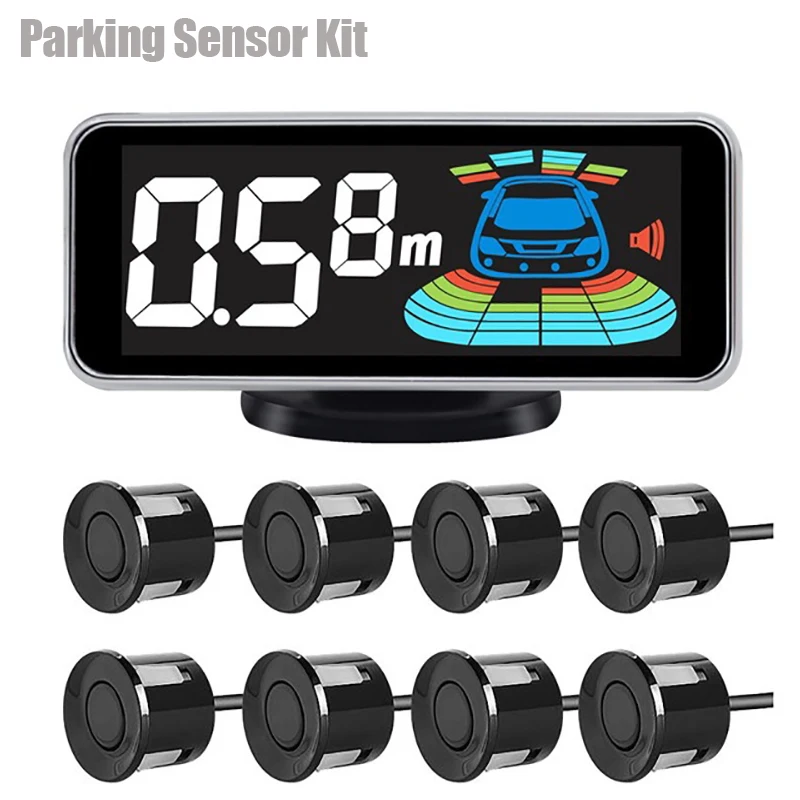
This advanced ultrasonic sensor features built-in hardware filtering and a configurable sampling rate, providing cleaner data directly from the source and reducing the need for extensive software filtering.
Step 3: Interpreting Data – What Does It Mean for My Robot?
Once your data is clean and reliable, the next step is to interpret it. This means translating numerical values into meaningful states or decisions for your robot. The simplest form of interpretation is often thresholding.
Thresholding: Simple Decision Making
Thresholding involves comparing a sensor reading to a predefined value (the threshold). For example, with a line-following robot, a light sensor might read a high value over a white surface and a low value over a black line. You could set a threshold: if the reading is below 500, it's black; otherwise, it's white.
// Example: Simple Thresholding for Line Following (using filtered data)
const int lineThreshold = 500; // Adjust this value based on your sensor and environment

void loop() {
  // Assume 'average' is your filtered sensor reading from the previous step
  // int sensorValue = analogRead(A0); // For raw data
  // int filteredValue = calculateAverage(sensorValue); // Or calculateMedian()
  int filteredValue = average; // Using the 'average' from the previous code snippet

  if (filteredValue < lineThreshold) {
    Serial.println("Robot is over a BLACK line!");
    // Command motors to turn or adjust
  } else {
    Serial.println("Robot is over a WHITE surface.");
    // Command motors to go straight
  }
  delay(100);
}
This simple logic forms the core of many basic robot behaviors. For a deeper dive into this application, explore our How to Build a Line-Following Robot: A Step-by-Step Sensor Guide.
Why Advanced Data Processing Matters
While basic filtering and thresholding are excellent starting points, more complex robotics applications demand sophisticated data processing. This leads to significantly improved performance and reliability.
These numbers highlight the tangible benefits of moving beyond raw data. Advanced techniques like Kalman filters, complementary filters, and even machine learning can fuse data from multiple sensors, predict future states, and adapt to changing conditions, making your robot truly robust.
What's your primary project's data processing need?
Focus on Basic Filtering & Thresholding
For tasks like basic line following, simple obstacle avoidance, or light detection, mastering moving averages, median filters, and clear thresholding will get you far. Keep your code lean and responsive.
Explore Sensor Fusion & Predictive Filters
If your robot needs to navigate dynamic environments, track objects, or combine data from multiple sensor types (e.g., IMU + GPS), you'll want to delve into Kalman filters, complementary filters, and potentially even basic machine learning for perception. These offer predictive capabilities and robust state estimation.
Prioritize Calibration & Advanced Noise Reduction
For applications requiring extreme accuracy, such as robotic arms or precision manufacturing, meticulous sensor calibration is paramount. Beyond basic filters, consider oversampling, digital signal processing (DSP) techniques, and high-resolution sensors to minimize error.
With its dual-core processor and integrated Wi-Fi/Bluetooth, the ESP32 is perfect for projects requiring more complex data processing, sensor fusion, and even lightweight machine learning models for advanced perception tasks.
Putting It All Together: A Line-Following Example
Let's combine what we've learned into a more complete (though still simplified) example for a line-following robot using an array of IR reflectance sensors. Each sensor gives a reading, and we want to determine if the robot is centered on a line, drifting left, or drifting right.
// Simplified Line Following Logic with Averaging Filter

const int LEFT_SENSOR_PIN = A1;
const int CENTER_SENSOR_PIN = A2;
const int RIGHT_SENSOR_PIN = A3;

const int NUM_READINGS = 5; // For averaging filter
int leftReadings[NUM_READINGS];
int centerReadings[NUM_READINGS];
int rightReadings[NUM_READINGS];
int leftIndex = 0, centerIndex = 0, rightIndex = 0;
long leftTotal = 0, centerTotal = 0, rightTotal = 0;

const int LINE_THRESHOLD = 400; // Assume values below this are 'black line'

void setup() {
  Serial.begin(9600);
  for (int i = 0; i < NUM_READINGS; i++) {
    leftReadings[i] = 0; centerReadings[i] = 0; rightReadings[i] = 0;
  }
}

// Function to get filtered sensor value
int getFilteredValue(int pin, int readings[], int& index, long& total) {
  total -= readings[index];
  readings[index] = analogRead(pin);
  total += readings[index];
  index = (index + 1) % NUM_READINGS;
  return total / NUM_READINGS;
}

void loop() {
  int filteredLeft = getFilteredValue(LEFT_SENSOR_PIN, leftReadings, leftIndex, leftTotal);
  int filteredCenter = getFilteredValue(CENTER_SENSOR_PIN, centerReadings, centerIndex, centerTotal);
  int filteredRight = getFilteredValue(RIGHT_SENSOR_PIN, rightReadings, rightIndex, rightTotal);

  bool leftOnLine = (filteredLeft < LINE_THRESHOLD);
  bool centerOnLine = (filteredCenter < LINE_THRESHOLD);
  bool rightOnLine = (filteredRight < LINE_THRESHOLD);

  Serial.print("L: "); Serial.print(filteredLeft); Serial.print(" ("); Serial.print(leftOnLine ? "BLACK" : "WHITE"); Serial.print(") | ");
  Serial.print("C: "); Serial.print(filteredCenter); Serial.print(" ("); Serial.print(centerOnLine ? "BLACK" : "WHITE"); Serial.print(") | ");
  Serial.print("R: "); Serial.print(filteredRight); Serial.print(" ("); Serial.print(rightOnLine ? "BLACK" : "WHITE"); Serial.println(")");

  if (centerOnLine) {
    Serial.println("Robot is centered. Go straight!");
    // moveMotorsStraight();
  } else if (leftOnLine) {
    Serial.println("Robot drifted right. Turn left slightly!");
    // turnMotorsLeft();
  } else if (rightOnLine) {
    Serial.println("Robot drifted left. Turn right slightly!");
    // turnMotorsRight();
  } else {
    Serial.println("Lost line! Search for line.");
    // searchForLine();
  }

  delay(50);
}
This example demonstrates how filtering (using the `getFilteredValue` function) and thresholding (`LINE_THRESHOLD`) work together to provide actionable intelligence for the robot. Remember that proper sensor calibration is key to setting effective thresholds.
Your Next Steps in Sensor Data Mastery
You've taken the crucial first step in understanding how to make sense of your robot's world. Here's how you can continue to build on this knowledge:
Continue Your Robotics Learning Journey
Ready to dive deeper into how robots perceive the world? Explore more of our learning resources:
Further Reading