

What Will My Robot Learn to Do with the Right Sensors?
Equipping your robot with the correct sensors is like giving it superpowers. Here's what you can expect your robot to achieve:
Perceive Its Environment
Enable your robot to detect objects, measure distances, and understand its surroundings, crucial for safe navigation and informed interaction with the physical world.
Track Movement & Position
Give your robot the ability to know its own speed, direction, and orientation in space, which is essential for precise control, mapping, and maintaining stability.
Interact Safely & Intuitively
Allow your robot to detect contact, pressure, and even recognize objects through touch, leading to safer operation and more natural human-robot interaction.
Make Smart Decisions
Sensors provide the critical data your robot needs to react dynamically to changes, avoid unexpected obstacles, and complete complex tasks autonomously and efficiently.
 Robots rely on sensors to understand their world, much like humans use their senses to navigate and interact.
Why Does My Robot Need Sensors Anyway?
Imagine trying to navigate a complex room blindfolded. That's essentially what a robot without sensors experiences. Sensors are the "eyes," "ears," and "skin" of your robot, providing crucial data about its internal state and the external environment. Without them, a robot is just a collection of motors and wires, unable to react to its surroundings or perform complex tasks beyond simple pre-programmed movements.
The right sensors transform a simple machine into an intelligent agent, capable of sophisticated behaviors like obstacle avoidance, precise navigation, delicate object manipulation, and even safe interaction with humans. They are fundamental to any autonomous or semi-autonomous robotic system, enabling everything from advanced industrial automation to personal assistant robots that seamlessly integrate into our daily lives.
Let's Find Your Starting Point: What's Your Robot's Primary Mission?
Different robot goals require different sensory inputs. Choose the option that best describes what you want your robot to achieve, and we'll point you towards the most relevant sensor categories to begin your search.
What's the most important thing your robot needs to accomplish?
Focus: Interaction & Manipulation
If your robot needs to touch, grasp, or feel its environment with precision, **Force & Touch Sensors** are absolutely essential. This category includes tactile sensors, pressure sensors, and force-torque sensors that provide crucial feedback for delicate operations, safe collision detection, and secure gripping. Dive deeper into how robots "feel" with our Force & Touch Sensors Guide.
Focus: Position & Movement Tracking
To know exactly where it is, how fast it's going, or its precise orientation in 3D space, your robot needs robust **Motion Sensors**. This category includes Inertial Measurement Units (IMUs) with accelerometers and gyroscopes, encoders for wheel rotation, and GPS for outdoor localization. These are vital for precise control, mapping, and maintaining stability. Learn more about giving your robot a sense of self-awareness in our Motion Sensors Guide.
Focus: Object & Color Identification
When your robot needs to "see" and interpret visual information – like recognizing specific objects, following a painted line, or sorting items by color – **Vision, Color & Light Sensors** are your go-to. This includes various types of cameras, dedicated color sensors, and ambient light sensors. These sensors provide rich data for advanced perception tasks. Check out our Vision, Color & Light Sensors Guide to understand how robots interpret the visual world.
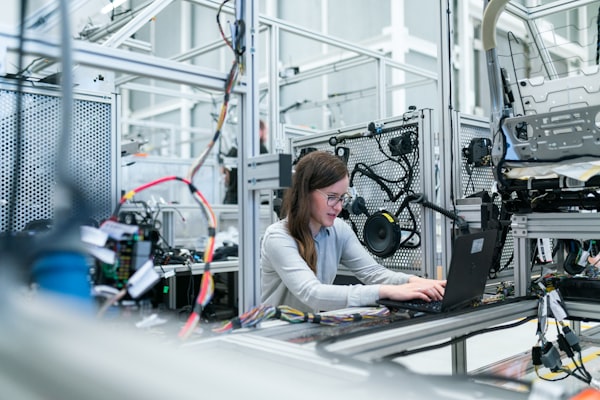 A diverse array of sensors, each designed to detect and measure a specific type of environmental data.
What Are the Main Types of Robot Sensors I Should Know About?
Robot sensors can be broadly categorized by the type of physical phenomenon they detect. Understanding these core categories is the first step in making an informed decision for your project. Each category serves a distinct purpose, providing different "senses" to your robot, much like our own senses work together to form a complete picture of our surroundings.
We'll explore the most common types, but remember that many advanced robots use a sophisticated combination of these to achieve highly complex and intelligent behaviors. Think of it like building a human's senses – you wouldn't rely on just sight or just touch; you combine them for a rich, nuanced understanding of the world.
Curious About How Sensors Actually Work?
While this guide focuses on selection, understanding the underlying principles of how sensors convert physical inputs into electrical signals can significantly help you troubleshoot and optimize your robot's performance. Here's a quick look at the fundamental difference in sensor outputs.
Most physical phenomena in the real world (like distance, temperature, light intensity) are continuous, or "analog." Sensors convert these into electrical signals. An **analog sensor** outputs a continuous range of voltage or current that directly corresponds to the measured physical quantity. For example, a potentiometer's resistance changes smoothly as you turn it, providing a continuous analog signal.
A **digital sensor**, on the other hand, outputs discrete values, typically binary (ON/OFF, 0/1). This is often achieved by an internal Analog-to-Digital Converter (ADC) within the sensor itself, or by simply sensing whether a certain threshold has been crossed. For instance, a simple push button is a digital sensor: it's either pressed (ON) or not pressed (OFF). Another example is a digital temperature sensor that outputs temperature in discrete steps.
Understanding this distinction is crucial for correctly interfacing sensors with your robot's microcontroller. Many microcontrollers have built-in ADCs for reading analog inputs, while digital inputs are generally simpler to read and process. Learn more in our dedicated guide: Analog vs. Digital Sensors: What's the Difference for My Robot?
Quick Comparison: Core Sensor Categories
Here's a high-level overview of the primary sensor types and their typical applications to help you quickly differentiate them and see where each excels.
| Sensor Category | What It Measures | Common Examples | Typical Applications |
|---|---|---|---|
| Distance Sensors | Proximity, range to objects, obstacle detection | Ultrasonic, Infrared (IR), Lidar, Time-of-Flight (ToF) | Obstacle avoidance, mapping, navigation, collision detection |
| Motion Sensors | Movement, orientation, speed, acceleration, angular velocity | Encoders, IMUs (accelerometer, gyroscope, magnetometer), GPS | Localization, balancing, speed control, drone stabilization, gesture recognition |
| Force & Touch Sensors | Pressure, contact, weight, grip force, tactile feedback | Tactile switches, FSRs (Force Sensitive Resistors), Load Cells, Strain Gauges | Object grasping, collision detection, human-robot interaction, weight measurement |
| Vision, Color & Light Sensors | Visual data, light intensity, color, patterns | Cameras (CMOS/CCD), Color sensors, Photoresistors (LDRs), Photodiodes | Object recognition, line following, sorting, ambient light detection, QR code scanning |
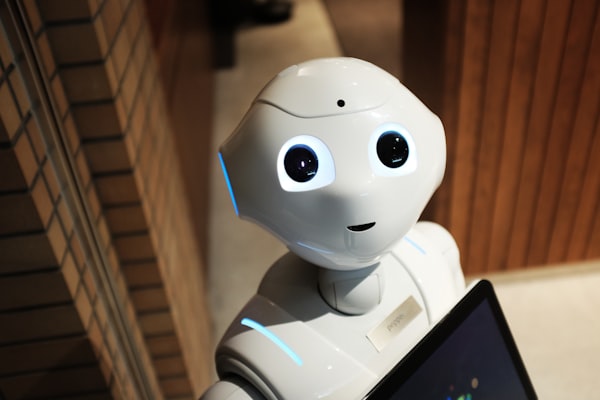 Precise manipulation often requires a sophisticated combination of vision and force/touch feedback.
Which Sensors Do I Need for Common Robot Tasks?
Now that you understand the broad categories, let's connect them directly to real-world robot applications. Most complex projects will require a combination of sensors working in harmony, but identifying the primary task helps narrow down your initial choices and build a solid foundation.
- Obstacle Avoidance: This is a foundational task for mobile robots. You'll primarily use distance sensors. Ultrasonic sensors are cost-effective for general detection, Infrared (IR) sensors are good for close-range detection, and Lidar or Time-of-Flight (ToF) sensors offer higher precision and mapping capabilities.
- Line Following: For robots that need to follow a specific path, color or infrared light sensors are perfect. They detect the contrast between the line and the surface, guiding the robot along its designated route.
- Precise Navigation (indoors): Achieving accurate indoor navigation often involves a fusion of sensors. This typically includes Lidar or depth cameras for environmental mapping, combined with IMUs and encoders for odometry (tracking the robot's own movement and rotation).
- Object Grasping/Manipulation: When a robot needs to interact with objects, cameras are crucial for object identification, localization, and pose estimation. These are often combined with force/touch sensors integrated into the gripper for feedback on grip strength and successful contact.
- Balancing Robots: For robots that need to maintain stability, such as a two-wheeled self-balancing robot, IMUs (Inertial Measurement Units) containing accelerometers and gyroscopes are critical. They detect tilt, acceleration, and angular velocity, allowing the robot to make rapid adjustments to stay upright.
Ready to Choose? Use This Sensor Selection Checklist!
Go through these questions to refine your sensor requirements and ensure you've considered all critical aspects of your robot's intended environment and mission. Checking off each item will help solidify your decision.
Your Sensor Project Checklist
0 of 7 completedThe Impact of Smart Sensor Selection
Choosing the right sensors isn't just about functionality; it's about optimizing performance, reliability, and safety. Here's how a thoughtful approach can benefit your robot project:
Quick Check: Test Your Sensor Knowledge!
Let's see if you've grasped the core concepts of sensor selection.
Which sensor type is generally best for detecting the exact force applied by a robot gripper when picking up an object?
 Processing sensor data is as crucial as selecting the right sensor itself for accurate robot behavior.
Beyond Selection: Processing and Calibration
Choosing the right sensor is only half the battle. Once you have your sensors, you'll need to integrate them effectively into your robot's system. This involves two critical, often overlooked, steps: proper data processing and meticulous calibration.
Data Processing: Raw sensor data is rarely perfect. It's often noisy, contains outliers, or is in a format that isn't immediately useful for your robot's decision-making. You'll need to write code to read, filter, and interpret this data. For example, an ultrasonic sensor might give you slightly different distance readings each time; you might need to average several readings to get a stable value or apply more advanced techniques like a Kalman filter for robust noise reduction. Our Sensor Data Processing Tutorial can help you get started with these essential techniques.
Calibration: Even the best sensors aren't perfectly accurate out of the box. Manufacturing tolerances, environmental factors, and mounting variations can all introduce errors. Calibration is the systematic process of adjusting your sensor's output to match a known standard, ensuring reliable and consistent measurements. This could involve simple offset adjustments, linear scaling, or more complex mapping functions. Neglecting calibration can lead to erratic robot behavior, inaccurate navigation, and unreliable task execution. Learn how to do it right with our How to Calibrate Your Robot Sensors for Accuracy guide.
Ready to Get Started?
Based on common beginner projects and the need for versatile experimentation, we recommend exploring a comprehensive sensor kit to get hands-on with different types.
This versatile kit includes ultrasonic, IR, light, and touch sensors, making it perfect for getting hands-on experience with various sensor types and building your first obstacle avoidance or line-following robot. It's an excellent foundation for any beginner.
Continue Your Sensor Journey
Ready to dive deeper into specific sensor types or explore more advanced selection tools? We've got you covered.
Explore All Sensor Types
Visit our main sensor hub to get a comprehensive overview of all sensor categories and their applications, from basic to advanced.
Go to Sensor Hub →Use Our Sensor Calculator
Input your specific project parameters and let our interactive tool suggest the best sensors tailored precisely to your needs.
Launch Calculator →Compare Sensor Kits
See a side-by-side comparison of our popular sensor kits to find the one that perfectly fits your budget and project scope.
Compare Kits →