

What Makes a Humanoid Robot Move Like Us?
Locomotion & Balance
Explore the sophisticated algorithms and mechanical designs that allow humanoids to walk, run, and maintain stability on two legs, mimicking human gait.
Manipulation & Dexterity
Understand how multi-jointed arms and articulated hands enable robots to grasp, lift, and interact with objects, from delicate items to heavy tools.
Perception & Interaction
Discover the array of sensors and AI that allow humanoids to see, hear, feel, and respond intelligently to their environment and human companions.
Control & Intelligence
Learn about the complex control systems, algorithms, and machine learning techniques that orchestrate every movement and decision a humanoid makes.
 Advanced leg designs and precise joint control are crucial for stable bipedal walking.
The Art of Bipedal Locomotion: How Do Humanoids Walk?
Walking on two legs, or bipedal locomotion, is incredibly complex, even for humans. For a robot, it requires constant calculation and adjustment to maintain balance. Humanoid robots achieve this through a combination of sophisticated mechanical design and advanced control algorithms.
Key to stable walking is managing the robot's Center of Mass (CoM) and its relationship to the Zero Moment Point (ZMP). The ZMP is essentially the point on the ground where the robot's weight and inertial forces balance out. By keeping the ZMP within the robot's support polygon (the area defined by its feet on the ground), the robot can avoid falling.
The Zero Moment Point (ZMP) is a fundamental concept in bipedal robotics. It's the point on the ground where the net moment (rotational force) of all forces acting on the robot (gravity, inertia, ground reaction forces) is zero. Imagine drawing a line from the robot's center of gravity straight down to the floor. For stable walking, this point, the ZMP, must always fall within the area covered by the robot's feet. If it moves outside this area, the robot will start to tip over. Robots use complex sensors and real-time adjustments to constantly monitor and control their ZMP, making tiny shifts in their posture and foot placement to stay upright.
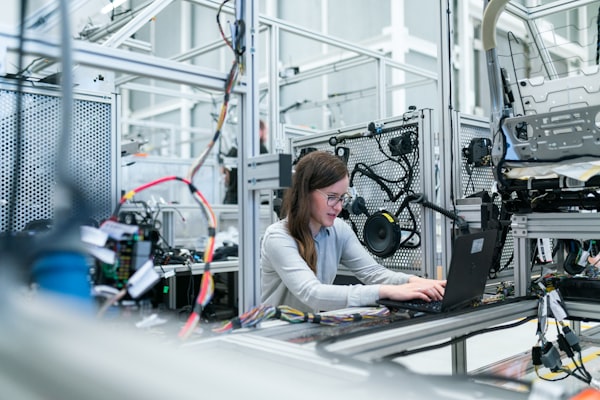 Servo motors are the workhorses, providing precise, controlled movement to each joint.
Powering the Movement: What Motors and Actuators Do They Use?
Every joint in a humanoid robot, from its neck to its ankles, requires an actuator to produce movement. These actuators are essentially the robot's muscles, converting electrical energy into mechanical force. The most common type found in advanced humanoids are high-performance servo motors.
Servo motors offer precise control over position, speed, and torque, which is critical for delicate tasks and maintaining balance. Beyond servos, some robots might incorporate linear actuators for specific movements or even hydraulic/pneumatic systems for high-power applications, though these are less common in general-purpose humanoids due to their complexity and weight.
Which actuator type best suits your robot's primary need?
Servo Motors are Your Best Bet
For applications requiring exact positioning and smooth, repeatable movements, such as delicate manipulation or complex gait generation, servo motors are ideal. They integrate feedback mechanisms (encoders) for closed-loop control, ensuring the robot knows its exact joint angle at all times. Look for high-resolution encoders and low backlash for optimal performance.
Engineered for precision and durability, these digital servos offer exceptional feedback and control for complex humanoid joint movements.
Consider Hydraulic or High-Power Electric Actuators
If your robot needs to lift heavy loads, exert significant force, or operate in demanding industrial environments, hydraulic or very powerful electric actuators might be necessary. While more complex to integrate, they deliver unmatched power density. For lighter, but still strong, applications, high-torque geared DC motors can be a good compromise.
Stepper Motors or Basic DC Motors for Simplicity
For simpler, less demanding movements where precise feedback isn't paramount, or for educational projects, stepper motors or basic DC motors with gearboxes can be a cost-effective choice. Steppers offer good open-loop position control, while DC motors are simple to drive for continuous rotation.
The Numbers Behind the Motion
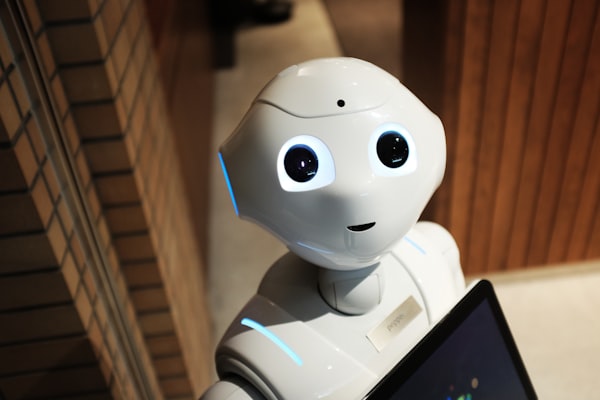 A robot's 'senses' are a complex network of cameras, force sensors, and other input devices.
Sensing the World: How Do Robots Perceive Their Environment?
Movement isn't just about actuators; it's also about perception. Humanoid robots rely on an array of sensors to understand their surroundings, much like our own senses. This sensory input is crucial for navigation, object recognition, and safe interaction.
Common sensors include:
To learn more about the specific types and functions of these critical components, visit our detailed guide: How Do Humanoid Robots Sense and Act?
Hands-On Interaction: How Do Humanoids Manipulate Objects?
Beyond walking, a humanoid robot's ability to interact with its environment hinges on its manipulators – typically arms and hands. These are designed to mimic human anatomy, featuring multiple degrees of freedom (DoF) at the shoulder, elbow, wrist, and fingers.
Advanced robotic hands can have several articulated fingers, each driven by its own set of motors, allowing for a wide range of grips, from power grasps for heavy objects to pinch grasps for delicate items. Force feedback sensors in the fingertips provide crucial information, preventing the robot from crushing objects or dropping them.
Perceive the Object
Using its vision system (cameras and depth sensors), the robot first identifies the object, determines its shape, size, and precise location in 3D space. It also assesses the object's material properties if possible, to anticipate required grip force.
Plan the Grasp
Based on the object's characteristics, the robot's control system calculates the optimal grasp strategy. This involves determining the best approach angle for the arm, the configuration of the fingers, and the initial force to apply. Inverse kinematics are used to translate the desired hand position into specific joint angles for the arm and hand.
Execute & Adjust
The robot extends its arm and closes its fingers around the object. Throughout this process, tactile and force sensors provide real-time feedback. If the grip is too weak, the robot increases force; if it detects too much pressure, it eases up. This continuous feedback loop ensures a secure yet gentle hold.
Equipped with multiple DoF and integrated force sensors, this arm provides unparalleled manipulation capabilities for your humanoid projects.
The Brains Behind the Brawn: How Are Movements Controlled?
The physical components of a humanoid robot are only as effective as the intelligence guiding them. The control system is the 'brain' that translates high-level commands into precise motor actions, manages balance, and processes sensory input.
This involves several layers of control:
Modern humanoids increasingly leverage machine learning and AI to refine these control strategies, allowing them to adapt to new environments and learn more natural, efficient movements over time. For a deeper dive into how these intelligent systems are built, explore our guide on Programming Your Humanoid: Getting Started with Basic Tasks.
Quick Comparison: Actuator Types for Humanoid Joints
Choosing the right actuator is critical for a robot's performance. Here's a quick look at common types:
| Feature | Servo Motors | Stepper Motors | Hydraulic Actuators |
|---|---|---|---|
| Precision | Excellent (with encoder feedback) | Good (open-loop, can lose steps) | Very High (with precise valves) |
| Torque/Force | Moderate to High | Low to Moderate | Very High |
| Speed | Good | Moderate | Excellent |
| Complexity | Moderate | Low | High (fluid systems) |
| Cost | Moderate to High | Low | Very High |
| Typical Use | Joints, grippers, dynamic balance | Simple positioning, less critical joints | Heavy industrial, high-impact tasks |
 Natural human-robot interaction goes beyond physical tasks to include social cues.
Beyond Physicality: How Do Humanoids Interact with Humans?
Interaction isn't just about physical contact; it's also about communication and understanding. Humanoid robots are designed to interact with humans in increasingly natural ways, leveraging their human-like form to facilitate intuitive engagement.
This includes:
Which of these is NOT a primary component of a humanoid robot's physical movement system?
Explore More Humanoid Robotics Topics
The world of humanoid robots is vast and constantly evolving. Continue your learning journey with these related articles:
Understanding Robot Anatomy: Joints, Sensors, & Brains
A foundational look at the physical components that make up any robot, including the structure and function of joints and sensory systems.
Programming Your Humanoid: Getting Started with Basic Tasks
Dive into the basics of coding and control, learning how to give your humanoid robot its first instructions and behaviors.
How Do Humanoid Robots Sense and Act?
A focused exploration of the specific sensors and actuators that enable robots to perceive their environment and execute physical actions.
Further Reading