

What You'll Discover
Perceiving the Environment
Understand how various sensors, from cameras to touch, allow humanoids to gather data and build a comprehensive picture of their surroundings.
Executing Actions Precisely
Explore the different types of actuators – the 'muscles' of a robot – that translate commands into physical motion, from walking to grasping.
The Brain-Body Connection
Learn how control systems integrate sensor data with actuator commands to enable intelligent decision-making and fluid, coordinated movements.
Future of Humanoid Interaction
Consider the ongoing advancements and challenges in making humanoids more perceptive, agile, and capable of complex human-like tasks.
 Advanced cameras provide humanoids with detailed visual information.
How Do Humanoids "See" and "Hear" the World?
Just like us, humanoid robots rely heavily on their senses to understand their environment. Vision is paramount, often achieved through a combination of cameras and depth sensors. These allow a robot to identify objects, map its surroundings, and even recognize faces or gestures.
Auditory sensors, primarily microphones, enable humanoids to detect sounds, locate their source, and even process speech commands. This is crucial for natural human-robot interaction and responding to verbal cues in dynamic environments.
Monocular Vision: Uses a single camera, similar to a human with one eye. It's simpler and cheaper but struggles with accurate depth perception. It often relies on algorithms and known object sizes to estimate distance.
Stereo Vision: Employs two cameras, mimicking human binocular vision. By comparing the slight differences in the images from each camera, the robot can calculate precise depth information, crucial for grasping objects and navigating complex spaces.
Feeling the World: Touch, Force, and Balance
Beyond sight and sound, humanoids need to feel. Tactile sensors, often embedded in fingertips or across the robot's 'skin,' detect pressure, contact, and even temperature. This allows for delicate manipulation of objects, preventing damage, and safe interaction with humans.
Force and torque sensors, typically found in joints and wrists, measure the forces exerted by or on the robot. This feedback is vital for maintaining balance, performing stable grasps, and adapting to unexpected loads. Proprioception, the robot's sense of its own body position and movement, is achieved through internal measurement units (IMUs) and encoders in joints. These provide data on orientation, acceleration, and joint angles, enabling precise control over its own limbs.
Which sensor type is primarily responsible for a robot's sense of its own body position?
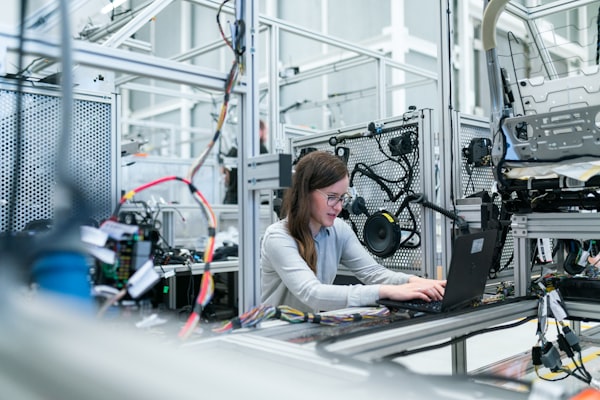 Tactile sensors allow robots to feel and interact gently with objects.
The Muscles of a Robot: Actuators Explained
If sensors are the eyes and ears, actuators are the muscles. These components convert electrical, hydraulic, or pneumatic energy into mechanical motion, enabling the robot to move its joints, grasp objects, and navigate its environment. The choice of actuator significantly impacts a robot's speed, strength, precision, and overall cost.
For humanoids, electric motors are the most common choice due to their precision, control, and relatively clean operation. However, the specific type of motor and its accompanying gearbox are critical design decisions. To learn more about the fundamental components that make up a robot's physical structure, check out our guide on Understanding Robot Anatomy: Joints, Sensors, & Brains.
Servo Motors: Precision & Control
Servo motors are widely used in humanoid robotics for their ability to provide precise angular positioning. They consist of a DC motor, a gearbox, and a feedback control system (often an encoder) that allows them to hold a specific position with high accuracy. They are excellent for joints requiring smooth, controlled movements like arms and hands.
- Pros: High precision, good torque at low speeds, closed-loop control.
- Cons: Can be less efficient at continuous rotation, can be bulky for very high torque.
Stepper Motors: Open-Loop Simplicity
Stepper motors move in discrete steps, making them suitable for applications where precise positioning is needed without complex feedback. They are often found in simpler robotic systems or for specific tasks like camera pan/tilt units. While less common for primary humanoid joints, they offer a cost-effective solution for certain movements.
- Pros: Simple control (open-loop), good holding torque, cost-effective.
- Cons: Can lose steps under load, lower speed, less efficient than servos for continuous motion.
Brushless DC (BLDC) Motors: Power & Efficiency
BLDC motors are gaining popularity in advanced humanoids due to their high power-to-weight ratio, efficiency, and long lifespan. They require more complex electronic control but offer superior performance for demanding applications like leg joints or high-speed arm movements. They are often paired with high-reduction gearboxes to achieve the necessary torque.
- Pros: High efficiency, high power density, long lifespan, excellent speed control.
- Cons: More complex control electronics, typically higher cost.
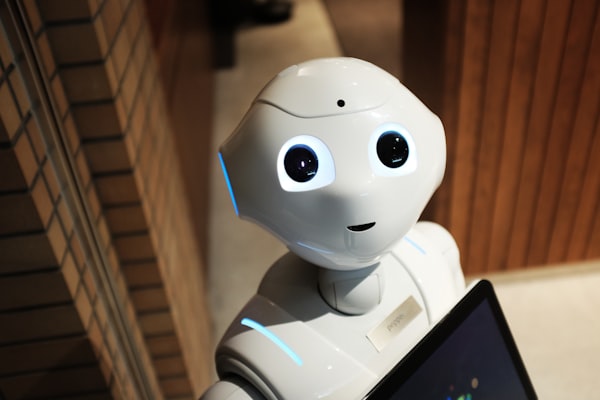 Precise control systems enable humanoids to perform delicate tasks.
Bringing it All Together: Control & Intelligence
The magic happens when sensors and actuators work in harmony, orchestrated by a sophisticated control system. This 'brain' of the robot processes sensor data, makes decisions based on its programming and AI algorithms, and then sends commands to the actuators. This creates a continuous feedback loop: sense, process, act, and then sense again to verify the action.
Advanced control architectures allow humanoids to perform complex tasks like dynamic balancing, path planning, and object manipulation. Machine learning and AI play an increasingly vital role, enabling robots to learn from experience, adapt to new situations, and even anticipate outcomes. For a deeper dive into how these decisions are translated into movement, explore our article on How Do Humanoid Robots Actually Move and Interact? And if you're curious about the programming side, our Programming Your Humanoid: Getting Started with Basic Tasks guide is a great next step.
What's your primary goal for a robot's movement?
Consider Servo Motors or BLDC with Gearboxes
For tasks requiring exact positioning and the ability to hold a position against external forces, servo motors are an excellent choice. If you also need high power density, a brushless DC motor paired with a precision gearbox offers superior performance.
Look into High-Performance BLDC Motors
Brushless DC motors excel in applications demanding high speed and significant power output. Their efficiency and ability to operate at higher RPMs make them ideal for dynamic movements, especially when combined with appropriate gearing for torque multiplication.
Stepper Motors or Basic DC Motors
For projects where budget is a primary concern and extreme precision or high speed isn't critical, stepper motors offer good value for controlled positioning. Simple DC motors with basic gearing can also be very cost-effective for less demanding movements.
The Numbers Behind Humanoid Movement
Challenges and the Road Ahead
Despite incredible progress, developing highly capable humanoid robots presents ongoing challenges. Miniaturization of powerful actuators and sensors, improving battery life for sustained operation, and reducing overall cost remain key areas of research. Creating truly natural and intuitive human-robot interaction (HRI) also requires further advancements in both perception and action capabilities.
The future promises humanoids with even more refined senses, capable of understanding complex social cues and navigating unstructured environments with unprecedented agility. Actuators will become stronger, lighter, and more energy-efficient, enabling longer operational times and more dynamic movements, blurring the lines between human and machine capabilities.
Evaluating a Humanoid's Capabilities Checklist
0 of 5 completed Future humanoids will offer more natural and intuitive interactions.
Recommended Robotics Components
Building or upgrading a humanoid robot requires the right components. Here are some top picks for advanced sensing and actuation:
Essential for accurate depth perception and environmental mapping, crucial for navigation and object manipulation in humanoids.
Combines the power and efficiency of BLDC motors with integrated feedback for precise, strong, and dynamic joint movements.
Provides critical feedback for stable grasping, dynamic balancing, and safe physical interaction with the environment and humans.
Keep Learning About Humanoid Robots
The world of humanoid robotics is constantly evolving. Dive deeper into related topics to expand your understanding:
How Do Humanoid Robots Actually Move and Interact?
Explore the mechanics of locomotion, balance, and manipulation that enable humanoids to navigate and perform tasks.
Read More →Programming Your Humanoid: Getting Started with Basic Tasks
Learn the fundamentals of coding and control systems that bring a robot's hardware to life.
Read More →Understanding Robot Anatomy: Joints, Sensors, & Brains
A comprehensive overview of the physical components that make up a humanoid robot's structure.
Read More →Further Reading