What You'll Learn in This Guide
Core Programming Concepts
Understand the fundamental logic and structures behind giving commands to your humanoid robot, from sequences to conditional actions.
Basic Movement Control
Learn how to make your robot move its limbs, turn its head, and perform simple gestures, bringing it to life with precise commands.
Integrating Sensor Data
Discover how your robot uses its sensors to perceive its environment and how you can program it to react intelligently to new information.
Automating Simple Tasks
Combine movements and sensor reactions to create basic routines, enabling your humanoid to perform useful, repetitive actions.
 Programming involves writing instructions for your robot to follow.
What Does "Programming" a Humanoid Actually Mean?
At its core, programming a humanoid robot means giving it a set of instructions, a "recipe" if you will, that it can understand and execute. Unlike a traditional computer program that just manipulates data, robot programming involves controlling physical actuators (like motors in joints) and interpreting data from sensors (like cameras or touch sensors).
You're essentially teaching your robot how to interact with the physical world. This can range from simple commands like "move arm up" to complex sequences that allow it to navigate a room, pick up an object, or even engage in basic conversation. The goal is to translate your desired actions into a language the robot's internal computer can process.
Which Programming Languages Are Used for Humanoids?
The choice of programming language often depends on the robot's platform, its intended use, and your own comfort level. Many modern humanoid robots offer multiple ways to program them.
While some advanced research platforms use highly specialized languages, beginners will often encounter these:
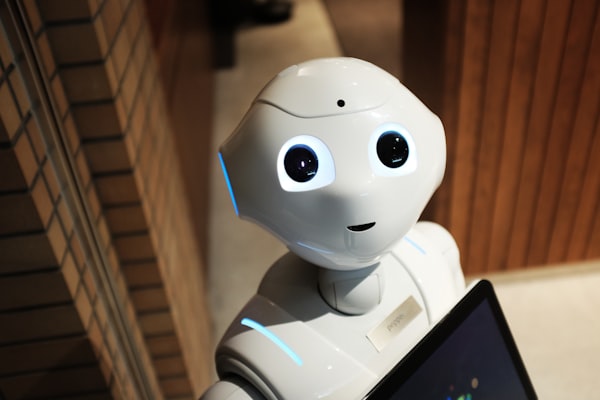 Each joint in a humanoid robot is controlled by an actuator.
How Do I Control My Humanoid's Basic Movements?
The most fundamental aspect of programming a humanoid is controlling its individual joints. Think of your robot as having many independent motors, each responsible for a specific degree of freedom (DOF). To make your robot move, you send commands to these motors, specifying their target position or velocity.
Most humanoid robot platforms provide an API (Application Programming Interface) or a set of functions that abstract away the low-level motor control. You might use commands like robot.set_joint_angle("right_shoulder_pitch", 45) or robot.move_head(pan=30, tilt=-15). Understanding how humanoids move is crucial here, as it explains the mechanics behind these commands.
Let's Program a Simple "Wave" Gesture!
This interactive guide will walk you through the logical steps to make your humanoid robot perform a basic wave. While specific code will vary by robot, the principles remain the same.
Initialize Your Robot & Connect
Before any programming, ensure your robot is powered on, safely positioned, and connected to your development environment. This might involve a USB cable, Wi-Fi, or Bluetooth. Refer to your robot's specific setup guide for connection details.
In your code, you'll typically start by importing the robot's library and creating an instance of your robot object:
import my_robot_sdk
robot = my_robot_sdk.HumanoidRobot()Raise the Arm
To wave, the robot first needs to raise an arm. Identify the joint responsible for shoulder abduction (moving the arm away from the body) and set it to an appropriate angle. You might also need to adjust the elbow or wrist slightly.
robot.set_joint_angle("right_shoulder_abduction", 90) # Raise arm to side
robot.set_joint_angle("right_elbow_flexion", -10) # Slight bend
Add a small delay to allow the robot to reach the position smoothly.
robot.wait(1.0) # Wait for 1 secondPerform the "Wave" Motion
The actual wave can be a simple back-and-forth motion of the wrist or forearm. This involves repeatedly changing the angle of a specific joint (e.g., wrist rotation or forearm pronation/supination).
for _ in range(3): # Wave 3 times
    robot.set_joint_angle("right_wrist_rotation", 45)
    robot.wait(0.5)
    robot.set_joint_angle("right_wrist_rotation", -45)
    robot.wait(0.5)
Experiment with angles and delays to get a natural-looking wave.
Return to Rest Position
After waving, it's good practice to return the robot to a neutral or "rest" position. This involves setting all affected joints back to their initial, safe angles.
robot.set_joint_angle("right_shoulder_abduction", 0)
robot.set_joint_angle("right_elbow_flexion", 0)
robot.set_joint_angle("right_wrist_rotation", 0)
robot.wait(1.0)
Congratulations! You've just programmed your first basic humanoid gesture.
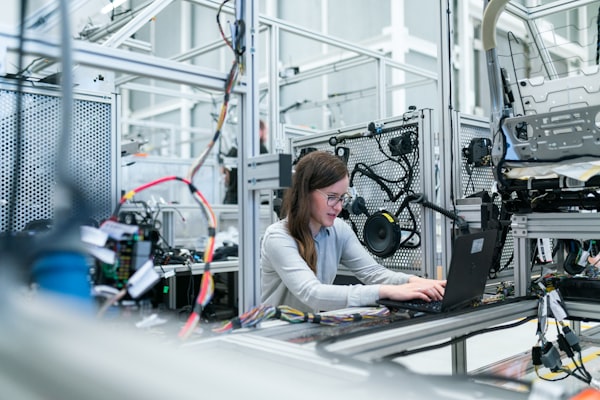 Sensors are the robot's eyes, ears, and touch.
How Do Humanoids Sense Their World and React to It?
A robot that only executes pre-programmed movements is limited. True interaction comes from its ability to perceive its environment using sensors and then react accordingly. Humanoid robots are equipped with a variety of sensors, from cameras and microphones to touch sensors and accelerometers. You can learn more about these in our How Do Humanoid Robots Sense and Act? guide.
Programming with sensors involves reading data from them and then using conditional logic (if/else statements) to decide the robot's next action. For example, "IF I see a face, THEN wave" or "IF I detect an obstacle, THEN stop and turn." This is where your robot starts to become truly autonomous and intelligent.
Quick Check: Understanding Robot Sensors
Which type of sensor would a humanoid robot primarily use to detect if it has bumped into an object?
How Do I Automate Simple Tasks with My Humanoid?
Once you're comfortable with individual movements and reading sensor data, you can start combining these elements to automate more complex tasks. This is where the real power of humanoid robotics shines. A "task" could be anything from fetching a small item to monitoring a specific area or performing a demonstration.
The key is to break down the task into smaller, manageable steps. For example, if you want your robot to pick up a cup:
- Perceive: Use a camera to locate the cup.
- Navigate: Walk or move towards the cup.
- Grasp: Extend arm, open gripper, close gripper when touch sensor detects contact.
- Lift: Raise arm carefully.
- Move: Carry the cup to a new location.
- Release: Open gripper, retract arm.
Each of these steps involves a combination of motor commands and sensor feedback. This iterative process of planning, coding, testing, and refining is central to robotics programming.
Your Task Planning Checklist
Use this interactive checklist to help plan your next simple robot task. Thinking through these points will make your programming process smoother.
Planning a Robot Task
0 of 5 completedPerfect for beginners, this kit includes a programmable humanoid with a user-friendly Python API and visual programming interface, making your first steps in robotics programming smooth and engaging.
Why Mastering Basic Programming Matters
Quick Comparison: Programming Environments
Different robots and platforms offer various ways to program them. Here's a look at common approaches:
| Feature | Visual Block-Based | Python SDK | ROS (Robot Operating System) |
|---|---|---|---|
| Ease of Use | Excellent for Beginners | Good for Intermediate | Steep Learning Curve |
| Flexibility | Limited to predefined blocks | High, access to many libraries | Very High, modular & powerful |
| Performance | Moderate | Good | Excellent, real-time capabilities |
| Community Support | Varies by platform | Large, active Python community | Massive, global robotics community |
| Typical Use | Educational, simple tasks | Prototyping, complex logic | Research, industrial, advanced control |
What's Next? Moving Towards Advanced Programming
Mastering basic movements and sensor integration is just the beginning. As you grow more comfortable, you'll naturally want to explore more advanced topics. This includes implementing more sophisticated navigation algorithms, integrating machine learning for object recognition or natural language processing, and developing complex human-robot interaction protocols.
The world of humanoid robotics is constantly evolving, with new tools and techniques emerging regularly. Don't be afraid to experiment, read documentation, and engage with the robotics community. Debugging is a natural part of the process; learning to troubleshoot common issues will be an invaluable skill.
For those ready to dive into advanced programming, this platform offers full ROS compatibility, powerful processing, and extensive sensor integration, ideal for research and complex autonomous tasks.
Continue Your Humanoid Robotics Journey
Ready to explore more about your humanoid robot? Dive into these related topics:
How Humanoids Move
Understand the intricate mechanics and control systems that enable humanoid robots to walk, balance, and interact with their environment.
Read More →DIY vs. Pre-Built Humanoids
Decide whether building your own humanoid or purchasing a pre-assembled model is the right path for your robotics aspirations.
Explore Options →Setting Up Your Humanoid
A comprehensive guide to unboxing, assembling, and performing the initial setup of your new humanoid robot.
Get Started →Further Reading