

What Makes a Humanoid Robot Move, See, and Think?
Just like humans, humanoid robots are complex systems built from many specialized parts working in harmony. Understanding these core components is the first step to appreciating their capabilities and designing your own. We'll explore the 'bones,' 'muscles,' 'nervous system,' and 'brain' of a robot.
The Skeletal Structure: Frame & Joints
Discover how a robot's chassis provides stability and how various joint types enable a wide range of motion, mimicking human flexibility.
The Muscular System: Actuators & Motors
Learn about the powerful components that translate electrical signals into physical force, allowing robots to move, lift, and manipulate objects.
The Nervous System: Sensors & Feedback
Explore the diverse array of sensors that allow robots to perceive their environment, gather data, and react intelligently to changes.
The Brain: Processors & AI
Understand the computational power that drives robot intelligence, from simple task execution to complex decision-making and learning.
 A complex joint assembly, crucial for a robot's dexterity.
What Holds a Robot Together and Gives it Structure?
At its core, a robot needs a sturdy framework, much like a human skeleton. This framework, often called the chassis or frame, provides the structural integrity and mounting points for all other components. Materials range from lightweight plastics for hobby robots to robust metals like aluminum or titanium for industrial and advanced humanoid models, chosen for their strength-to-weight ratio and durability.
Connected to this frame are the joints, which are the pivot points allowing for movement. The number and type of joints determine a robot's degrees of freedom (DoF) – essentially, how many independent ways it can move. More DoF generally means greater flexibility and dexterity, but also increased complexity and cost.
What's a Revolute Joint and Why is it Common?
A revolute joint, also known as a rotary joint, allows for rotational movement around a single axis, similar to a hinge or a human elbow. These are incredibly common in robotics because they are relatively simple to implement and control, forming the basis for most articulated arms and legs. Think of a robot turning its head or bending its knee – that's a revolute joint in action.
How is a Prismatic Joint Different from a Revolute Joint?
Unlike a revolute joint's rotation, a prismatic joint allows for linear motion along a single axis, like a piston or a sliding drawer. While less common in humanoid limbs than revolute joints, they are vital for tasks requiring extension or retraction, such as a robot's torso extending upwards or a gripper moving linearly to grasp an object. They provide precise linear positioning.
What About Spherical Joints? Are They Like a Human Shoulder?
Yes, exactly! A spherical joint, or ball-and-socket joint, offers rotational movement around three axes, providing the most flexibility. This mimics joints like the human shoulder or hip, allowing for complex, multi-directional motion. While offering incredible dexterity, they are mechanically more complex to design and control, often requiring multiple actuators working in concert.
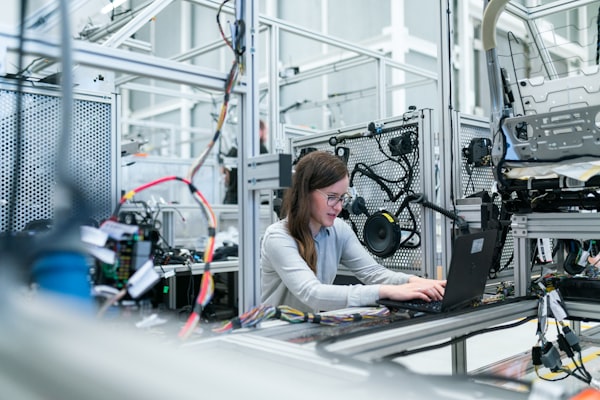 Servo motors are commonly used for precise, controlled movements in robotics.
How Do Robots Actually Move? The Role of Actuators and Motors
If the frame is the skeleton, then actuators and motors are the muscles. These components are responsible for converting electrical energy into mechanical force, driving the joints and enabling the robot to move. The choice of actuator significantly impacts a robot's speed, strength, precision, and overall power consumption.
Common types include electric motors (DC, stepper, servo), which are prevalent in humanoid robots due to their precision and ease of control. Hydraulic and pneumatic actuators, while powerful, are typically reserved for heavy-duty industrial robots where high force is paramount, as they are often bulkier and require external pumps or compressors. For a deeper dive into how these components work, check out our guide on How Do Humanoid Robots Actually Move and Interact?
How Do Humanoid Robots Sense the World Around Them?
A robot's ability to interact with its environment hinges on its sensory system. Just like our eyes, ears, and touch, robots use a variety of sensors to gather information, understand their surroundings, and react appropriately. This feedback loop is critical for everything from maintaining balance to navigating complex spaces and interacting safely with humans.
Sensors can be broadly categorized by what they detect:
For a more detailed look at the specific types and applications of sensors, explore our dedicated article: How Do Humanoid Robots Sense and Act?
IMUs (Inertial Measurement Units) are critical for a robot's proprioception – its sense of its own body's position and movement in space. Accelerometers detect linear acceleration and gravity, helping the robot understand its tilt. Gyroscopes measure angular velocity, indicating how fast the robot is rotating. By combining this data, the robot's control system can estimate its orientation and detect any deviations from its intended posture, allowing it to make rapid adjustments to maintain balance, especially during walking or dynamic movements.
LiDAR (Light Detection and Ranging) sensors are primarily used in humanoids for high-precision 3D mapping and navigation. They emit laser pulses and measure the time it takes for them to return, creating a detailed point cloud of the environment. This data is invaluable for building accurate maps, detecting obstacles, and enabling autonomous navigation in complex and dynamic settings, far beyond what simple 2D cameras can achieve alone.
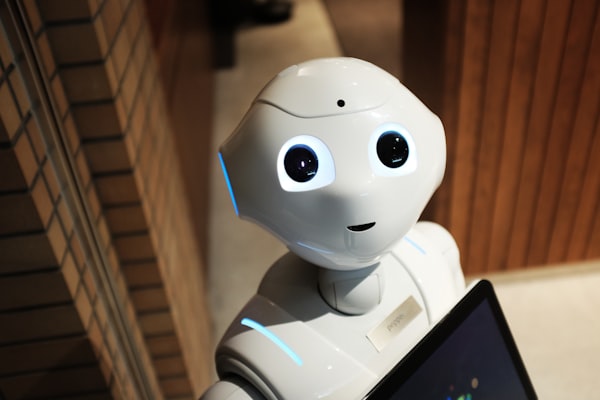 The processing unit, the 'brain' of the robot, handles all computations.
Where Does a Robot's Intelligence Come From? Processors and AI
Every robot needs a 'brain' to process sensory input, make decisions, and control its movements. This brain is typically composed of one or more processing units, ranging from simple microcontrollers for basic tasks to powerful microprocessors and GPUs (Graphics Processing Units) for complex AI computations.
For humanoid robots, the processing demands are immense. They need to simultaneously interpret vast amounts of sensor data (from cameras, LiDAR, IMUs), execute complex motion control algorithms, and often run sophisticated artificial intelligence (AI) models for tasks like speech recognition, object identification, and path planning. Modern humanoids often leverage specialized AI accelerators to handle these computational loads efficiently, enabling real-time decision-making and learning.
Which component is primarily responsible for a robot's real-time balance and orientation sensing?
Bringing It All Together: A System of Systems
The true marvel of robot anatomy isn't just the individual components, but how they all integrate into a cohesive, functional system. The 'brain' (processors) constantly receives data from the 'nervous system' (sensors), processes it, and sends commands to the 'muscles' (actuators) to move the 'skeleton' (frame and joints). This continuous feedback loop allows the robot to perform complex tasks, adapt to changing environments, and even learn over time.
Consider a humanoid robot walking: IMUs detect its current orientation, cameras identify obstacles, and force sensors in its feet measure ground contact. The processor takes all this data, calculates the necessary joint angles and motor torques, and sends commands to hundreds of motors simultaneously to maintain balance and propel the robot forward. This intricate dance of sensing, thinking, and acting is what defines advanced robotics.
This powerful development board features an ARM Cortex-A72 processor and integrated AI acceleration, making it ideal for prototyping humanoid robot brains and experimenting with complex AI algorithms.
Key Performance Indicators for Robot Anatomy
When evaluating or designing a humanoid robot, these metrics highlight the sophistication and capability of its underlying anatomy.
Choosing Your Components: What's Your Robot's Purpose?
The ideal robot anatomy isn't universal; it depends heavily on the robot's intended application. A robot designed for delicate manipulation will prioritize different components than one built for robust navigation or complex AI research. Use this interactive tool to guide your component considerations.
What's your primary goal for your humanoid robot?
Focus: Precision & Control
For high dexterity, prioritize high-resolution servo motors with minimal backlash for joints, especially in hands and arms. Look for force-torque sensors in wrists and grippers for delicate object handling. A high number of degrees of freedom (DoF) in the upper body is essential. Consider advanced tactile sensors for nuanced interaction.
This pack of high-resolution, low-backlash servo motors is perfect for building articulated hands and arms that require fine motor control and delicate manipulation capabilities.
Focus: Computational Power & Data Handling
For AI research, prioritize a powerful processing unit with dedicated AI accelerators (GPUs or NPUs) to handle complex neural networks. A flexible sensor interface to easily swap and test different sensor types is beneficial. Ample RAM and storage are necessary for large datasets and complex models. Consider open-source platforms for easier development and community support.
Glossary of Essential Robot Anatomy Terms
To help solidify your understanding, here's a quick reference for some of the key terms we've discussed:
| Term | Definition | Relevance to Humanoids |
|---|---|---|
| Actuator | A component that converts energy (electrical, hydraulic, pneumatic) into mechanical motion. | The 'muscles' that drive joint movement and enable physical interaction. |
| Chassis/Frame | The structural foundation of the robot, providing support and mounting points for all components. | The 'skeleton' that defines the robot's form factor and stability. |
| Degrees of Freedom (DoF) | The number of independent parameters that define the configuration of a mechanical system. | Indicates how many ways a robot can move; higher DoF means greater flexibility. |
| Encoder | A sensor that provides feedback on the position or rotational speed of a motor or joint. | Crucial for precise control, allowing the robot to know exactly where its joints are. |
| IMU (Inertial Measurement Unit) | A sensor that measures a robot's orientation, angular velocity, and linear acceleration. | Essential for balance, navigation, and understanding the robot's own movement in space. |
| Joint | A connection between two or more rigid bodies that allows for relative motion between them. | The 'pivot points' that enable movement, mimicking human articulation. |
| LiDAR | Light Detection and Ranging; a remote sensing method that uses pulsed laser light to measure distances. | Used for high-precision 3D mapping, obstacle detection, and autonomous navigation. |
| Microcontroller | A small computer on a single integrated circuit, designed to perform specific control functions. | Often used for low-level control of individual motors or sensor interfaces. |
| Microprocessor | A central processing unit (CPU) on a single integrated circuit, capable of general-purpose computation. | The 'brain' that executes complex algorithms, AI, and overall system control. |
| Proprioception | The sense of the relative position of one's own body parts and strength of effort being employed in movement. | A robot's internal awareness of its body state, often achieved through IMUs and encoders. |
| Servo Motor | A rotary or linear actuator that allows for precise control of angular or linear position, velocity, and acceleration. | Widely used in humanoids for their precision and ability to hold a specific position. |
| SLAM | Simultaneous Localization and Mapping; a computational problem of constructing or updating a map of an unknown environment while simultaneously keeping track of an agent's location within it. | A key capability for autonomous robots to navigate and understand dynamic environments. |
Ready to Explore Further or Build Your Own?
Understanding robot anatomy is just the beginning. The world of humanoid robotics is vast and constantly evolving. Whether you're looking to delve deeper into specific components or start your own robotics project, we have resources to guide you.
How Do Humanoids Sense and Act?
Dive deeper into the intricate world of sensors and actuators, understanding their specific roles and how they enable complex robot behaviors. Read More →
Programming Your Humanoid
Once you know the parts, learn how to bring them to life. Our guide helps you get started with basic programming tasks for your humanoid robot. Start Programming →
What Exactly Are Humanoid Robots?
If you're new to the field, start with the basics. Understand the definition, history, and potential of humanoid robots. Learn the Basics →
Further Reading