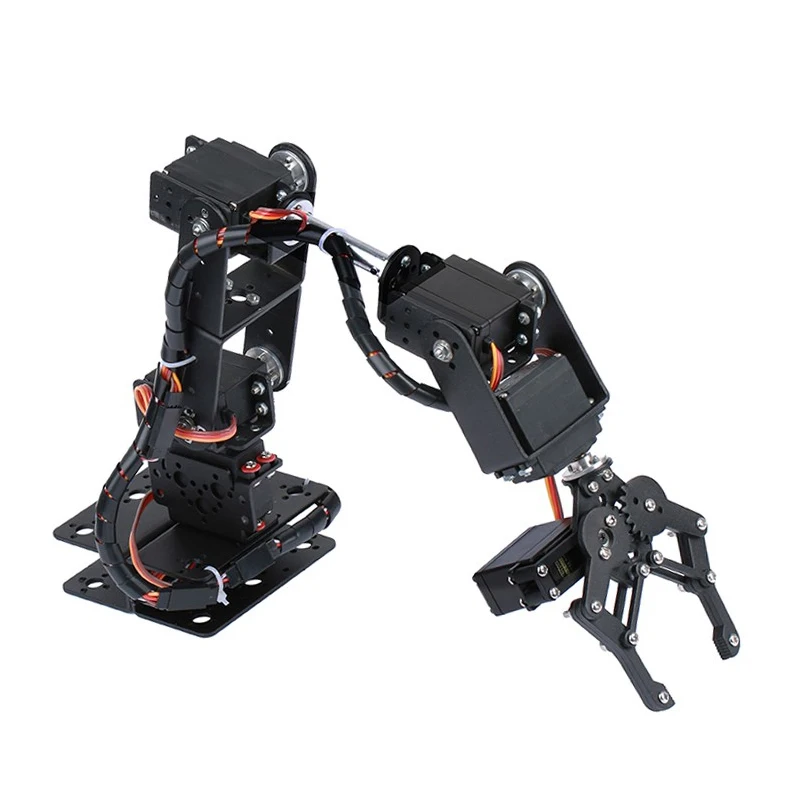
What You'll Discover About Robot Anatomy
Building or even just understanding humanoid robots means getting familiar with their core components. Think of it like learning human anatomy, but for machines. We'll explore the critical parts that enable movement, perception, and intelligent decision-making.
Joints & Actuators
Learn how mechanical joints provide flexibility and how actuators (robot muscles) generate precise, controlled movement.
Sensors & Perception
Explore the diverse range of sensors that allow robots to perceive their environment, from vision to touch and balance.
Control Systems & AI
Understand the 'brain' of the robot: microcontrollers, processors, and the software that enables intelligent behavior.
Power & Structure
Delve into the power sources and structural integrity that provide the foundation for a robot's operation and durability.
 Robot joints are complex assemblies of mechanical parts and actuators.
How Do Humanoid Robots Hold Together and Move?
At its core, a humanoid robot's physical structure is designed to mimic human form and function. This starts with a robust frame, often called a chassis or skeleton, which provides the foundational support. Materials like aluminum alloys, carbon fiber, or even advanced plastics are chosen for their strength-to-weight ratio, ensuring the robot is both durable and agile.
The ability to move comes from its joints. Just like our elbows and knees, robot joints allow for rotation and articulation. These aren't just simple hinges; they're complex mechanical assemblies that house the actuators – the robot's 'muscles' – which generate the force and motion. Understanding the interplay between the structural frame and these moving parts is crucial for designing stable and dynamic robots.
Think of a joint as the physical connection point between two segments of the robot, like a shoulder or a hip. It defines the axis or axes of rotation. An actuator, on the other hand, is the component *within* or *at* the joint that actually produces the movement. It's the motor, the piston, or the artificial muscle that applies torque or force to make the joint rotate or extend. So, a joint is the structure, and an actuator is the mechanism that drives its motion.
 Servo motors are commonly used as actuators for precise robotic movements.
What Kind of Motors Make Robots Move So Smoothly?
Actuators are the unsung heroes of robot movement, converting electrical, hydraulic, or pneumatic energy into mechanical force. For humanoid robots, the most common types are electric motors, particularly servo motors. These are favored for their precision, compact size, and ability to hold a specific position or move to a desired angle with high accuracy.
Beyond servos, other actuators play specialized roles. Stepper motors offer precise, incremental movements, ideal for tasks requiring exact positioning. Hydraulic and pneumatic actuators, while less common in smaller humanoids due to their bulk, provide immense power for larger, industrial-grade robots. The choice of actuator heavily influences a robot's speed, strength, and agility.
Which type of actuator is best known for precise position control in humanoid robots?
This high-performance servo offers excellent torque, precise control, and daisy-chaining capabilities, making it a popular choice for multi-jointed humanoid robot projects.
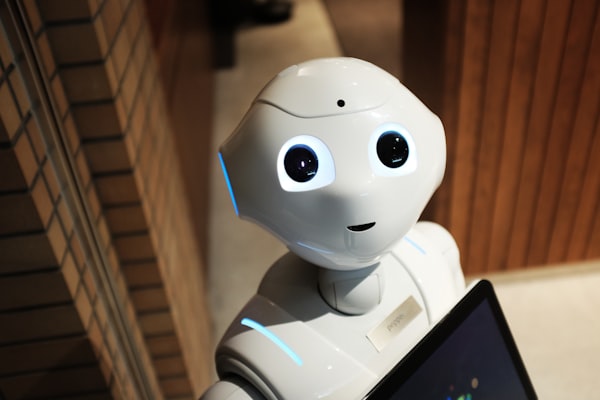
 Humanoid robots use a variety of sensors to perceive their surroundings.
How Do Humanoid Robots "See," "Hear," and "Feel"?
Sensors are the robot's eyes, ears, and skin, providing crucial data about its internal state and external environment. Without them, a robot would be blind, deaf, and unresponsive. Humanoid robots employ a sophisticated array of sensors to gather information, enabling them to navigate, interact, and perform tasks safely and effectively.
These sensors fall into several categories: vision sensors (cameras), proximity sensors (LiDAR, ultrasonic), touch and force sensors, and inertial measurement units (IMUs) for balance and orientation. Each type contributes a unique piece of the puzzle, allowing the robot to build a comprehensive understanding of its surroundings. To dive deeper into how these work, check out our detailed guide on How Do Humanoid Robots Sense and Act?
Exploring Essential Sensors in Detail
Let's break down some of the most common and critical sensors found in advanced humanoid robots.
Vision Sensors (Cameras)
Cameras are fundamental for a robot's visual perception, allowing it to recognize objects, track movement, and map its environment. Stereo cameras provide depth perception, mimicking human binocular vision, while RGB-D cameras (like Intel RealSense or Microsoft Kinect) offer both color and depth data, crucial for 3D reconstruction and obstacle avoidance.
Proximity & Range Sensors (LiDAR, Ultrasonic)
These sensors measure the distance to objects without physical contact. LiDAR (Light Detection and Ranging) uses pulsed laser light to measure distances, creating highly accurate 2D or 3D maps of the surroundings. Ultrasonic sensors emit sound waves and measure the time it takes for the echo to return, providing simpler, less precise distance measurements, often used for basic obstacle detection.
Force & Torque Sensors
Located in joints, wrists, or grippers, these sensors measure the forces and torques exerted by or on the robot. This feedback is vital for delicate manipulation tasks, ensuring the robot doesn't apply too much pressure (e.g., when picking up an egg) or for maintaining balance while interacting with its environment.
Inertial Measurement Units (IMUs)
An IMU typically combines accelerometers, gyroscopes, and sometimes magnetometers. Accelerometers measure linear acceleration, gyroscopes measure angular velocity (rotation), and magnetometers provide heading relative to the Earth's magnetic field. Together, they give the robot crucial data about its orientation, balance, and movement in 3D space, essential for stable walking and dynamic tasks.
Tactile Sensors (Touch)
Mimicking human skin, tactile sensors detect physical contact, pressure, and even texture. They are often arrays of pressure-sensitive elements placed on fingertips, palms, or other contact points. This allows robots to grasp objects with appropriate force, detect collisions, and even perform rudimentary object recognition through touch.
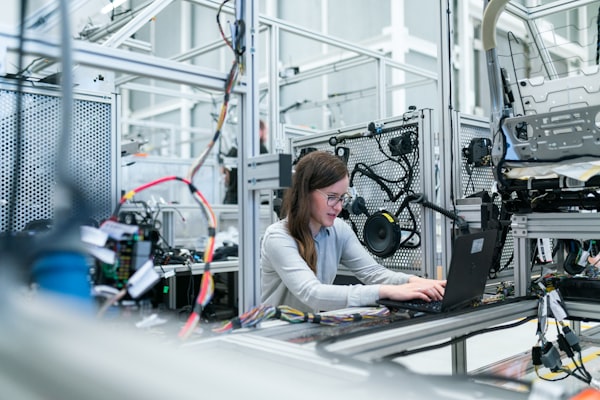
 The central processing unit acts as the robot's brain, executing complex algorithms.
What Powers a Robot's Decisions and Intelligence?
The 'brain' of a humanoid robot is its control system, a sophisticated network of hardware and software that processes sensor data, executes commands, and makes decisions. This typically involves a central processing unit (CPU) or multiple specialized processors, often in the form of microcontrollers for low-level tasks (like motor control) and more powerful single-board computers (SBCs) like a Raspberry Pi or NVIDIA Jetson for high-level intelligence.
These processors run complex algorithms, artificial intelligence (AI) models, and machine learning (ML) frameworks to interpret sensor input, plan movements, and interact intelligently with humans and the environment. The choice of processing power directly impacts the robot's ability to perform advanced tasks, learn, and adapt. For more on how to give your robot its smarts, explore our guide on Programming Your Humanoid: Getting Started with Basic Tasks.
 Lithium Polymer (LiPo) batteries are common for their high energy density.
How Do Humanoid Robots Get Their Energy?
Power is the lifeblood of any robot. For mobile humanoid robots, this typically comes from onboard battery packs. Lithium Polymer (LiPo) and Lithium Iron Phosphate (LiFePO4) batteries are popular choices due to their high energy density, allowing for longer operating times relative to their weight. However, managing this power effectively is just as critical as the battery itself.
A sophisticated power management system ensures that power is distributed efficiently to all components – actuators, sensors, and the control board – while also monitoring battery levels and protecting against overcharge or discharge. This system often includes voltage regulators and current limiters to provide stable power to sensitive electronics and prevent damage. The capacity (mAh) and voltage (V) of the battery are key considerations for overall performance and runtime.
Critical Specs to Consider for Your Robot
Understanding these key metrics will help you evaluate and select the right components for your humanoid robot project.
Putting It All Together: A System View
The true magic of a humanoid robot isn't in any single component, but in how they all integrate and communicate. From the low-level motor control to high-level AI decision-making, a well-designed robot operates as a cohesive system.
| Component Type | Primary Function | Key Considerations | Example |
|---|---|---|---|
| Frame/Chassis | Structural support, houses components | Weight, rigidity, material strength | Aluminum alloy skeleton |
| Actuators | Generate movement at joints | Torque, speed, precision, power consumption | Servo motors (e.g., Dynamixel) |
| Vision Sensors | Perceive visual environment, depth | Resolution, frame rate, field of view | Stereo cameras, RGB-D sensors |
| IMUs | Measure orientation, acceleration, balance | Accuracy, drift, update rate | 9-axis IMU (accelerometer, gyro, mag) |
| Main Controller | High-level decision making, AI | Processing power, RAM, OS compatibility | Single-board computer (e.g., NVIDIA Jetson) |
| Power System | Energy storage and distribution | Capacity (mAh), voltage, safety features | LiPo battery pack with BMS |
Your Robot Anatomy Checklist
Ready to start planning your own humanoid robot or just want to ensure you've grasped the essentials? Use this interactive checklist to review the critical components.
Essential Humanoid Robot Components
0 of 6 completedContinue Your Humanoid Robotics Journey
Now that you have a solid grasp of humanoid robot anatomy, explore more topics to deepen your understanding and get hands-on with your own projects.
How Do Humanoid Robots Move?
Explore the kinematics, dynamics, and control algorithms that enable lifelike motion.
Read More →Programming Your Humanoid
Get started with the basics of coding and controlling your robot's actions.
Start Learning →How Do Humanoid Robots Sense and Act?
A deeper dive into the specific technologies behind robot perception and interaction.
Explore Sensors →Further Reading